
InApp
Unity Ads for iGaming: How the Source Works and Who It Fits
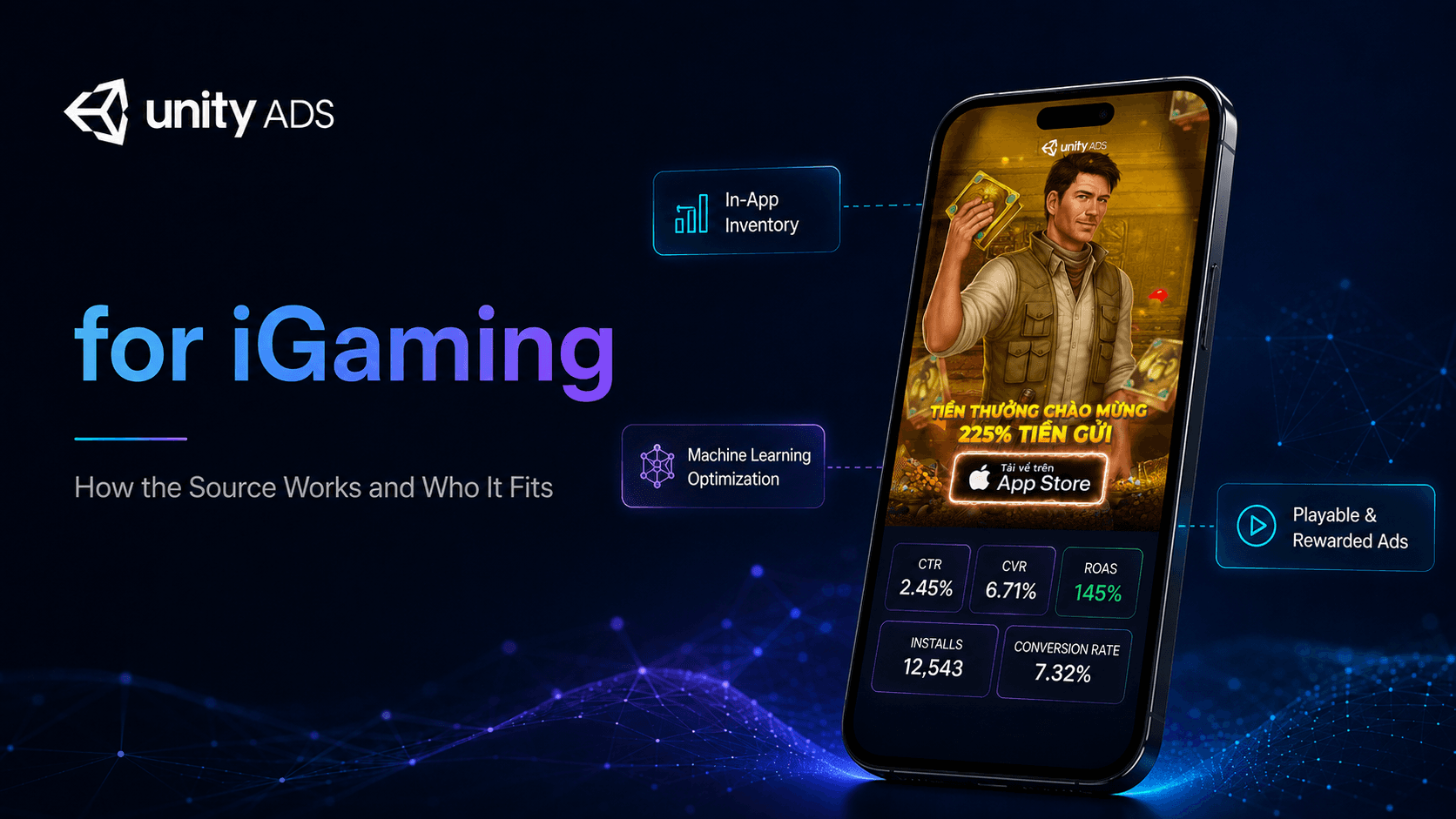
Every time Facebook storms, everyone remembers InApp. But "running traffic on Unity" and "understanding how Unity works" are two different things, and the second one decides almost everything. Here's the anatomy of the source: where its traffic comes from, why a campaign is a set of signals rather than a control panel, and who Unity actually fits for iGaming.
Where Unity's Traffic Comes From
Unity is first and foremost a game engine that powers a huge share of mobile games. The developers of those games monetize through Unity's ad SDK: Rewarded Video, Interstitial, and Playable ads run inside their titles. So the network's inventory is literally the screens of millions of mobile games.
Two consequences follow for a buyer.
Unity's audience is gamers. People already used to game mechanics, risk-taking, and in-app purchases. That's exactly why slot-style creative angles land here especially well: you don't have to explain what spinning a reel means, the user is already in that context.
The inventory is enormous and uneven. It ranges from quality games with solvent audiences to outright junk apps. Because of that, placement work (blacklists and whitelists) becomes one of the core optimization mechanics, not optional tuning.
Unity Vector: Why It's a DSP Now, Not a Network
The main thing to understand about modern Unity: the entire network, both iOS and Android, runs on Unity Vector, its machine-learning optimization core. Buying, scaling, and user matching are all tied to it. According to Unity, the move to Vector delivered advertisers a 15-20% lift in installs and revenue compared to the previous optimization model.
The practical meaning of that shift: Unity keeps moving away from being a classic ad network and closer to a full DSP approach, where the algorithm itself decides who to show an ad to, where, and at what price, based on predictive models of user behavior.
A Campaign Is a Set of Signals, Not a Control Panel
If the algorithm is predictive, the buyer's job changes radically. You don't micromanage impressions. You feed the algorithm signals properly, and there are essentially four of them:
- Events. Correct postbacks with registrations and deposits. Without them Vector is blind, and no amount of settings compensates for that.
- Bids. Sane targets that don't choke the search for traffic.
- Creatives. Quality, varied material the algorithm can learn from.
- Room to learn. Targeting that isn't too narrow, and stable settings while the campaign is still learning.
Hence the classic mistake of newcomers arriving from Facebook: they see a dip, start turning knobs, and break the learning. In Unity, abrupt changes cost more than they appear to.
Formats: Why Playable Is at Home Here
Unity has three working formats: Rewarded Video (the user watches an ad for an in-game reward), Interstitial (a fullscreen ad between levels), and Playable (an interactive mini-game inside the ad).
Playable performs best in InApp, and the reason is contextual: the user is already in game mode with their thumbs on the screen, so a "play this" prompt doesn't read as an obstacle. We broke that mechanic down in a separate article on Playable Ads.
Accounts: Why the Type Decides More Than You'd Think
Here's the nuance almost everyone underestimates on their first run at Unity. The ad account is a buyer's main working asset, and its type determines auction priority, moderation speed, blocking risk, and even which optimization models are available to you.
There are two fundamentally different types on the market: prepay and credit (agency) accounts. They look similar from the outside, but for iGaming the difference is critical.
Prepay looks like an easy start, yet for our vertical it carries real downsides: high blocking risk, no way to recover funds when an account is blocked (the balance simply burns), throttled delivery, and no dedicated support.
Credit accounts through a provider come with different terms: reduced risk of restrictions, auction priority, dedicated support, and the option of post-pay. Separately there are RMG (Real Money Gaming) accounts, and those are what Unity permits gambling creatives on, which is why slot advertising passes moderation at all.
An honest caveat here: simply having a credit account doesn't make traffic profitable. It's an infrastructure advantage you still have to know how to use, and a team's entire operational discipline is built around that skill.
Unity vs Facebook: What Doesn't Transfer
The most common cause of a bad first experience with Unity is trying to work with old habits. A few things that don't carry over:
- Manual micromanagement. On Facebook you're used to adjusting bids and duplicating ad sets. Here that mostly hurts.
- Targeting logic. Vector finds the user itself, and over-narrowing cuts down its room to work.
- Judging by the click. InApp demands looking at events and the post-click path, because inventory quality varies wildly.
What does transfer well is discipline: quality creatives, clean analytics, and patience while a campaign learns.
Who Unity Fits
The honest answer: not everyone, and not immediately.
Unity works well for teams that operate with apps, can set up correct event tracking, and are willing to give the algorithm time to learn instead of poking it daily. It's a source for people who think in volume and systems.
It fits less well for anyone who wants to quickly test a single bundle on a minimal budget, or who is used to full manual control. This requires infrastructure: the right account type, an app, a configured MMP, and an understanding of how to reconcile the numbers.
Summary
- Unity's traffic is mobile game inventory and its audience is gamers, so slot-style angles land naturally.
- The network runs on the Unity Vector ML core and behaves more like a DSP than a classic ad network.
- A Unity campaign is a set of signals (events, bids, creatives, room to learn), not a manual control panel.
- Account type decides auction priority, moderation, and risk, and RMG accounts are what make gambling possible at all.
- Facebook habits transfer badly; discipline and clean analytics transfer well.
Unity rewards those who understand the logic of the source and punishes those who treat it like Facebook. The difference between "we tried it and it didn't work" and steady volume almost always sits not in campaign settings, but in the infrastructure and discipline around them.
We packaged our experience running Unity Ads for iGaming into a full training course: from choosing an account type and renting apps to moderation, ROAS optimization, and reconciling numbers with your MMP. If you'd rather master the source systematically than learn every lesson on your own budget, reach out and we'll tell you more. See the full system
Glossary terms in this article
Unfamiliar with a term? Each links to a full definition in our affiliate & iGaming glossary.
You might also like
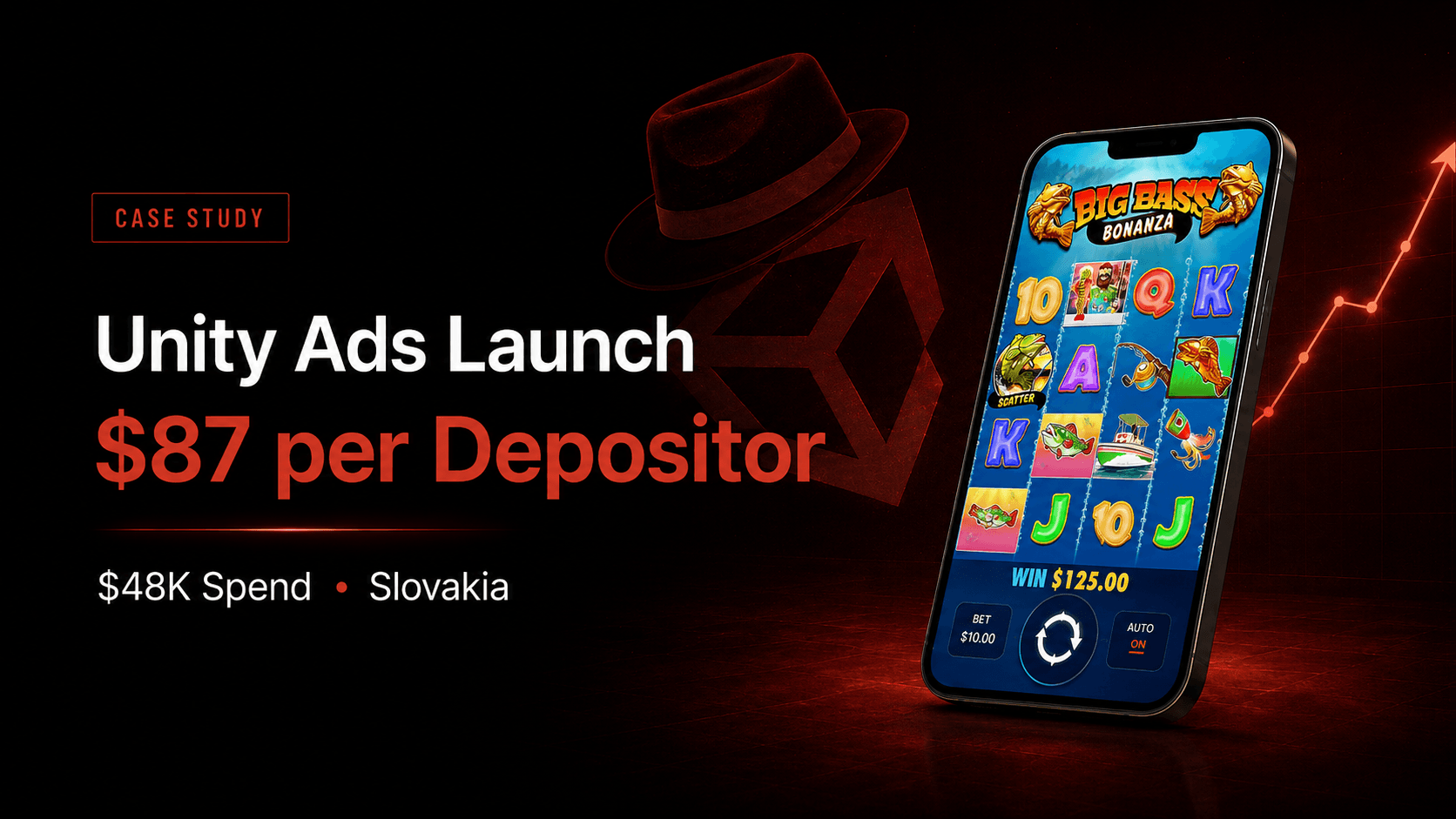
Unity Ads Launch: $87 per Depositor Across $48K
Between April and June, one of our buyers spent $48,000 on Unity Ads into Slovakia and kept the cost of a first-time depositor at $87 the whole way.
Read article →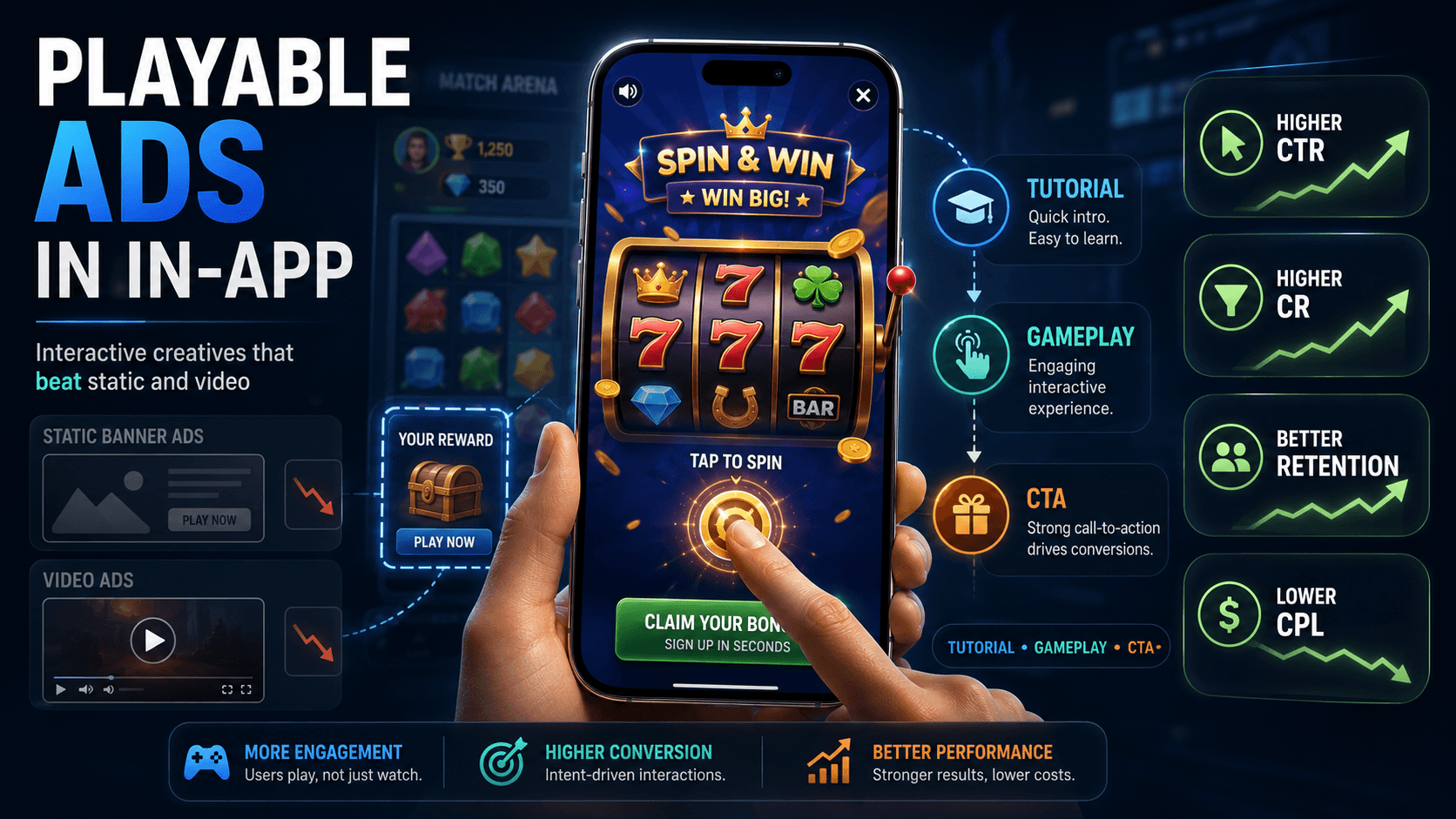
Playable Ads: Why Interactive Creatives Win - and Belong in InApp
Playable ads let users try the offer before they install, breaking banner blindness, lifting CTR, CR and retention, and often cutting CPL by 25-30%. Here's how they work and why InApp is their home.
Read article →
Meta vs Moloco for iGaming: What Scales Better?
Meta vs Moloco for iGaming: which source fits PWA better, which one is stronger for apps, and how to choose the right setup for scaling.
Read article →