iGaming
iGaming Facebook Ads vs Google Ads: Which to Choose in 2026
Let's cut through the illusions right away: easy money in BlackHat is long gone. If someone tells you about a "money button" in 2026, run. You're being scammed.
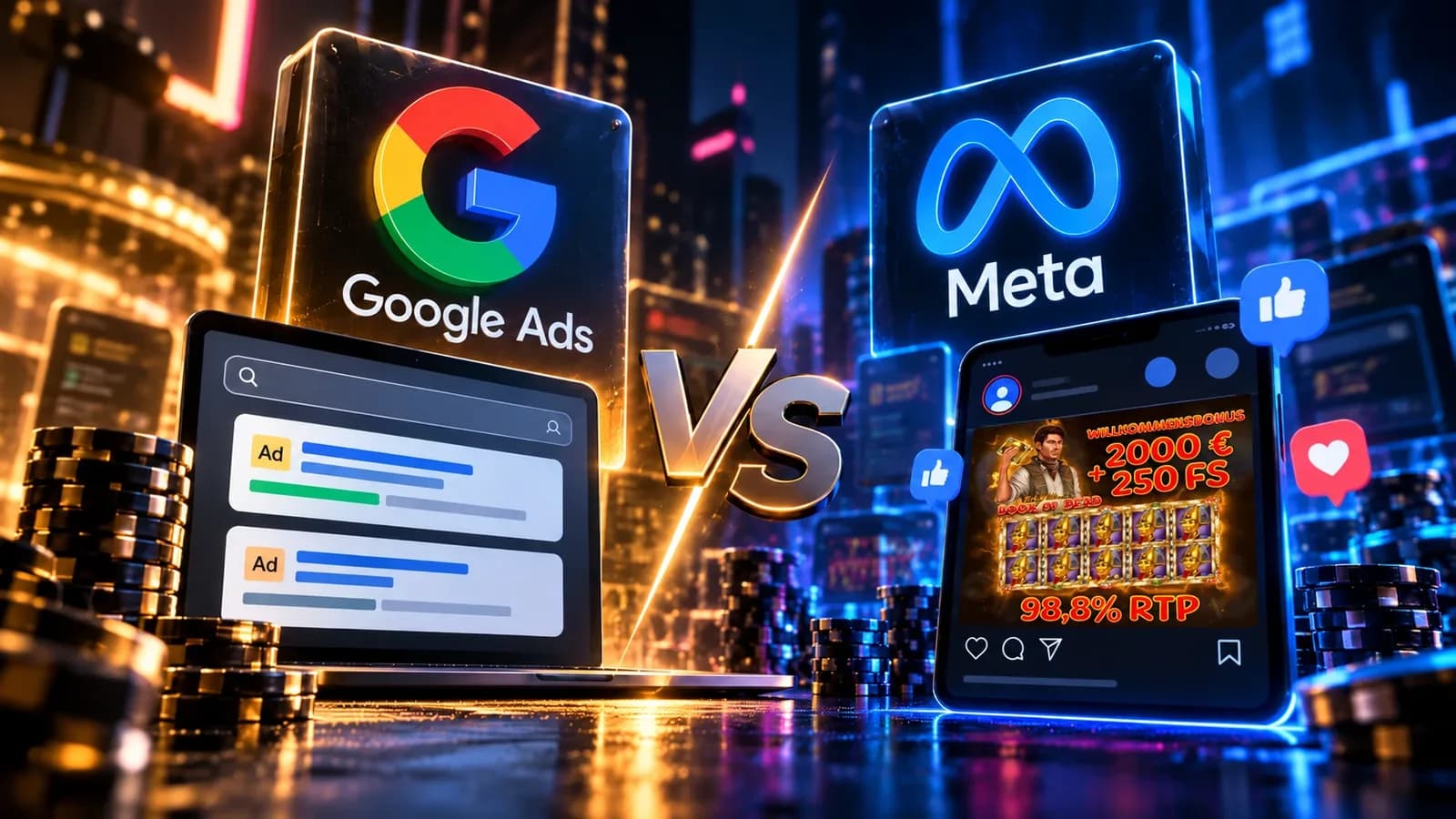
We're pitting two traffic titans against each other: Google and Meta (Facebook). Both platforms can bring you a Lamborghini, but one will turn your hair gray faster than you earn your first down payment. We're talking about "gray" (BlackHat) iGaming: slots, casinos, crash games.
Google and Meta are the two biggest traffic sources in iGaming, and both can make you money. The difference is how much each one demands from you before the first deposit. In 2026 that gap grew even wider: Google has closed itself off to anyone without certification and infrastructure, and Meta has moved its checks from the creative to the advertiser and the money.
Is Google Ads or Facebook Ads Better for iGaming?
For most teams the place to start is Facebook. Entry is cheaper, the feedback loop is shorter, and the first deposit shows up in days rather than weeks. Google gives the warmest traffic in iGaming because the player types the casino query themselves, but it demands certification, verification and a technical team before the first click. That is why Google is usually the second channel, not the first.
The Market Split into Two Floors
In 2026 both platforms drew a clear line between licensed brands and everyone else. Google is opening even premium formats such as YouTube Masthead to certified gambling brands. Meta has started checking the licences not only of operators but of affiliate sites too. We covered this in detail in Licensed First.
For a media buyer this means the choice of platform now depends first on which floor you work on, and only then on budget.
Google Ads for iGaming: The Meat Grinder for the Rich & Patient
Google PPC (Context) is elite, a sniper rifle. You catch a "hot" player at the exact moment they search "Best Casino Brasil" or "Aposta Online." Conversion is solid, ROI can reach peaks, but...
The 2026 Reality: Why Google Is Storming Right Now
If you think you'll enter Google with three accounts and $1,000 in your pocket, forget it. Google has transformed into a closed club for teams with powerful infrastructure. Over recent months the market has narrowed further: moderation of gambling and finance keeps tightening, certification increasingly depends on the agency behind the account, and new campaigns take a long time to get out of the "sandbox."
What's happening right now (Insider Info):
1. "Compromised Site" Everywhere
You can run traffic to good whites, but Google still flags them as "Compromised." There's no cure yet; you have to go through hundreds of domains and hosting providers.
2. Spend Before Ban Dropped 3x
Previously on Tier-1 (USA, Canada, Australia), an account lived through $1,500-2,000 spend. In early 2026? You're lucky to push $500-700. Accounts get banned faster than you can optimize the campaign.
Verification is hell. Old document templates ("drawn" docs) no longer pass. Google learned to burn them. You need new, quality solutions for advertiser verification.
3. Certificates Are "Crumbling"
Even when warming up with white keywords, accounts with gambling certificates get banned for "Circumventing Systems."
Does Google Allow Gambling Ads?
Yes, but only for licensed operators with a Google gambling certification for the specific country, a verified advertiser and a landing page that follows local rules. The list of countries and requirements varies, and some markets are not taking new applications right now. Without a certificate, gambling ads on Google break the rules and get banned.
How Pros Survive in Google
- Scale: They launch not 5, but 50+ accounts simultaneously. One dies, another picks up. It's a conveyor belt.
- Keywords: They don't fight head-on for "Casino Online" (where a click costs like a kidney). They build a keyword core from the long tail, competitor brand queries and negative keywords, and check traffic quality against the tracker every day.
- Automation: Scripts manage bids, AI generates hundreds of text variations, antifraud filters out bots. There's nothing to do manually here.
Google Verdict: It's expensive, painful, and technically complex.
Facebook Ads for iGaming: Chaos & Randomness Where the Adaptable Survive
Facebook Ads is a shotgun. You shoot into the crowd (Broad), and the algorithm finds those who want to spin slots. Traffic here is "colder" than Google, but there's infinitely more of it.
Why Meta Is Paradise for Aggressive Tests
On Facebook, there's less "technical suffocation" but more creativity.
1. Lower Entry Barrier
You don't need NASA-level cloaking at the start. A good antidetect browser, proxies, and agency/farm accounts are enough. We budget $3,000-5,000 to learn one geo, and the tool stack costs around $500-700 a month from separate services, or $84 on our platform where it all sits in one place. The full launch, step by step, is in Gambling Traffic Arbitrage on Facebook.
2. PWA Apps (Progressive Web Apps)
This is the "gold mine" of recent years. You drive traffic not to a site but to an "app" that installs from the browser. Facebook perceives this more loyally, and the user gets a casino icon on their home screen (push notifications = high LTV).
3. Creatives Decide Everything
In Google, you're limited to text. In Meta, you can show emotion: a streamer screaming from a win in Gates of Olympus, or an "earning scheme" in Aviator. Since Meta's GEM model started matching ads to people by what the ad contains, the creative is effectively the targeting: creatives that differ in meaning open different audiences. More in Meta GEM Model.
The Facebook Headache
Bans exist here too, and they're frequent. Everything can fly: from Business Manager to Fan Page. In autumn 2026 the checks also moved to the money: financial bans at $1,000-2,000 of spend, bans on card binding, advertiser verification in some geos. But getting past a Facebook ban is still easier.
- Appeals work more often.
- A new account launches faster.
- The key is analysis. Analyze competitors' creatives (SPY services), adapt them, change approaches.
What Should a Beginner Choose?
Let's be honest. Players who've been in the market for 5+ years successfully "milk" both channels. They have teams for Google and FB. But if you're just starting your journey in iGaming arbitrage...
Forget about Google Ads. For now.
Why?
Because Google demands infrastructure. You need a farming department, a cloaking technical specialist, huge budgets for consumables (accounts, proxies, domains) just to start. You'll "burn out" at the launch stage, getting 10 consecutive bans and spending $2,000 without a single lead.
Your choice is Facebook.
Yes, it's not a walk in the park either. But here you'll see the first result faster.
- Made a creative → Launched PWA → Got a deposit.
- The feedback loop is shorter.
- You'll learn to understand the audience (what triggers them: bonuses, emotions, or "freebies"), learn to analyze the funnel, and work with bans in "lite mode."
Master Facebook. Learn to run profitably at volume. Build your capital.
When to Move to Google
Google makes sense once you are already running profitably from another channel and are ready to invest in certification, tracking with offline conversions and keyword work. For teams at that stage we put together the Google Ads for iGaming Playbook: from legal access and keywords to app campaigns and scaling.
Key Takeaways: Google Ads vs Facebook Ads for iGaming
| Factor | Google Ads | Meta (Facebook) |
|---|---|---|
| Entry Barrier | Very High ($5K+ infrastructure, certification) | Medium ($3-5K test budget per geo) |
| Traffic Quality | Hot (search intent) | Cold (broad targeting) |
| Access | Gambling certification per country | Ad accounts, payment and advertiser checks |
| Spend Before Ban | $500-700 (Tier-1, early 2026) | Varies widely |
| Cloaking Complexity | Extremely high | Moderate |
| Creative Freedom | Limited (text ads) | High (video, images, PWA) |
| Learning Curve | Steep (technical) | Moderate (creative focus) |
| Best For Beginners | ❌ No | ✅ Yes |
| ROI Potential | Very High (if survived) | High (with testing) |
Final Word: Start Smart, Scale Later
The iGaming traffic game in 2026 isn't about finding a "secret hack." It's about understanding platform mechanics, building resilience against bans, and continuously testing.
Start with Meta. Build your skills, your budget, and your team. Once you're consistently profitable on Facebook, you'll have the resources and knowledge to tackle Google's complexity.
Remember: in BlackHat iGaming, survival is the first metric. Profitability comes second.
Glossary terms in this article
Unfamiliar with a term? Each links to a full definition in our affiliate & iGaming glossary.
You might also like
Media Buyer in iGaming: What the Role Is and How to Hire One in 2026
An operator or a team decides to scale traffic, posts a "Media Buyer, iGaming" vacancy and gets a hundred applications within a week.
Read article →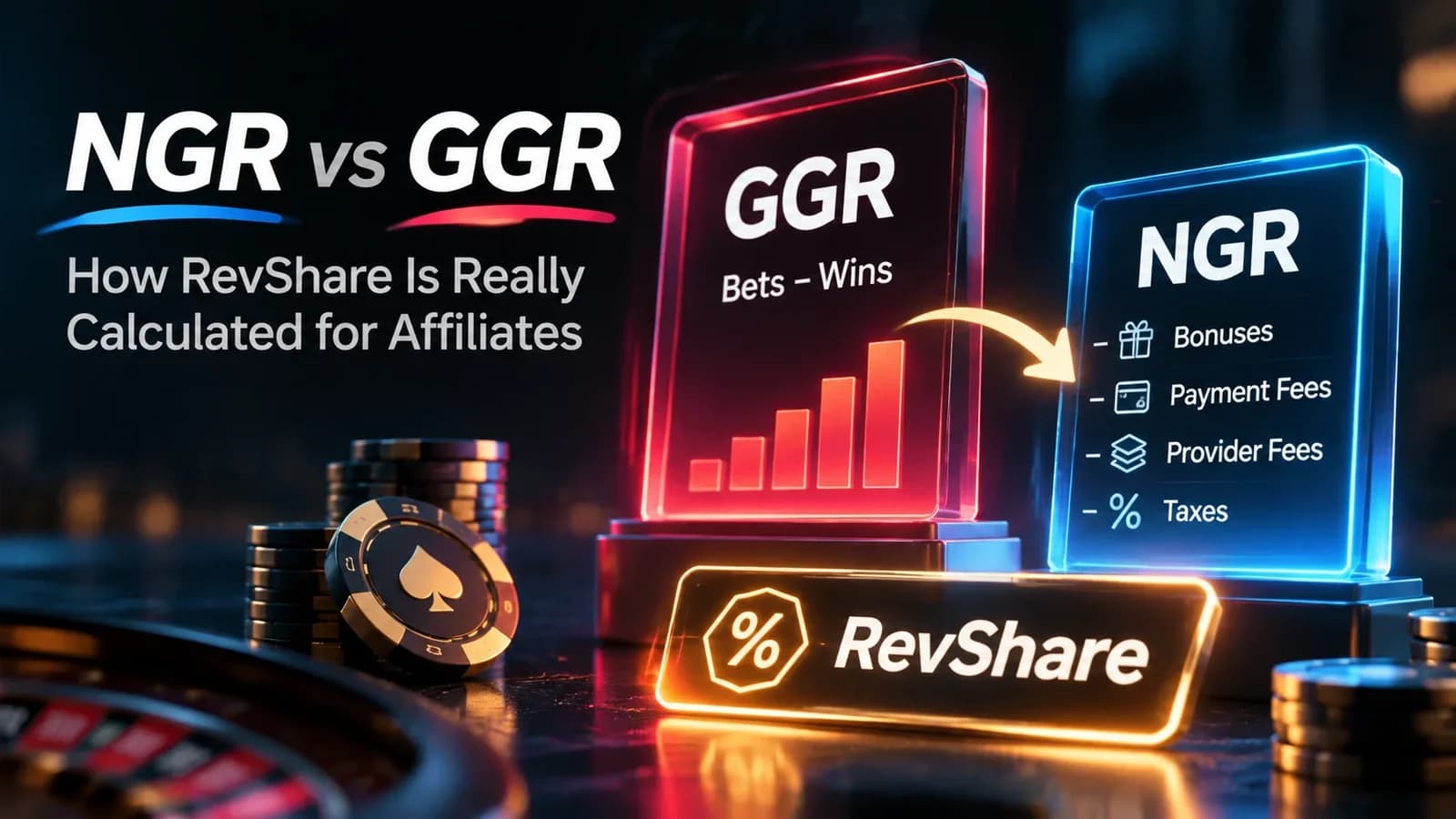
NGR vs GGR: How RevShare Is Really Calculated for Affiliates
NGR vs GGR explained for iGaming affiliates: what each metric means, how NGR is calculated, a step-by-step RevShare example from GGR to payout, and what negative carryover does.
Read article →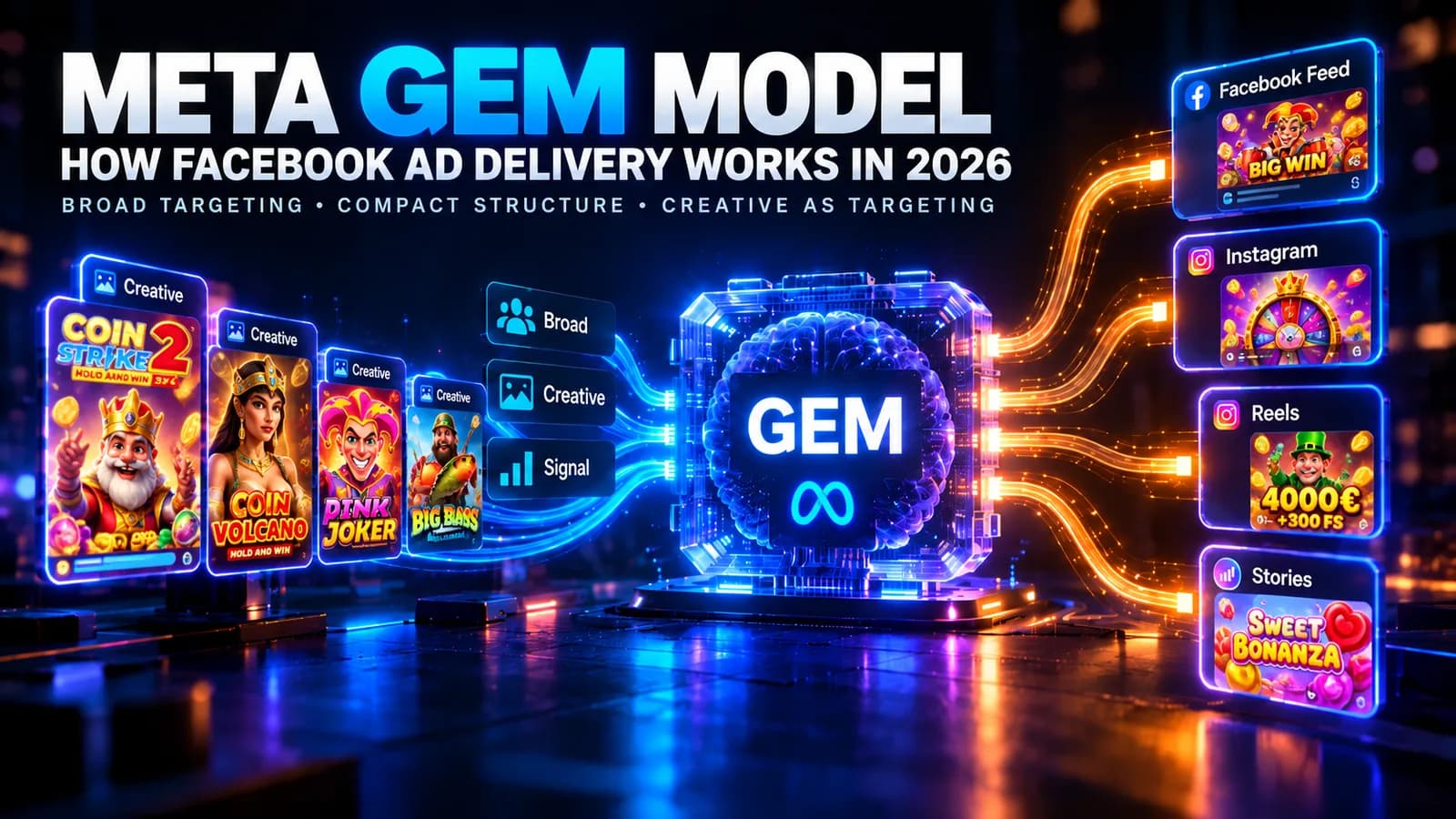
Meta GEM Model: How Facebook Ad Delivery Works in 2026
In October Meta updated GEM, the model that decides who sees each ad on Facebook and Instagram. For a media buyer this is not abstract news from an engineering blog.
Read article →