Facebook Ads
Gambling Traffic Arbitrage on Facebook: How It Works in 2026
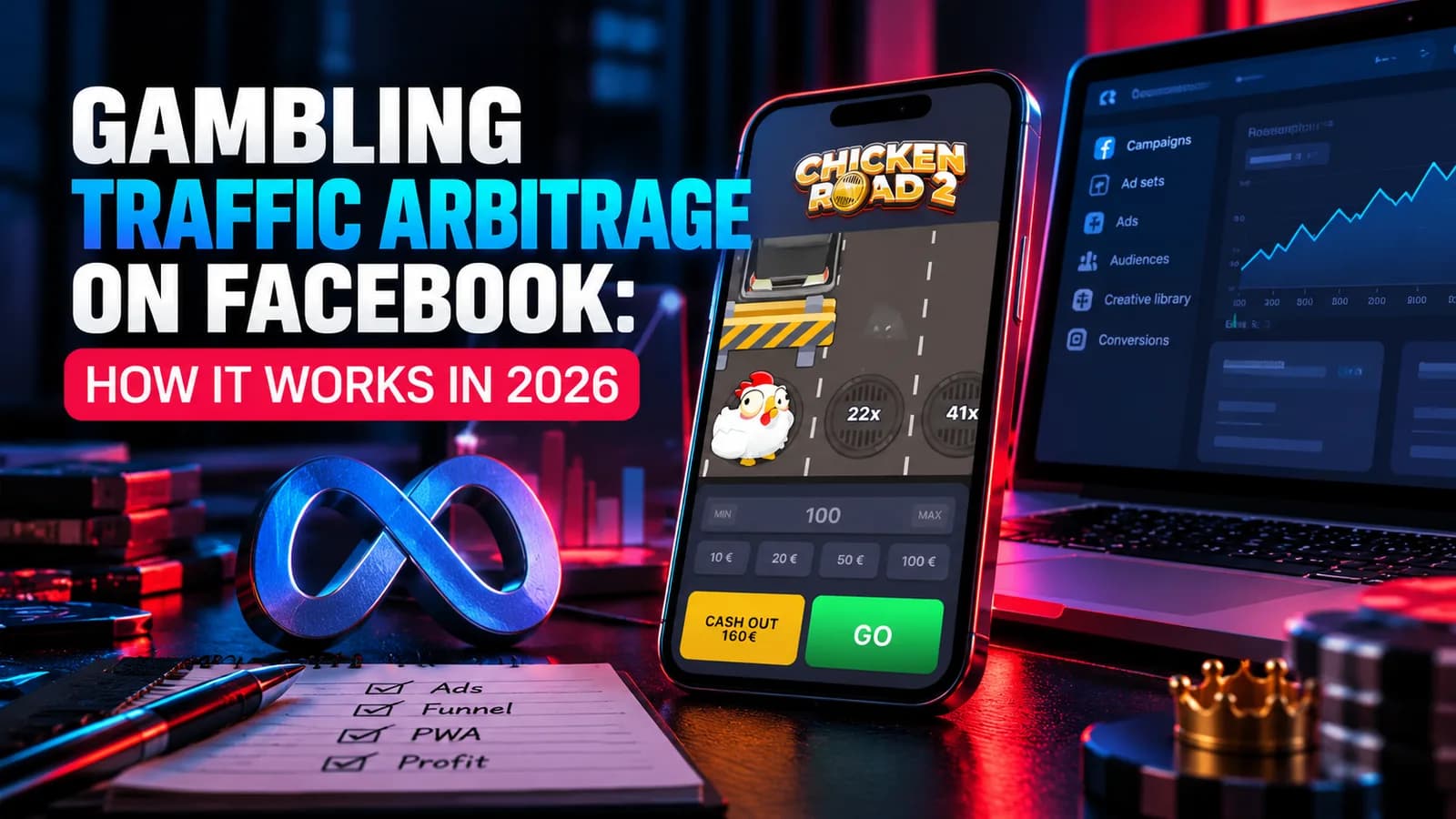
Gambling traffic arbitrage on Facebook means buying ads on Meta and selling the players they bring to casinos, for a fixed payout or a share of revenue. The model has been alive for more than five years. What changes every year is the cost of entry, and in 2026 it looks far more like an operating business than a hunt for a working trick.
What Is Gambling Traffic Arbitrage on Facebook?
A media buyer runs ads on Facebook and Instagram, takes the user through a funnel to a casino offer and gets paid for every player who makes a first deposit (FTD). The payer is usually an affiliate program, but buyers with contacts on the operator side can work with gambling operators directly. The difference between ad spend and payouts is the profit. In practice that profit depends not on one creative but on the whole chain: ad account, creative, funnel, offer and how fast the team reacts to platform changes.
Does Facebook Allow Gambling Ads?
Meta allows online gambling ads only with prior written permission, for licensed operators, in countries where gambling is legal and with 18+ targeting. Most affiliate traffic does not run under that permission. That is why bans, rejects and verification checks are the everyday background of this work rather than a force majeure, and they belong in the budget from day one.
How the Funnel Works
The creative in the feed leads to a fan page and on to a PWA, an app installed from the browser that looks like a store page and can send push notifications. From the app the player lands on the casino offer. Every step has its own conversion: click to install, install to registration, registration to deposit. A weak spot at any of them eats the profit, even when the creative performs well.
How Much Does It Cost to Start?
Count three budget lines separately.
Test budget. To learn a geo and understand how working with Facebook actually goes, we set aside $3,000-5,000. On cheaper tiers results show up faster, but traffic there needs closer watching, because the budget is easy to burn on impressions that never convert.
Infrastructure. Assembled from separate services (antidetect browser, tracker, spy tool, PWA builder), it comes to around $500-700 a month before the first ad goes live. We put all of it on one platform, where a nearly complete setup costs $84. Whether your team can make creatives with AI and rework videos for its own vertical also moves this number a lot.
Ad accounts. Agency ad accounts take 5-7% of spend, depending on the provider and the state of the market. More and more often they have to be backed up with your own farmed accounts and Business Managers, so plan that as a small extra line too.
How We Launch a New Geo
Our base setup:
- 2 fan pages, localised for the geo and fully filled out;
- PWA design, description and comments adapted to the geo;
- 1-3 ad accounts;
- a 50/50 mix of slots and crash games, around 4 games to start;
- 5-10 ABO campaigns with a 1:3:1 or 1:5:1 structure, one creative per campaign, to find the winners;
- in parallel, as the stronger creatives emerge, a CBO campaign with a 1-1-10 structure and different creatives.
The budget per ad set equals the payout for one FTD. The logic is simple: an ad set should have a chance to bring at least one deposit before you decide whether it works.
What Changed in Campaign Structures Over the Last Month?
In October buyers noticeably simplified their launches. During the ban waves part of the market dropped aggressive structures like 1-N-N and switched to a 1-1-1 CBO at $70-90, turning on the next campaign only once the previous one started delivering, and duplicating from there. Others test an approach with dynamic creatives in a 1-1-2 structure, with 5-9 creatives per ad.
Bans are only part of the reason. Meta updated GEM, the model that decides who sees an ad, and it works better with a compact structure and creatives that differ in meaning, not just in visuals. Our takeaway: ABO stays for finding creatives, but we run fewer campaigns in parallel and consolidate winners into CBO earlier.
How to Scale What Works
We scale once an ad set brings 3+ deposits at an acceptable cost. From there, two routes: raise the budget by 20-30% once a day at the start of the day in the ad account's time zone, or duplicate the ad set 2-5 times into new ABO or CBO campaigns. Weak ads are switched off before duplicating. For reference: on one of our recent launches, a well-optimised campaign in Canada brought deposits at $170 each.
What to Factor In for 2026
Two trends show up in every monthly digest. First, the trust check has moved off the ad and onto the advertiser and the money: financial bans, card binding and selfie checks are now ordinary risks, so a reserve of ad accounts and documents is needed from day one. Second, the platform keeps taking away manual controls. More on both in our October digest.
If you would rather go through this with a structure than by trial and error, we teach how to build the process on live launches.
Glossary terms in this article
Unfamiliar with a term? Each links to a full definition in our affiliate & iGaming glossary.
You might also like
Facebook Ads Digest, October 2026: Payment Checks, Card Bans and GEM
In September Meta moved its trust check off the ad and onto the advertiser. In October it reached the money. Accounts went down not for a creative, but for their spend…
Read article →
Licensed First: Google and Meta Split the Gambling Ad Market in Two
Three things happened in a single week of October. Google opened its most visible ad format to certified gambling advertisers.
Read article →
The Prelander Before a PWA: Three Jobs It Has to Do
When a funnel needs to get shorter, the prelander is usually the first thing to go. The logic is simple: fewer screens mean fewer drop-offs and more installs.
Read article →