

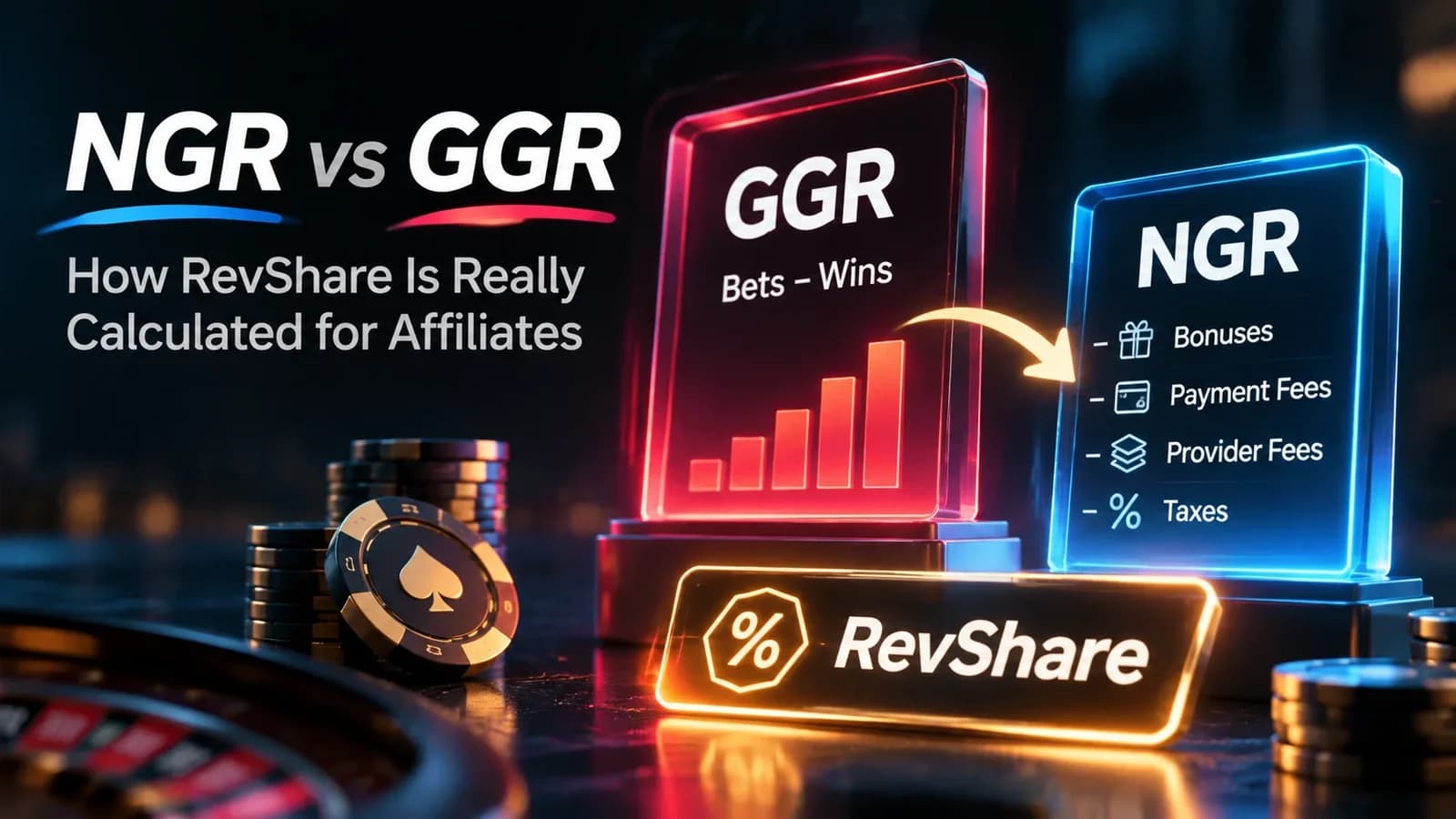
An affiliate sees in the report that players from their traffic lost $10,000, multiplies it by 40% and expects $4,000. The payout comes in at $1,960. Nobody stole anything. RevShare is calculated from NGR, and several deductions sit between what players lost and that number. Let's go through which ones and calculate an example from the first bet to the payout.
What Is GGR in a Casino?
GGR (Gross Gaming Revenue) is the total of player bets minus player wins. No bonuses, fees or taxes have been subtracted yet. GGR shows how much the product earned on the game itself and describes volume well. But it is always larger than the operator's real income, so operators are rarely willing to pay affiliates a share of GGR.
What Is NGR and How Is It Calculated?
NGR (Net Gaming Revenue) is GGR after deductions: bonuses and cashback, payment fees, game provider and platform fees, and taxes. The formula is simple: NGR = bets − wins − bonuses − fees − taxes. RevShare is calculated from NGR, which is why the same amount of bets can produce very different payouts.
NGR vs GGR: What Is the Difference?
GGR answers the question "how much did players lose", NGR answers "how much of that stayed with the operator". The gap between them comes from the bonuses the operator handed out, the money taken by payment providers and game providers, and the country's tax. The more aggressive a brand's bonus policy, the wider the gap between GGR and NGR, and the smaller the RevShare payout from the same traffic.
How Is RevShare Calculated From NGR? A Step-by-Step Example
All numbers below are an illustrative example made up for this article. We take one cohort of players over one month.
| Step | Amount (example) |
|---|---|
| Player bets | $100,000 |
| Player wins | $90,000 |
| GGR | $10,000 |
| Bonuses and cashback | minus $3,000 |
| Payment fees | minus $500 |
| Game provider and platform fees | minus $1,000 |
| Tax | minus $600 |
| NGR | $4,900 |
| RevShare 40% (example) | $1,960 to the affiliate |
What matters here. Bonuses alone account for more than half of the gap between the $4,000 "in your head" and the $1,960 in the payout. That is why two brands with the same RevShare rate can pay completely differently: it all depends on what is deducted before the percentage is applied. Every program has its own list of deductions, so ask your manager for it in writing before you launch.
What Is Negative Carryover?
Negative carryover means a negative NGR is carried over into the following periods. Let's continue the example: next month one player hits a big win, and the cohort's NGR comes out at minus $3,000. The payout for that month is $0, and the minus $3,000 first eats into the NGR of the following months. If a program carries the minus over without limits, one lucky player can wipe out the RevShare of a whole cohort for several months. Some programs reset the negative balance every month, others carry it over. This is question number two for your manager, right after the list of deductions.
RevShare, CPA or Hybrid: Which One to Pick?
RevShare earns on the whole lifetime of a player, so it pays off when players come back and make repeat deposits, that is, when your traffic has a high LTV. CPA pays once for the deposit and does not depend on what the player does next. Hybrid combines a fixed payment per deposit with a percentage of NGR. We covered where each model is strong, and the hidden conflict of interest in CPA, in CPA vs Spend Model in iGaming.
A simple rule of thumb: until you can see how your traffic behaves after one and two months, RevShare is hard to forecast. Once you have cohort statistics, RevShare and Hybrid start working for you.
What to Check in RevShare Terms Before You Launch
- What the percentage is calculated from: GGR or NGR.
- Exactly which deductions go into NGR, as a list.
- Whether negative NGR is carried over, and for how long.
- Whether you see statistics player by player for your own traffic.
If you want to learn to read offer terms and traffic economics like this, see our programs.
Summary
GGR shows how much players lost. NGR shows what stayed with the operator after bonuses, fees and taxes. RevShare is applied to NGR, so before a launch check three things together: the percentage, the list of deductions and the negative carryover rule.
Glossary terms in this article
Unfamiliar with a term? Each links to a full definition in our affiliate & iGaming glossary.
You might also like

Meta GEM Model: How Facebook Ad Delivery Works in 2026
In October Meta updated GEM, the model that decides who sees each ad on Facebook and Instagram. For a media buyer this is not abstract news from an engineering blog.
Read article →
Gambling Traffic Arbitrage on Facebook: How It Works in 2026
Gambling traffic arbitrage on Facebook means buying ads on Meta and selling the players they bring to casinos, for a fixed payout or a share of revenue.
Read article →
Facebook Ads Digest, October 2026: Payment Checks, Card Bans and GEM
In September Meta moved its trust check off the ad and onto the advertiser. In October it reached the money. Accounts went down not for a creative, but for their spend…
Read article →