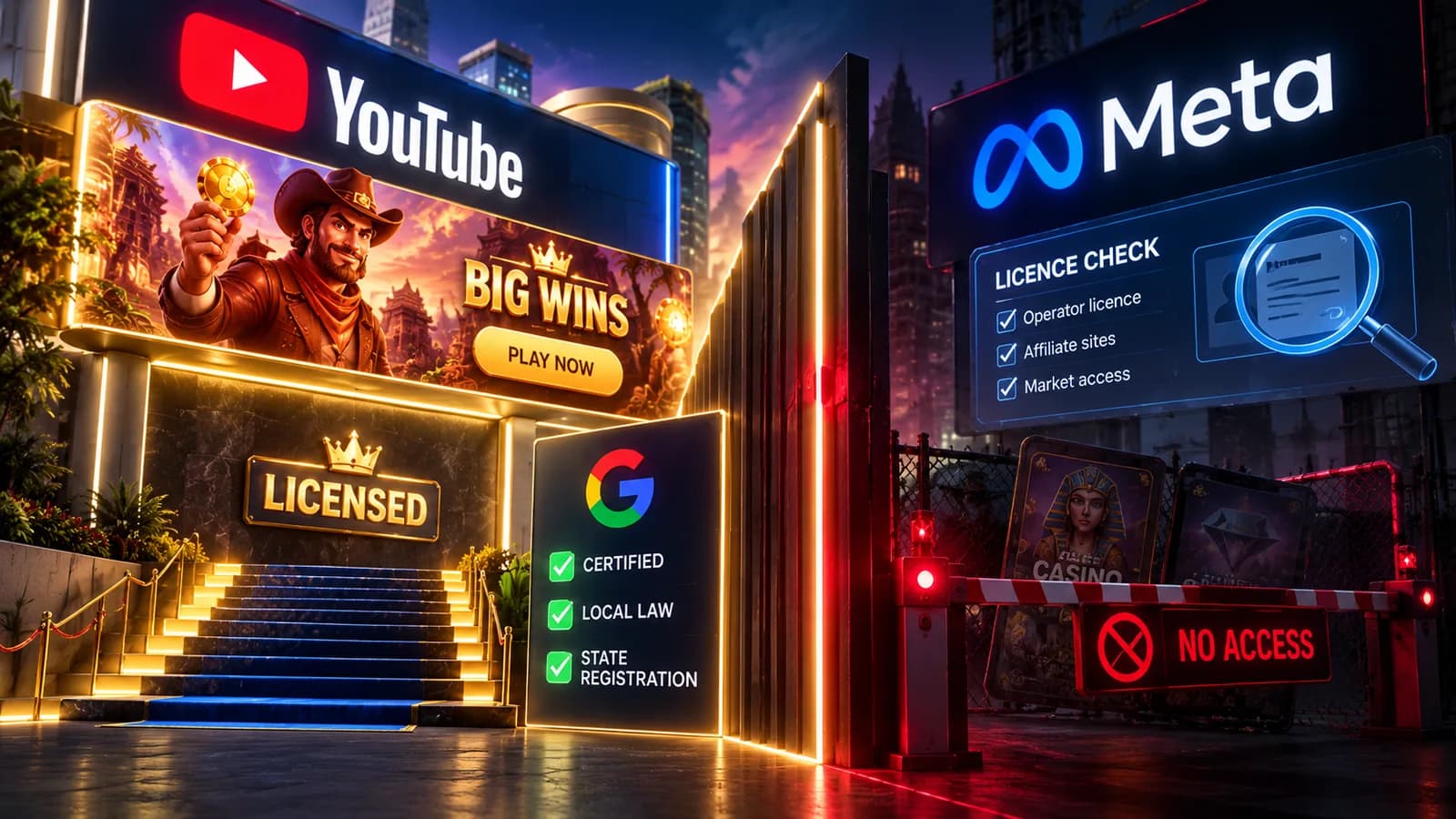
Three things happened in a single week of October. Google opened its most visible ad format to certified gambling advertisers. Meta started checking the licences not only of operators but also of affiliate sites. And the Dutch regulator began building a single list of licensed EU operators together with Google.
Taken one by one, these are three news items. Taken together, they show the gambling ad market splitting into two floors, each with its own rules.
The Upper Floor: Premium for the Licensed
From 21 October, certified online gambling advertisers can buy YouTube Masthead. It is the large banner at the top of the YouTube home page, one of the most visible formats the platform has. Until now it carried mostly sports betting; now casinos get access too.
The conditions are strict:
- Google Ads certification under the platform's gambling rules.
- Local law: age and territorial restrictions, with permitted categories differing from country to country.
- Mandatory state registration. Gambling products that do not require it are not allowed into the format.
Google has not yet said which countries it will launch in or whether Masthead will need a separate certification. But the point is clear: a licensed operator gets a tool an illegal one does not have, and a chance to stand out through sheer reach.
The Lower Floor: Checks Reach the Affiliates
Meta is launching a pilot with the licensed operator Paf, starting in Switzerland. Paf will pass Meta licence data and the site addresses of operators and affiliates. That lets the platform check who is behind an ad and whether they have the right to operate in that market.
The real news here is the word "affiliates". Until now, the checks covered ad accounts. Now the partner domains that send players on to operators come into view as well. Meta has not disclosed its criteria or announced mandatory certification for affiliates, and for now this is a pilot, not mass blocking.
The numbers show why the pressure is building. According to an association of Dutch operators, more than 90% of the gambling ads it checked led to illegal casinos, and only 11 to 15% of them were removed.
The third step comes from a regulator. The Dutch KSA is working with Google on a single list of licensed EU operators. Those not on it may lose advertising on Google. Meta took part in the talks, but a similar list for Meta has not been confirmed, and no timelines have been given.
Why Now
The platforms have long lived with a double problem. Licensed operators complained that illegal competitors advertised freely right next to them. Regulators threatened lawsuits. The simplest answer to both complaints is to give more to those with a licence and less to everyone else.
This is not a new move. It continues what we saw with payments (The Ban Moved to the Wallet). Regulators look for places where control is cheap, and ad platforms are becoming the same kind of bottleneck as banks. Both layers rest on one question: does the operator hold a licence in this market?
What It Means for Each Side
For operators. A licence in a specific country now gives not only the right to operate but also access to the best ad inventory. An operator without a local licence is gradually losing both advertising and payments.
For affiliates. Your domain becomes part of the check. What matters is not only how the site looks but which brands it sends players to. A site that leads to unlicensed casinos is the first at risk once the pilot moves beyond Switzerland.
For media buyers. An offer's licence status in the target geo becomes a launch criterion alongside the payout and the payment methods. Before starting, it is worth knowing whether the brand is licensed in that country and how that affects the traffic sources available to you.
Summary
- Google opened YouTube Masthead to certified gambling advertisers, Meta started checking licences of operators and affiliate sites, and a regulator is building a single list of licensed EU operators with Google.
- The market is splitting into two floors: premium inventory for the licensed and tighter checks for everyone else.
- For the first time, the checks reach affiliate domains.
- A licence in a specific geo is becoming a condition for access to advertising, just as it already is for payments.
Licensed and illegal gambling used to compete in the same auction. Now the platforms are building a staircase between them, and only a licence gets you upstairs.
Glossary terms in this article
Unfamiliar with a term? Each links to a full definition in our affiliate & iGaming glossary.
You might also like
The Prelander Before a PWA: Three Jobs It Has to Do
When a funnel needs to get shorter, the prelander is usually the first thing to go. The logic is simple: fewer screens mean fewer drop-offs and more installs.
Read article →
The Ban Moved to the Wallet: Gambling Regulators Now Block Payments, Not Domains
In September we wrote that the enforcement point in gambling was shifting from the operator's licence to the payment rail (iGaming Regulation in 2026).
Read article →
What Media Buyers Check Before Sending Traffic to a Casino Affiliate Network
Affiliate networks compete on rates because a rate is easy to compare: it sits right on the offer card. A buyer looks at something else.
Read article →