

Media Buying
Media Buyer in iGaming: What the Role Is and How to Hire One in 2026
An operator or a team decides to scale traffic, posts a "Media Buyer, iGaming" vacancy and gets a hundred applications within a week. Every candidate has "gambling experience" and "big spends", and a month later it turns out the person could only launch campaigns from someone else's playbook. Here is what a media buyer in iGaming actually does, which levels exist, what the role costs in 2026 and how to check a candidate before they get your budget.
What Does a Media Buyer Do in iGaming?
A media buyer does media buying: buys advertising traffic and turns budget into player deposits. They choose the source and GEO, test creatives and offers, launch campaigns, watch the cost of a registration and an FTD, and scale what pays back. In gambling this comes with infrastructure: ad accounts, a tracker, PWAs, and handling bans and rejects.
Media Buyer vs Performance Marketing: What Is the Difference?
A performance marketer owns marketing results as a whole: several channels, budgets, analytics, often the brand too. A media buyer works at the buying level: a specific source, specific campaigns, daily decisions on bids, creatives and scale. In iGaming a media buyer usually runs one or two sources, most often Facebook, and owns the ROI of every dollar in them.
What Levels Do Media Buyers Have?
The market has no single standard, and every team sets its own thresholds. Most often the level comes down to two things: experience in gambling specifically and the monthly spend the person managed on their own. Here is the benchmark we use when we vet buyers, checked against the requirements in 2026 vacancies.
| Level | Experience | Monthly spend | Handles on their own |
|---|---|---|---|
| Junior | up to 1.5 years | $5-20k | launching campaigns, basic optimization, reporting |
| Middle | 1.5-3 years | $20-60k | running campaigns, A/B tests, creative analysis |
| Senior | 3+ years | from $60k | strategy, advanced optimization, mentoring |
Strong teams set the Senior bar higher: vacancies ask for $3,000 of spend per day and $100k or more per month.
How Much Do Media Buyers Make in 2026?
According to Djinni salary statistics for November 2026, the median range in media buyer vacancies is $1,000-3,000 per month, and the median salary of hired candidates is $1,500. The data covers all verticals and mostly remote roles on the Ukrainian market. Pay grows noticeably with experience:
| Experience | Range in vacancies | Median for hires |
|---|---|---|
| under 1 year | $500-1,200 | no data |
| 1 year | $1,000-3,000 | $1,050 |
| 2 years | $1,500-3,750 | $1,500 |
| 3 years | $1,500-4,000 | $2,000 |
| 5+ years | $2,250-5,500 | no data |
In gambling the fixed part is usually small and most of the income comes from a percentage. 2026 vacancies show these models: a probation fix of $1,000 for Middle and $1,500 for Senior plus up to 50% of profit on CPA, 30% of profit on spend deals, or pay as a percentage of spend.
How Has Hiring Media Buyers Changed in 2026?
The iGaming job market has tightened. There are fewer vacancies, dozens or hundreds of candidates apply for one position, and before opening a role companies calculate the revenue it will bring. Requirements are getting wider: a buyer is expected to handle analytics, creatives and product understanding too. Pay in USDT without a contract and percentage-only models are more common.
Hire In-House or Work by Project?
An in-house buyer gives you control but needs a fixed salary, infrastructure and time to ramp up. A project partnership (a fee for running the account plus a percentage of volume) lets you bring in an experienced buyer for a specific client without hiring. In that case, agree on reporting and scope of responsibility from day one.
How to Vet a Media Buyer Before Hiring?
A CV and talk of "big spends" prove nothing. Check how the person thinks and what their numbers are:
- The "new GEO, one offer, $3,000 to start" case. Ask for the first steps, how many campaigns they would launch and how they would split the budget.
- The "campaign dropped" case. A stable campaign stopped delivering an acceptable cost per deposit: revive it, pause it or launch a new one? Look at the reasoning, since there is no single right answer.
- Ban risk. How they spread budget across accounts so traffic does not stop after a ban.
- Proof. A screenshot of stats from the ad account or tracker for the last 2-3 months: GEO, spend, cost per FTD. Offer names and setups are not needed.
Treat the first one or two projects as a trial for both sides.
Can AI Replace a Media Buyer?
Not fully, for now. AI already takes over routine work: generating creatives, reports, part of the analytics. Decisions with a high cost of error stay with a person: where to send the budget, when to stop a campaign, how to react to a ban wave. The market values buyers who use AI to run more campaigns without losing quality.
Summary
A media buyer in iGaming buys traffic and is responsible for every dollar coming back as deposits. The level depends on gambling experience and the spend the person managed on their own. The market range in 2026 is $1,000-3,000 per month, and in gambling most of the income comes from a percentage. Before hiring, check the thinking with cases and the numbers with screenshots.
If you are an operator and would rather not hire and train buyers yourself, see how we buy gambling traffic on a spend model with a ready team.
Glossary terms in this article
Unfamiliar with a term? Each links to a full definition in our affiliate & iGaming glossary.
You might also like
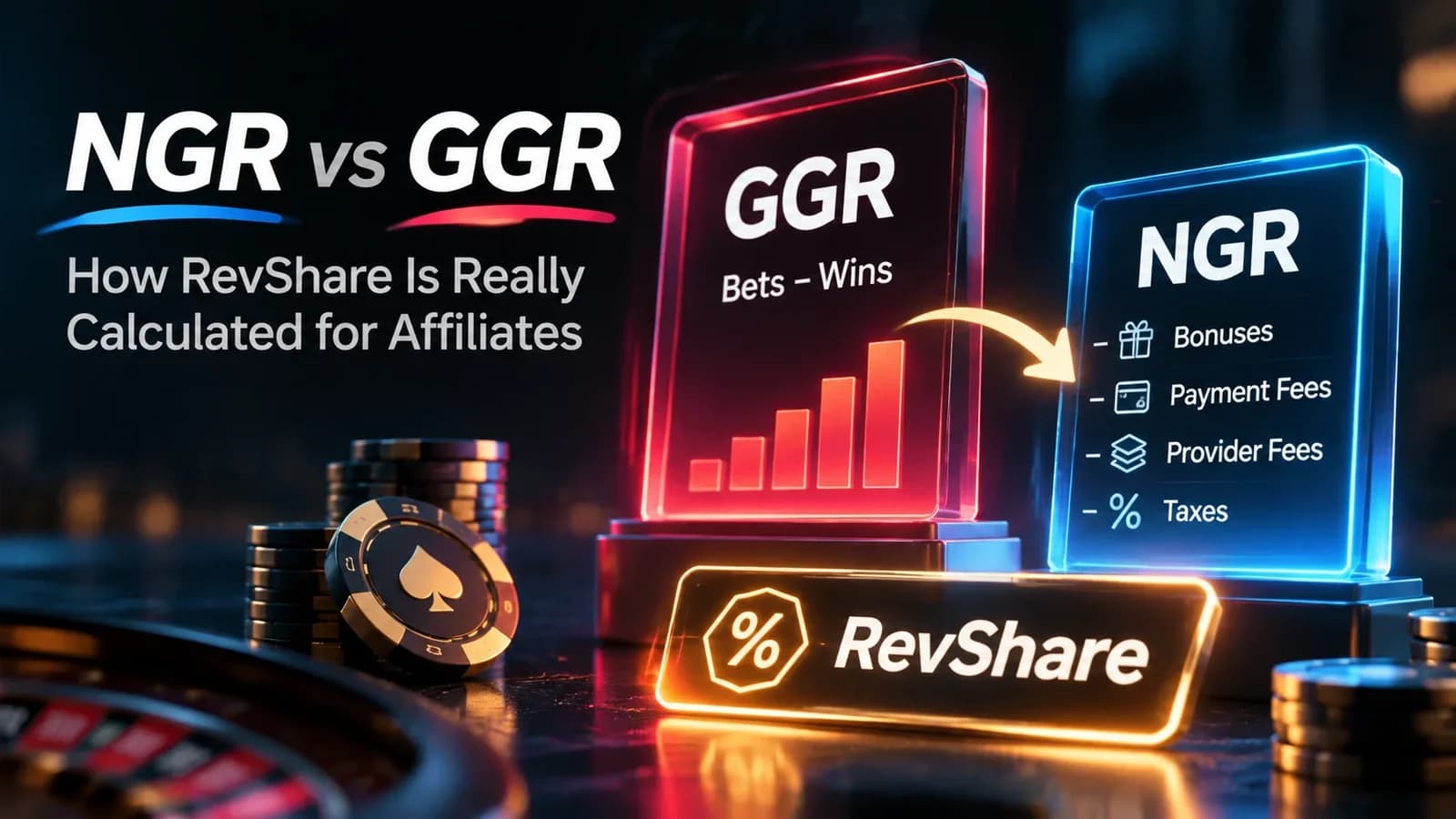
NGR vs GGR: How RevShare Is Really Calculated for Affiliates
NGR vs GGR explained for iGaming affiliates: what each metric means, how NGR is calculated, a step-by-step RevShare example from GGR to payout, and what negative carryover does.
Read article →
Meta GEM Model: How Facebook Ad Delivery Works in 2026
In October Meta updated GEM, the model that decides who sees each ad on Facebook and Instagram. For a media buyer this is not abstract news from an engineering blog.
Read article →
Gambling Traffic Arbitrage on Facebook: How It Works in 2026
Gambling traffic arbitrage on Facebook means buying ads on Meta and selling the players they bring to casinos, for a fixed payout or a share of revenue.
Read article →