
In-App
Why In-App Doesn't Ban the Gambling That Facebook Bans
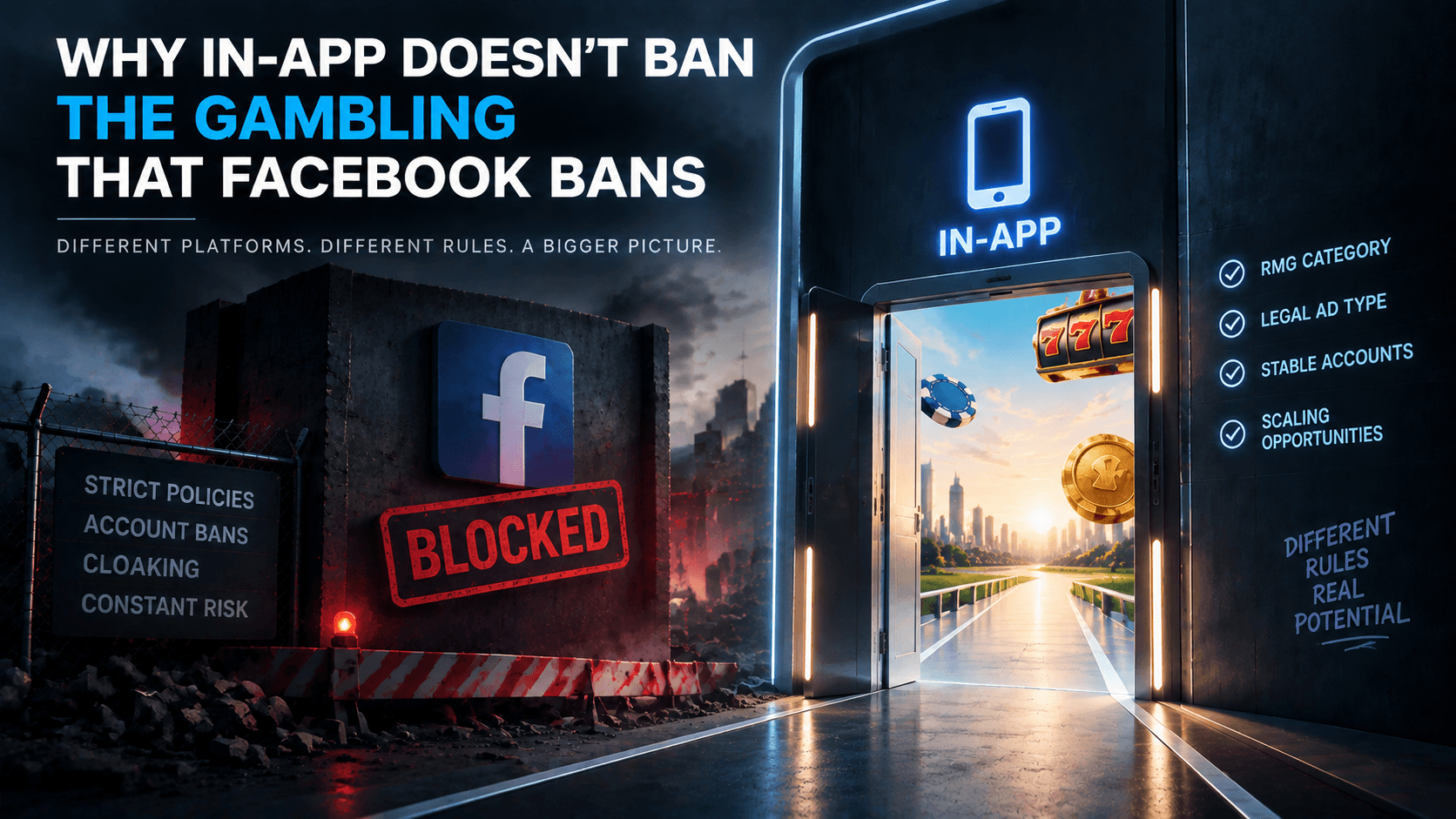
The autumn ban wave on Meta did not become the topic of the month by accident. While buyers patch up the account farm, the cloaking (masking the landing page from moderation) and the proxies, the very same gambling creatives keep running quietly in in-app. The reason is not that Unity or Mintegral are nicer by temperament. The reason is structural: in-app has a legal lane for gambling, and Facebook simply does not have one. Here is where that lane comes from, and why it does not make in-app an easy mode.
The Autumn Where Two of Ten Survive
The autumn wave hits infrastructure rather than individual creatives. An account does not survive long enough to reach volume before it gets taken, and the buyer is back at the start: new account, new warm-up, new cloaking, new proxies. Every account cut down is not only lost budget but lost time, and that time eats into the next working cycle.
One buyer's report from the late-August wave puts numbers on it: of ten accounts launched, four started running at all, and two of those were already gone. That is one team's experience rather than a market average, but it matches the mood of the quarter closely enough that everybody recognised it.
This is exactly why in-app reads so sharply right now. The question every team is asking itself is whether you can run gambling traffic somewhere that does not take you down every week. The short answer is yes, but under different rules.
It Is Not That the Platform Is Nicer. It Is RMG
One concept explains all of it: RMG, Real Money Gaming, meaning games played for real money. In-app networks (Unity, Mintegral, Liftoff) maintain a separate category and a separate account status for this vertical. In permitted geos, gambling there is not a violation you have to hide, it is a legal ad type with its own requirements.
The consequence is simple. On an RMG account you are not hiding from the platform, you are passing its rules. Cloaking makes no sense, because the offer is permitted anyway. There is no need for an account farm, because the account does not get taken for the mere fact of being gambling. That is the legal lane Facebook does not have.
Why Facebook Structurally Cannot Do the Same
On Facebook, gambling is outside the rules by default. Legal exceptions exist (a licensed advertiser, specific jurisdictions, written permission), but for the affiliate model none of those is a working path. So the buyer is by definition in opposition to the platform: the algorithm looks for violations, the buyer hides them. Cloaking, antidetect browsers, warm-up, budgets spread across accounts, all of it is equipment for one war, fought to last a little longer.
In-app inverts the logic itself. Instead of "how do I get around moderation", the question becomes "how do I pass moderation and make the economics work". That is not easier. It is a different job.
The Reality of In-App: Four Myths That Break Budgets
The most common mistake among people arriving with Facebook habits is expecting an easy mode. In-app has its own set of frictions, and it is better to know them before the first dollar.
-
Myth: it does not ban, so running traffic is easier. Reality: the account does not get taken for gambling, but moderation is every bit as strict. Gambling here is restricted content: without an RMG account the creative will not pass, and a share of approaches gets cut exactly as it would at Meta.
-
Myth: no pixel, so less hassle with tracking. Reality: the opposite. All attribution runs through an MMP (mobile measurement partner, AppsFlyer or Adjust, for example). Event postbacks are the foundation: without clean tracking the campaign is blind, and there is physically nothing to calculate ROAS from.
-
Myth: once it is allowed, you can move the bid and the goal around like on Facebook. Reality: the campaign goal does not change after creation. Pick install optimisation and "switching to ROAS later" means a new campaign, not an edit to the old one.
-
Myth: without the farm and the cloaking, entry is cheaper. Reality: tests are more expensive and take longer. The first days of budget go into teaching the algorithm (the learning phase), and CPI at the start is high by default.
Summary
- The autumn ban wave leaves a small fraction of accounts alive, and it is against that backdrop that in-app as an alternative reads so sharply.
- In-app is not "nicer". It has RMG, a legal lane for gambling in permitted geos, and Facebook has no such lane. That is structure, not temperament.
- You pay for it differently: with strict moderation, more expensive and slower tests, attribution through an MMP, and a campaign goal that cannot be changed.
Anyone who walks into in-app with Facebook habits burns budget not on bans, but on tracking and economics.
Looking at in-app as a second channel for gambling while Facebook keeps storming? Write to us: we will go through how the RMG lane fits your specific product and traffic, and what you will have to rebuild in tracking and economics before running anything seriously.
Glossary terms in this article
Unfamiliar with a term? Each links to a full definition in our affiliate & iGaming glossary.
You might also like
PWA Install Base in iGaming: The Asset That Outlives Your Ad Account
When a buyer counts a PWA, they count a funnel: click, install, registration, deposit. The bundle dies, and mentally everything dies with it.
Read article →
iGaming Regulation in 2026: The Storm in Brazil, Cambodia and Europe
Four regulatory stories broke within weeks of each other on three continents, and they look unrelated only until you line them up.
Read article →
Meta Andromeda in 2026: The Levers Buyers Aren't Using
That Andromeda broke familiar things is already documented: similar creatives count as one ad, attribution split, auto-enhancements quietly damaging conversion.
Read article →