
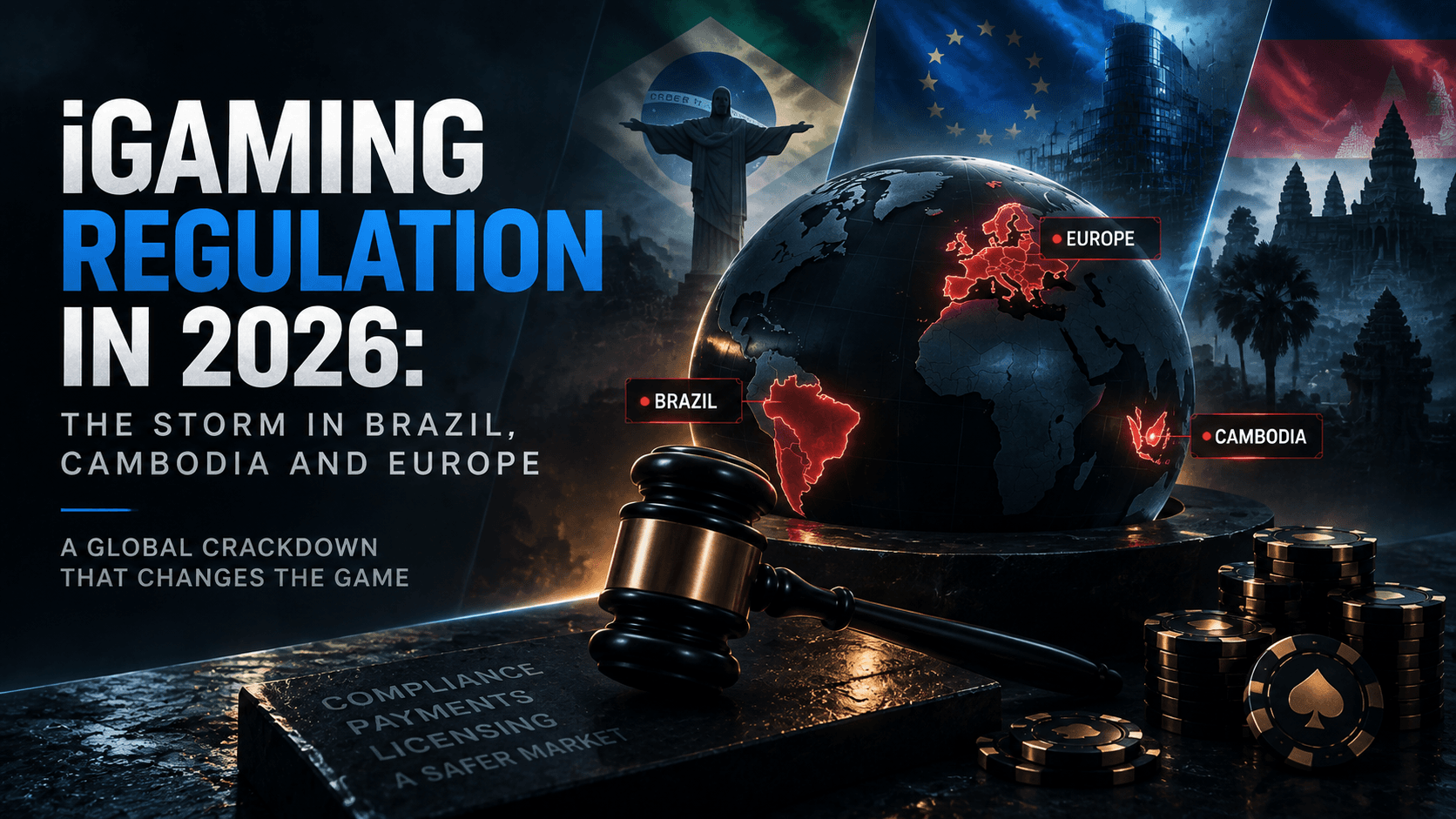
Four regulatory stories broke within weeks of each other on three continents, and they look unrelated only until you line them up. Brazil is threatening to shut down its own most profitable gambling product, Cambodia is switching online gambling off entirely, Europe is quietly rewriting what a "regulated market" even means, and FATF has published its first detailed report on illegal online gambling since 2009. The trigger behind all four is the same, and it is worth understanding before you plan your next GEO.
Brazil: The Regulator Is Aiming at the Product That Feeds the Market
Brazil's president publicly floated shutting down online gambling, and specifically the crash and instant games that dominate the market. Aviator and the tigrinho-style titles account for roughly 70% of operator revenue in the country, so the proposal is not aimed at the periphery, it is aimed at the core.
The counterweight is fiscal. The budget already books R$8.75 billion in gambling taxes for January through July 2026, with full-year estimates around $16 billion. A government does not delete that line easily, which is why the realistic outcome is not a ban but a squeeze.
That squeeze is already visible: advertising rules in force since 17 July, self-exclusion past 925,000 registrations, and roughly 2.8 million welfare recipients blocked from betting accounts. For traffic this reads as tighter creative moderation, more payment scrutiny, and an audience being removed from the funnel administratively rather than persuaded out of it.
Cambodia: A Full Shutdown, and the Reason Behind It
Cambodia is going the other way and simply switching online gambling off. From October 2026 every licensed casino in the country loses the right to operate online, framed by the prime minister as a full suspension rather than a pause.
The context makes it readable: 86 scam compounds liquidated, around 30,000 suspects from 39 countries detained, 18 licences revoked and 9 suspended. Cambodian online licences had become legal cover for operations with very little gambling in them, and the new rule closes the loophole left open in 2019.
The practical takeaway: a licence that exists mainly to be shown to a payment provider is a liability, not an asset. When the jurisdiction behind it comes under pressure, the licence disappears faster than the traffic you built on top of it.
Europe: "Regulated" Now Has to Be Measured
Europe is not producing headlines of that size, but it is doing something more consequential: changing how a gambling market's health is judged. Three markers are becoming standard.
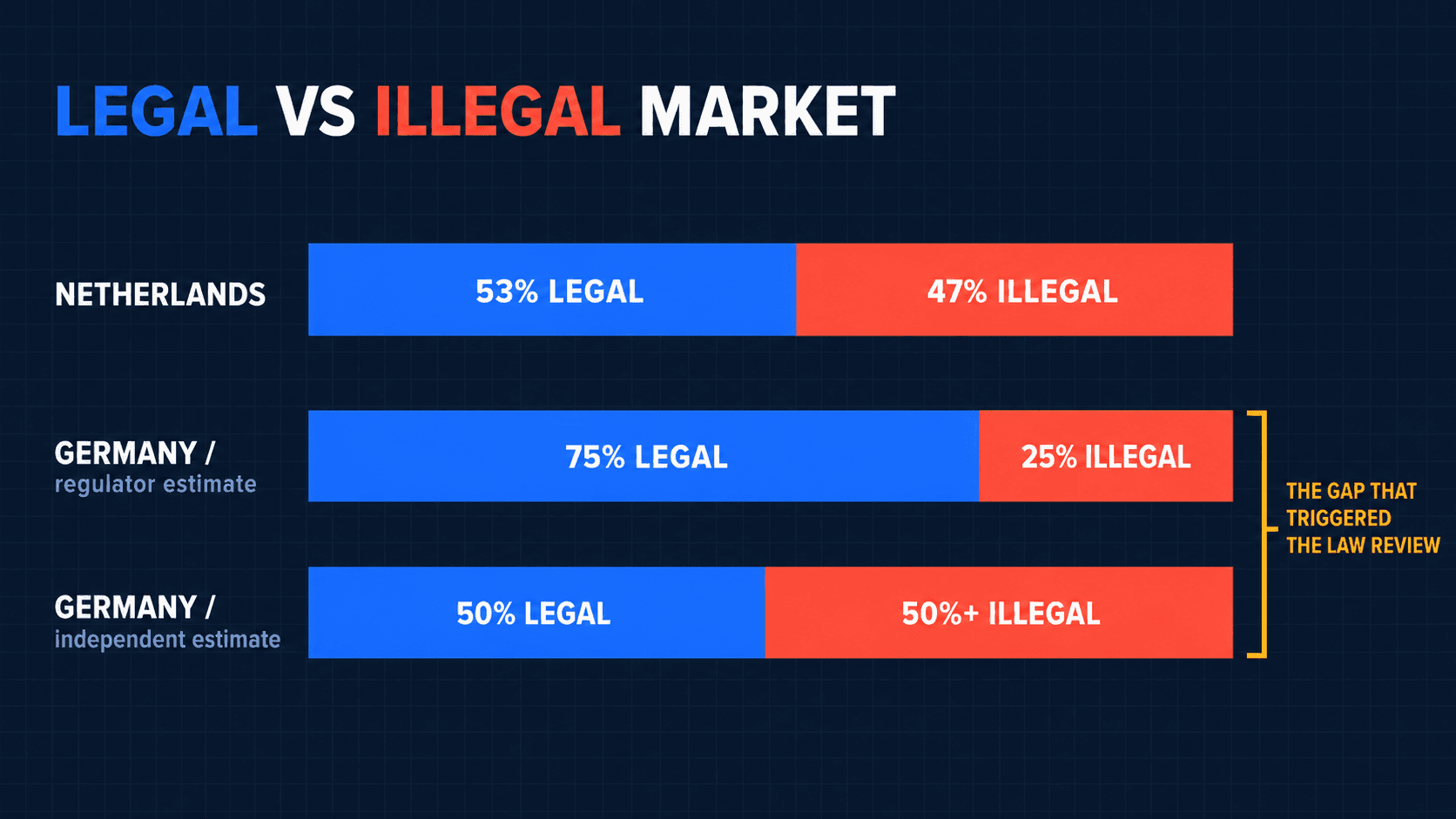
The first is channelisation measured by money, not by headcount. In the Netherlands 91% of players sit in the legal market, yet licensed operators hold only 53% of the money turnover. The people are legal, the volume is not.
The second is who does the measuring. Germany's regulator puts the illegal share at around 25%, while independent estimates put it above 50%. That gap is precisely what forces a rules review, because the regulator either cannot see half the market or is choosing not to count it.
The third is a licensing regime that arrives with a timetable instead of a declaration. Finland opens licensing in March 2026 with full launch in July 2027, so the window between "you may apply" and "you must comply" is a known quantity.
Read together, these three tell you whether a GEO is genuinely regulated or simply calls itself that. Low money channelisation plus estimates that disagree by a factor of two means a rule change is coming.
FATF: Enforcement Moves Onto Payments
FATF has published its first detailed report on online and illegal gambling. The previous one, back in 2009, covered land-based operations only, which tells you how far behind the framework had fallen. The new report draws on more than 80 jurisdictions and is addressed to over 200 member countries.
What matters is the red flags it names: fast withdrawals with almost no play, multiple accounts and payment methods behind one person, third-party transactions. None of that is news inside the vertical. What is new is that these flags are now written into guidance for payment service providers, e-wallets and fintech.
That relocates enforcement. Until now the pressure point was the operator and its licence. From here it is the payment rail, which is harder to move and slower to replace.
The Common Thread: The Trigger Is the Same Everywhere
Brazil, Cambodia, the Netherlands, Germany and FATF are all reacting to one thing: the visible size of the uncontrolled segment. Not to gambling as such, and not to advertising volume.
Brazil moves because the product driving 70% of revenue also drives the social bill. Cambodia moves because the licence became a shield for something else. The Netherlands and Germany move because the numbers do not add up. FATF moves because the money stopped passing through the places it used to watch.
So the useful question about a GEO is not "is gambling legal here" but "how large is the grey zone here, and who is counting it". The size of that gap is the best available predictor of the next rule change.
Before You Enter a GEO
- Check money channelisation, not player channelisation. A market where most players are legal but half the turnover is not is a market standing on the edge of a rewrite.
- Compare the regulator's estimate against an independent one. A twofold disagreement is a leading indicator, not a statistical quirk.
- Treat the licence as a dependency, not a guarantee. Ask what that jurisdiction is under pressure for, and what happens to your payments if it loses standing.
- Assume the payment rail is now the enforcement point. After the FATF report the questions reach you from the PSP before they reach you from the regulator.
- Watch the product mix, not just the vertical. When one format carries most of the revenue it carries most of the regulatory risk, which is exactly Brazil's situation.
Summary
- The four stories are one story: regulators are responding to the gap between the market they can see and the market that exists.
- Brazil will squeeze rather than ban, because R$8.75 billion in tax receipts is not a line you delete.
- Cambodia shows what happens when a licence functions as cover: the whole regime goes, not just the offenders.
- In Europe the new test of a regulated market is money channelisation plus agreement between regulator and independent estimates.
- FATF moved the red flags onto payment providers, so enforcement now starts at the rail rather than at the licence.
- For GEO planning, the size of the grey zone predicts the next rule change better than the current legal status does.
Regulation rarely arrives as a surprise. It arrives as a number that stopped adding up, several months earlier. If you want your GEO shortlist built on those numbers instead of on last year's legal status, get in touch and we will go through your markets.
Glossary terms in this article
Unfamiliar with a term? Each links to a full definition in our affiliate & iGaming glossary.
You might also like

Meta Andromeda in 2026: The Levers Buyers Aren't Using
That Andromeda broke familiar things is already documented: similar creatives count as one ad, attribution split, auto-enhancements quietly damaging conversion.
Read article →
Casino Player Reactivation: Why Sending a Bonus Doesn't Work
Most companies build reactivation as a single switch: the player disappears for N days, we send a bonus, we wait.
Read article →
How to Build an iGaming Media Buying Team That Doesn't Fall Apart
Teams are collapsing across the vertical right now, and it is not a run of bad luck. ROI in iGaming has fallen to what practitioners are calling historic lows…
Read article →