

Facebook Ads
Facebook Media Buying for iGaming: The Decision Chain from Ad Account to Scale

Most material on Facebook media buying in gambling is either a case study or a digest of platform news. Neither explains the thing that actually decides the outcome: in what order decisions get made, and on what signal. That is where the money is lost. Below is a map of the full chain and the decision criteria at every link.
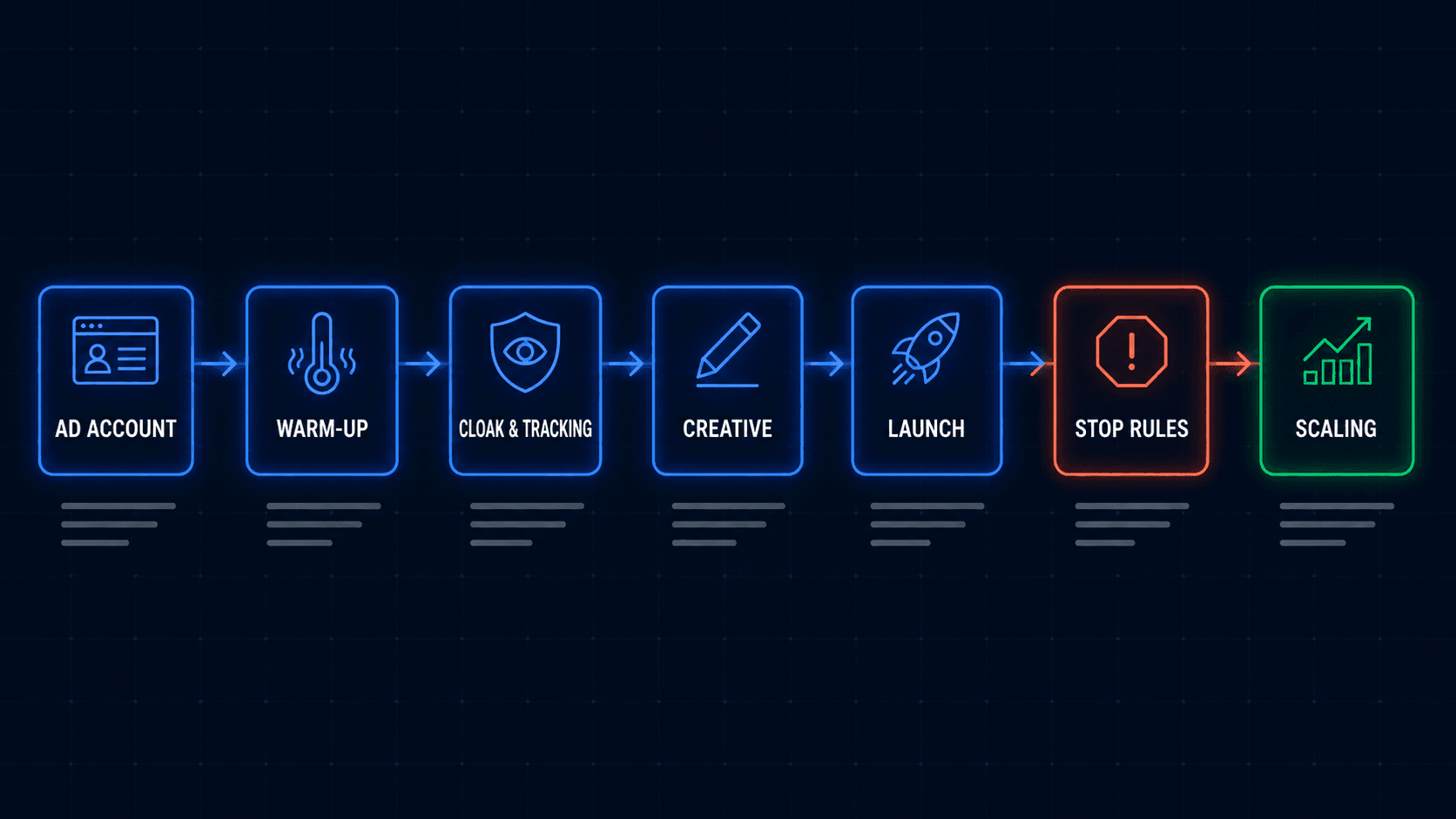
The Chain: Seven Links, and Where the Money Actually Leaks
A launch in gambling is seven layers, each of which can kill the result and each of which disguises itself as the one next to it: ad account, warm-up, cloaking and tracking, creative, launch, stop metrics, scaling.
The thesis to start from: most losses today come not from a missing spark up (the affiliate term for an ad set landing well in the auction and catching a live, engaged audience), but from chaotic decision-making during the test. Some hold a bundle too long, others cut it before the statistics have accumulated. There is rarely a middle ground, because the rules get defined during the pour instead of before it.
The Account: You Are Renting Time, Not Buying an Asset
An ad account in this vertical is a consumable with a limited lifespan. In one of our tests, agency accounts lived around three days on average, faster than we had budgeted for. In August the market went through two ban waves, on the 14th and the 25th, and the second one caught even old verified BMs: one buyer lost 11 of 20 running accounts in five minutes. In the July wave the market recorded roughly 40% of accounts going into a block.
The conclusion is not "hunt for an eternal account" but "build a structure where the death of an account does not stop the traffic": campaigns spread across several accounts, separate pixels and domains for different bundles, and replacement treated as a planned operation rather than an emergency.
Warm-Up: The Most Overrated Link
The market treats warm-up as load-bearing and sells recipes for it. In practice it rarely decides the fate of a launch, and field data shows why.
The typical picture: a buyer takes nine warmed accounts from two different providers, and only one account from each actually starts delivering. The rest either do not spend at all or mass-reject creatives. On the ones that do run, the metrics are not guaranteed either: install-to-registration conversion can collapse several times below what was expected.
Warm-up makes sense as minimum hygiene: one campaign, one ad set, one ad at the start, and a post boost on the fan page before the main pour. But it does not turn a bad account into a good one. If you are looking for the cause of a failure in the warm-up, you are almost always looking in the wrong place.
Cloaking and Tracking: The Layer That Breaks Quietly
Cloaking extends a campaign's life but does not save you from user complaints, weak landing pages, or bad creatives. What matters more is what breaks next to it, unnoticed.
Tracking is where decisions get lost. The network's click ID has to map into an end-to-end identifier, otherwise the network never learns which click converted and its optimisation stays blind. The landing page has to point at the tracker link rather than straight at the offer, or the click never comes back.
A benchmark for discrepancies: 5-7% is technical margin of error, 20-50% is a critical signal. And if the discrepancy shows up only on certain geos or only on mobile, the cause is usually not the traffic but the network's antifraud or platform-level restrictions.
Creative: Ammunition, Not an Asset
A creative in Meta is no longer an asset you store, it is a consumable. The fatigue signature is stable: a sharp drop in CTR, a gradual rise in CPM, falling conversion.
The most important change after the Andromeda updates: similar creatives count as a single ad. Ten near-identical images of the same idea are shown as one, not ten. So what you split is not variations but approaches: slot videos, streams, reactions, crash games. The algorithm reads the visual pattern, not the text under it, and two clips with different voiceovers but the same structure are twins to it.
A benchmark for quick filtering: CTR above 1% after 500-1000 impressions is a good signal, but not sufficient on its own. It tells you the creative catches attention, and nothing about traffic quality further down the funnel.
Launch: The Numbers Are Decided Before the Money Moves
The main mistake is not in the settings but in the order. Bid and budget are derived from the deposit payout and the funnel conversion. If you work out an acceptable registration cost after the start, you are not running a test, you are watching one.
Three things to fix before launch:
- A price ceiling at every funnel step. Click, install, registration and deposit each have an allowable ceiling, and all of them are derived from the payout, not from a feeling.
- How many ad sets per campaign. More than five start competing against each other for your own money.
- What you are betting on: the spark up or the optimisation. Formally the learning phase runs until 50 conversions, but in gambling on Facebook you rarely get there: accounts die earlier, and almost any edit knocks off the spark. So the bet is on catching the spark fast and then not interfering with an ad set that has already taken off, rather than on long-run optimisation.
Stop Rules: The Half Nobody Publishes
This is where most material stops. Our principle is a single one: every stopping point is pegged to a share of the deposit payout, not to a sum that feels large. Four checkpoints: you have spent this much and have no click, no install, no registration, no deposit. The specific shares differ by geo and offer.
But there is a second half, and it matters more than the first. Without it, stop rules turn a test into a day-one massacre.
The optimisation buffer is the set of exceptions where a metric has formally crossed the threshold but you must not stop. Click more expensive than target, but CTR holds and installs are coming: let it run. Registration above the ceiling, but conversion into deposit is normal: keep it. Install expensive but converting normally further down: that is a candidate for continued testing, not for a stop.
The logic is simple: a stop rule looks at one metric, while money is made by the chain. So the decision is made on the threshold plus the behaviour of the next step in the funnel.
What Exactly Broke: Diagnosis by Layer
The most useful skill here is not knowing thresholds but being able to identify the layer from the signal:
- Mass rejects. The first suspect is not the creative but the domain and the fan page, because they get checked last. Test by elimination: run the creative you need on a trusted link, then your own domain with a maximally neutral creative. If it passes on the trusted link but rejects on yours, the problem is the domain.
- CPA is fine but the click is expensive. Creative level, refresh it.
- Leads are cheap, no deposits. Look at the funnel and the offer, not the campaign.
- Good lead price but few deposits. A question about traffic quality.
- Registrations come, deposits systematically do not. Run a full test deposit yourself. If the path takes more than three steps, the drop is built into the product.
- Tracker and ad account diverge by more than 20%. A technical fault, not weak traffic, and it is not cured by a new creative.
The principle underneath all of it: suspect the layer you did not touch. That is why a reject is more often about the domain, and a conversion drop more often about what the platform changed than about the geo.
Diagnosis only works when there is somewhere to look: accounts, tracker, creatives and bundle decisions gathered in one place rather than scattered across chats and spreadsheets. We built our own buyer's workspace around exactly that.
Scaling: What Earns It, and What Broke in the Old Playbook
Scaling does not start with the first deposit. One deposit does not make a campaign good. The signs that a bundle can be pushed: stable deposits across several days rather than one evening, conversion holding along the whole chain, and infrastructure that is not falling apart with bans.
The working position on tempo: no more than plus twenty percent of budget per day. And a hard ceiling: if deposit cost exceeds double the payout, the campaign is paused rather than "nursed along."
Separately, on what changed. The classic scaling scheme of duplicating the winner is eroding: duplicates start learning from scratch and the accumulated conversion history does not carry over. The market is split on this, some say duplicates are all but dead, others show launches where most deposits came precisely from duplicated ad sets. The honest answer: duplication has stopped being the default and become a hypothesis to test on your own bundle, while raising the budget on a working ad set more often gives a predictable result.
How It Looks on a Live Geo
Argentina is one of the most popular geos among buyers right now, so let us take it as a full example of the chain. According to market data passing through our digest, the benchmarks look like this: install around two dollars, registration in the region of four to five, registration-to-deposit conversion above 30%, deposit payout in the split roughly 17-24 dollars, starting budget per ad set 15-20 dollars.
Two details that change decisions. First: the contrast with Tier-1, where 150 dollars buys you two registrations, explains why the same stop rules do not transfer between geos without recalculation. Second concerns accounting: a normal operator sends the FTD postback to the tracker immediately, so you orient on the tracker and the affiliate dashboard, reconciling them against the ad account. Some deposits get lost in the ad account, and that is an attribution characteristic, not lost money.
For comparison, Poland: desktop converted three times better than mobile, a localised PWA beat a direct link twofold, creatives with a football theme delivered CTR of 4.2% against 1.8% for generic ones, and offers without the zloty among payment methods lost around 40% of registrations. None of these are visible in the campaign settings, and all of them decide the result.
Summary
- The chain has seven links, and each disguises itself as the next: most losses come from chaotic decisions during the test, not from a missing spark up.
- An ad account is a consumable with a lifespan of a few days, so structure matters more than hunting for an eternal account.
- Warm-up is overrated: it does not turn a bad account into a good one.
- Stop rules are pegged to a share of the payout and defined before launch, but without an optimisation buffer they kill working bundles.
- Diagnosis matters more than thresholds: suspect the layer you did not touch.
- Scaling is earned by stability, not by the first deposit, and duplicating the winner is no longer the default.
Glossary terms in this article
Unfamiliar with a term? Each links to a full definition in our affiliate & iGaming glossary.
You might also like

Facebook Account Rentals: How Media Buying Infrastructure Works
How Facebook account rentals, Business Managers, and app access shape media buying infrastructure, testing speed, and campaign continuity.
Read article →
The FB Media Buyer's Routine in 2026: Process and Skills
Facebook media buying isn't an endless fight with bans, it's a craft where you switch between analyst, creative, and risk manager daily. What the buyer's routine actually looks like in 2026 and the skills it demands.
Read article →
Why Tracker Data Doesn't Match Facebook: Solving Registration Discrepancies for Gambling PWA Campaigns
How to fix big gaps between Facebook Ads Manager and your tracker for gambling PWAs by repairing the attribution chain, postbacks, and network integrations.
Read article →