Media Buying
Facebook Account Rentals: How Media Buying Infrastructure Works
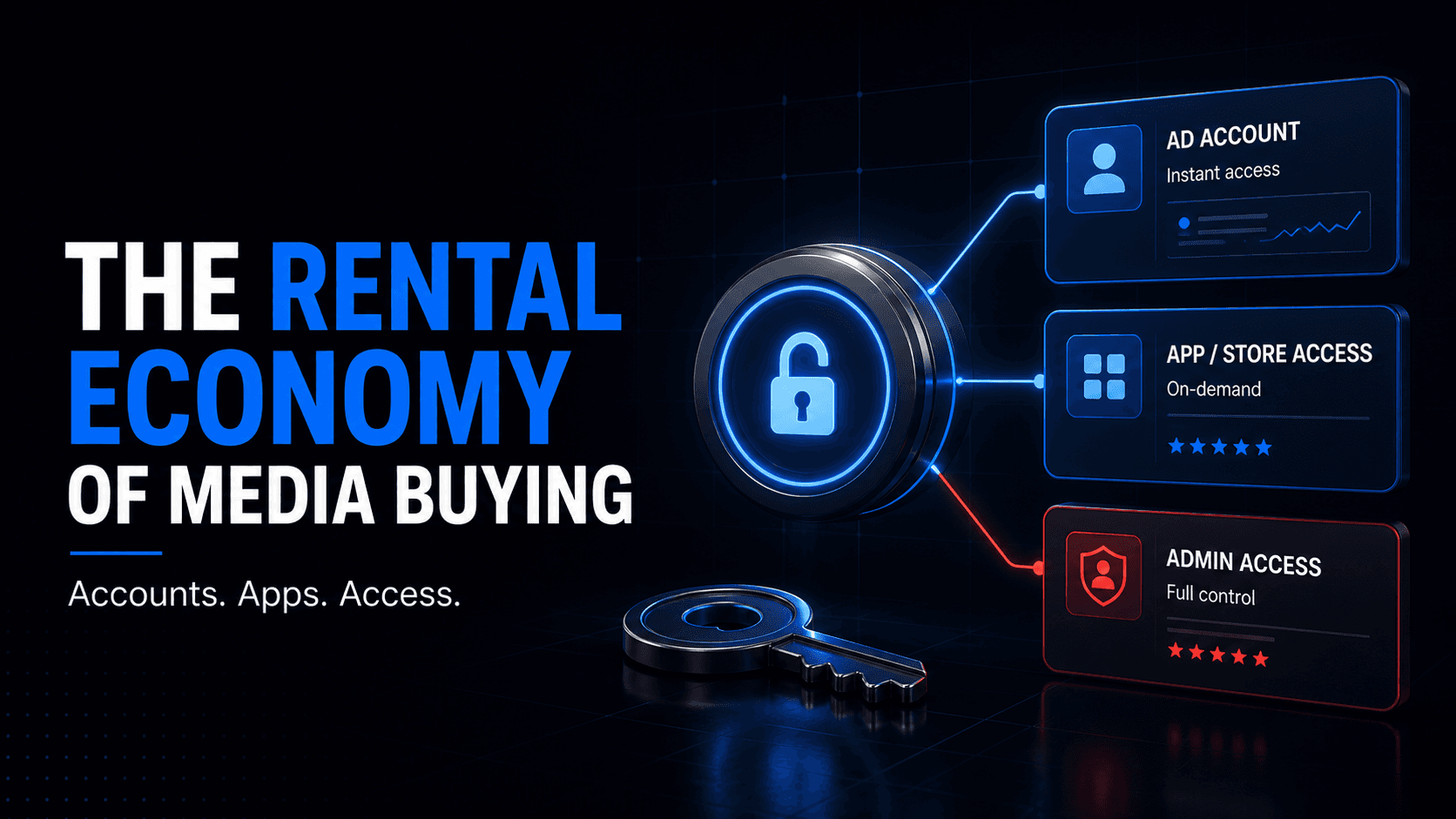
In media buying, you rarely own every part of the stack. Ad accounts, Business Managers, store apps, payment access, proxy infrastructure, tracker permissions: much of it runs on rental or partner-access models.
That is not a sign of a weak team. It is the market's operating model, where getting a valid test live quickly can matter more than owning an asset outright. But renting access never removes the buyer's responsibility for traffic quality, data, or continuity.
Why media buying uses a rental economy
Building proprietary infrastructure sounds safer until you count the time, cost, and operational risk. A team that wants to own everything must develop and maintain accounts, payment operations, apps, store compliance, MMP integrations, and tracking.
For a lean buying team, that can pull attention away from the work that actually produces an edge: testing, creative iteration, funnel diagnosis, and GEO economics.
The market has therefore specialised. Some teams build and maintain infrastructure. Others buy media. Others develop apps or provide access to inventory. A buyer assembles those layers into a working setup for a specific offer, GEO, and traffic source. Our platform is one way to keep the tool layer (antidetect, tracker, ad spy, creatives) in a single account, next to whatever you rent.
Media buying is less like owning a factory and more like running a production line. The point is not to hold every component on the balance sheet. The point is to know which component keeps the campaign running, who is accountable for it, and what happens when it changes.
What media buying teams actually rent
Rental in affiliate marketing is not limited to a Facebook ad account. It usually covers several independent layers.
Facebook ad accounts and Business Managers
An ad account is where campaigns, ad sets, and ads are managed. A Business Manager, commonly called a BM, is the administrative layer around it: access roles, Pages, pixels, payment methods, and team permissions.
When a team uses agency ad accounts or rented access, the real question is not simply whether an account exists. It is whether the operating conditions match the campaign:
- available limit and realistic spending pace;
- billing currency and payment method;
- stability of access and team permissions;
- replacement terms if an operational issue occurs;
- response time from the partner;
- a clear boundary between the partner's infrastructure and the buyer's campaign decisions.
Cheap access without defined terms is often more expensive than reliable access. If an account will not spend, access is lost, or a replacement takes days, the team loses more than budget. It loses testing pace and the learning signal that the platform needs to distribute a campaign.
Apps for InApp traffic
In an InApp funnel (for example on Unity Ads), the app is a separate operating asset. It carries the Game ID, MMP SDK, event mapping, and attribution logic. It affects both the install experience and the way an ad network receives downstream quality signals.
Developing an app in-house takes time, money, and an operating team. Its life in a store is not determined by code quality alone. For many buying teams, renting an app is the practical route: the test can start in days instead of being delayed by months of product work.
But a rented app is not interchangeable. It has its own store history, rating, localisation, GEO availability, event setup, and previous delivery history in a source. The same creative and offer on a new app are not a continuation of an old launch. They are a new test.
Data and operational access
The least visible layer is often the most damaging when it fails. Campaigns depend on tracker access, MMP data, postbacks, reporting permissions, and a shared record of what ran where.
Without this, a team cannot distinguish a weak campaign from a broken measurement path. It also cannot carry learning from one infrastructure change to the next.
Renting access does not mean giving up control
One common mistake is treating rented infrastructure as a completely external responsibility. A provider can supply access, but it cannot build a sound conversion system for the buyer.
The media buying team still owns:
- the fit between creative and the expectation after the click or install;
- campaign structure, budget, and testing logic;
- event tracking and postbacks;
- reconciliation of registrations and first-time deposits with the partner's data;
- traffic-quality assessment beyond CPM or CPI;
- the decision to scale, pause, or rebuild a bundle.
A strong app can help the install path work correctly. It will not repair a weak landing page, an unsuitable offer, or a broken deposit journey. A stable Facebook account does not create conversion if the creative attracts the wrong audience.
Infrastructure creates the conditions to work. Performance comes from the system around it.
Where rentals save money in media buying
Rentals are not valuable because their invoice is always lower. They are valuable because they reduce the cost of being wrong.
Instead of committing to an owned asset before a hypothesis is proven, a team can access the capacity required for a test. If the GEO, creative, or funnel does not meet the economics, the asset does not carry months of maintenance cost behind it.
That matters in Facebook Ads and InApp traffic, where results depend on a combination of source, GEO, creative, offer, app, events, bid, and spending pace. A rental model makes it easier to change one layer without rebuilding the entire operating system.
How to spot infrastructure risk early
Not every weak result comes from the auction or a creative. Sometimes the fault sits lower in the stack.
Treat these as operational signals:
- the account repeatedly fails to reach a planned spending pace without a clear explanation;
- access roles, payment methods, or operational conditions keep changing;
- source, tracker, MMP, and partner data do not reconcile;
- a replacement app or account arrives without the data needed to continue the analysis;
- the provider cannot explain an app's history, GEO availability, or replacement terms;
- the team has no record of which infrastructure supported which test.
The most expensive outcome is not an isolated technical problem. It is changing infrastructure and losing the ability to explain what changed in the funnel and the data.
Questions to ask before renting an account or app
You do not need a ten-page audit before every launch. You do need answers before budget enters the system.
- What exactly is included in the access, and what remains the team's responsibility?
- What are the replacement terms if an operational issue interrupts delivery?
- Who controls the data, MMP access, and event history?
- Does the app have relevant history in the target GEO and source?
- What support response time can the partner commit to?
- Which records must be preserved so a replacement does not erase the learning from the test?
These questions cannot guarantee a perfect launch. They prevent the more costly scenario: a test stops and nobody knows what can be recovered.
Summary
The rental economy of media buying is not about temporary shortcuts. It is about speed, flexibility, and sharing operational risk with specialists.
A strong buyer does not need to own every layer of infrastructure. They understand its limits, protect the data, avoid building the whole operation around one access point, and design the workflow so that replacing one component does not stop traffic altogether.
Glossary terms in this article
Unfamiliar with a term? Each links to a full definition in our affiliate & iGaming glossary.
You might also like
Facebook Media Buying for iGaming: The Decision Chain from Ad Account to Scale
Most material on Facebook media buying in gambling is either a case study or a digest of platform news. Neither explains the thing that actually decides the outcome: in…
Read article →
How to Cloak Links: Step-by-Step Guide 2025
Learn how to cloak links and protect your gambling campaigns from bans. Step-by-step guide on link cloaking, white page setup, IP filtering, and traffic routing for Facebook, Google, and TikTok ads.
Read article →
Why Tracker Data Doesn't Match Facebook: Solving Registration Discrepancies for Gambling PWA Campaigns
How to fix big gaps between Facebook Ads Manager and your tracker for gambling PWAs by repairing the attribution chain, postbacks, and network integrations.
Read article →