Moloco
Is Moloco Back for Gambling Traffic? Reading the Hype After the IPO
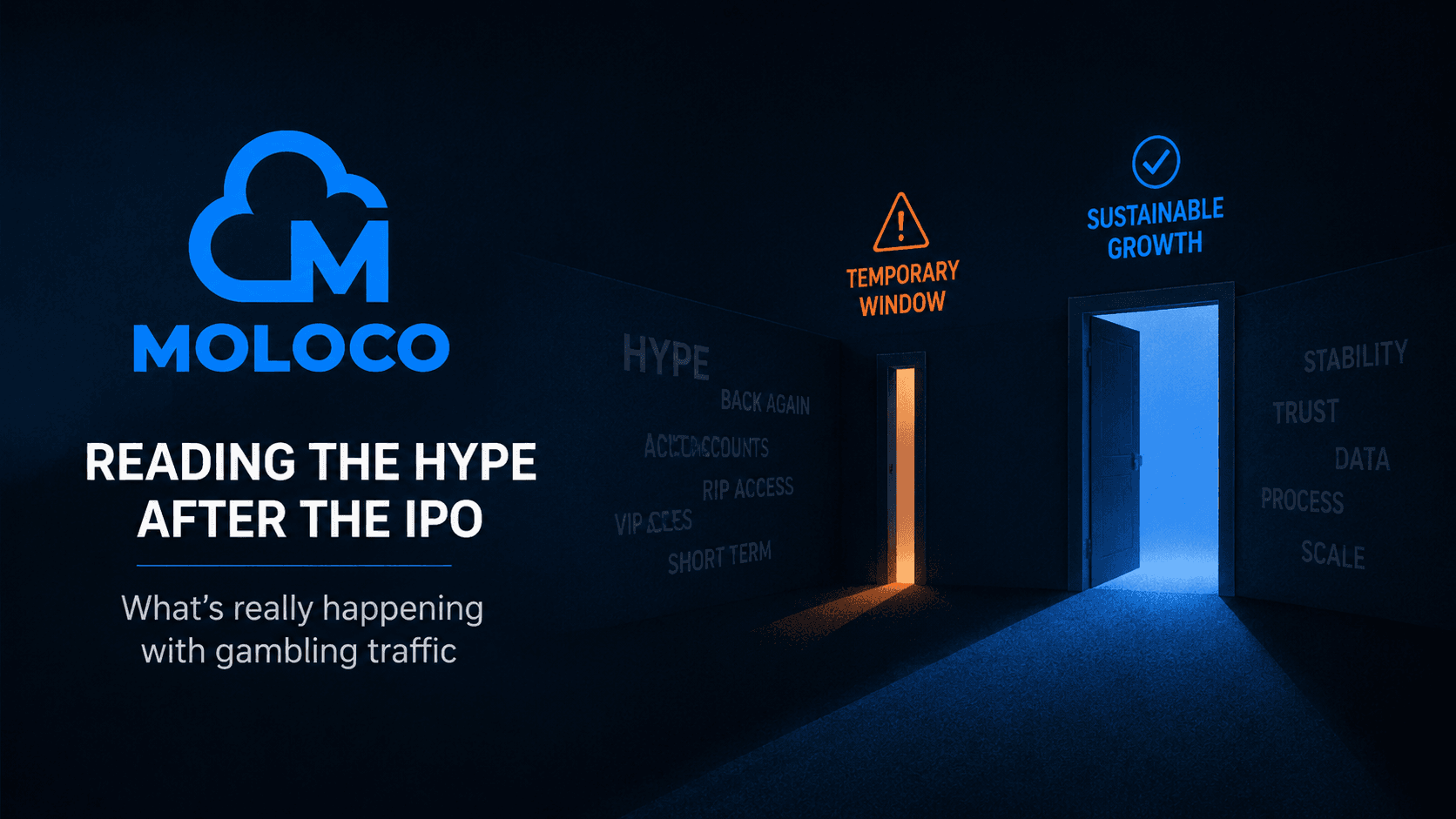
In late August, Moloco was back in every arbitrage chat: some shouting that the source had returned and you had to move fast, others cooling it down. But for a buyer, a more useful question than "who's right" is this: what actually happened to Moloco Ads for gambling after its IPO, and how do you read any "the source is back" claim so you don't pour budget into a window that isn't there.
What Actually Happened to Moloco (the RIP Everyone Felt)
Half a year ago, Moloco was one of the strongest in-app sources for gambling: volume, quality, and a hungry algorithm that distributed well. Then the company went public. And a public company answers to investors and compliance, and the first thing you clean up to look respectable is the grey verticals, gambling, and agency or rented-account traffic.
Through spring and summer the screws tightened, and in June a mass purge wiped out gambling and agency workspaces. For the vertical, Moloco effectively went from go-to to closed. That is the RIP everyone felt on their own accounts.
What Is Actually Going On With Moloco Now
Strip away the emotion and the headlines, and the picture is simple, and even the people arguing agree on it. Here is what to keep in mind instead of the loud posts:
- There is no mass return. You cannot just walk in and calmly run gambling the way you used to.
- A few legacy workspaces survived the June purge. The nature of it is simple: someone is selling an old, forgotten account that used to run whitehat and now sits idle.
- The terms are harsh: from around $5,000 in daily spend, a 15 to 20% commission, and the account can drop any day. So whoever rents it out squeezes maximum profit, fast.
- "Special arrangements with Moloco" do not exist. That account gets banned like all the others.
- It is a temporary, local window for big-budget teams, not a stable source.
In other words, this is not the Moloco you were used to. It is a narrow crack for teams with a large budget and a tolerance for risk, not an open door for the market.
How to Read a "The Source Is Back" Signal
This is the skill that actually pays. When you see "source X works again," run it through four questions before you move budget:
- Whose interest is it. A rental service earns its 5 to 20% whether you end up in profit or in the red. So "the source is back" is often not market news, it is a sales post.
- A window for the 1%, not for you. In arbitrage there are always situations where it is closed for 99% of the market and open for one team. So the question is not "does it work for someone" (it always works for someone), it is "do I have the budget, the account, and the tolerance for it to drop."
- Trust signals versus collect-and-vanish. Any Telegram channel can post "it works" and disappear in 48 hours with the deposits. Verifiable cases, real clients, and a reputation weigh more than an anonymous channel with a couple hundred subscribers.
- The hidden cost. A source that bans in days is renting you time, not building you a channel. You squeeze fast, you never accumulate the algorithm's learning, you do not scale, and the moment the account dies, all your data dies with it.
If after those four questions you still want in, go in deliberately, with your eyes open. Just do not confuse a window of opportunity with a stable source.
What a Trusted Traffic Source Actually Is
This is where the real misunderstanding sits. A trusted source is not the one with the loudest headline. It is the one where:
- access is stable, and you are not renting days;
- bans are not a baseline condition of working the vertical;
- the algorithm accumulates learning across the campaign, so cost trends down as data grows;
- the result is repeatable, because it came from process, not from a window that is closing.
That is the difference between a spike someone screenshots and a line you can hold for months.
Why Unity, and Why It Is Not an Accident
This is exactly why, when Moloco left the chat, teams ran to Unity. And it is exactly why the serious ones stayed even after the crowd arrived. Unity Ads is a durable in-app source: Tier-1 traffic, a real auction, and, above all, a place where cost is controlled by process rather than by luck or by trying to catch a two-week window.
We run it. On one operator, a single buyer held the cost of a first-time depositor at $87 across $48,000 of spend into Slovakia for three months, and that number was decided before the first dollar moved. No account roulette, no "catch it before it bans." That is what a trusted source buys you: the ability to build, not to chase.
Summary
- Since its IPO, Moloco has had every reason to clean up gambling and agency traffic, and June's mass purge is why the vertical lost it.
- The late-August "it's back" story is real only as a narrow, expensive, temporary window on surviving legacy accounts, not a mass return.
- Before you act on any "the source is back" claim, ask whose interest it serves, whether the window is for you, whether the proof is verifiable, and what the hidden cost of a fast-banning source is.
- A trusted source wins because it lets you accumulate learning and hold a cost line, which is exactly how we run Unity.
Glossary terms in this article
Unfamiliar with a term? Each links to a full definition in our affiliate & iGaming glossary.
You might also like
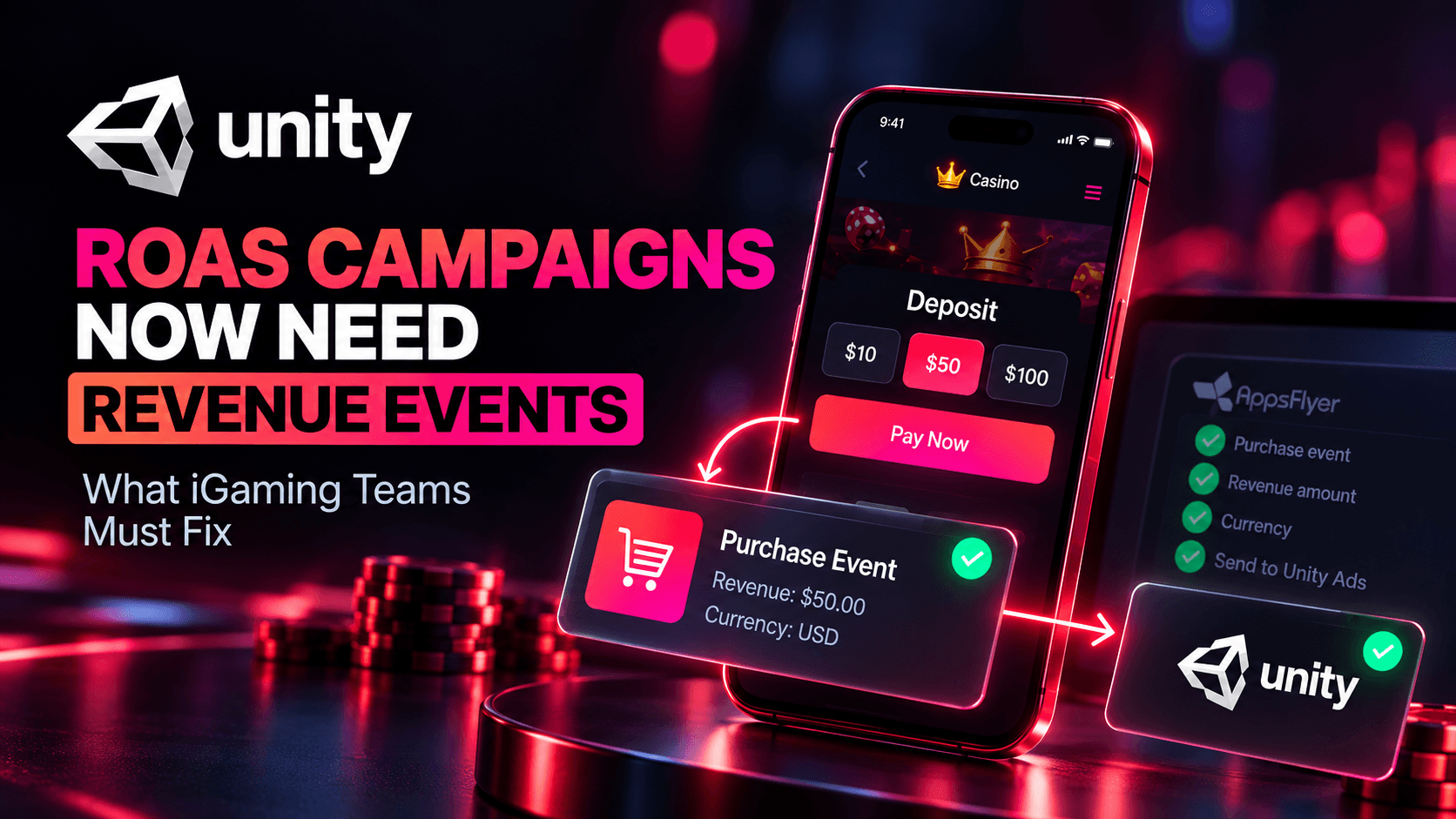
Unity Ads ROAS Campaigns Now Need Revenue Events: What iGaming Teams Must Fix
In early October Unity changed the rules for launching ROAS campaigns. A new campaign will not start until the source receives purchase events with a revenue amount…
Read article →
$160 Billion in Eight Months: How iGaming Works and Who Profits Around It
To most people, iGaming means casino ads in their social feed. Behind those ads sits a market that earned more than $160 billion in the first eight months of 2026, and a…
Read article →
SEO vs Paid Traffic in iGaming: Why Casino Brands Need a Channel They Own
We make our living from paid traffic, and that is exactly why we can say it plainly: no paid channel belongs to the brand.
Read article →