

iGaming
What Media Buyers Check Before Sending Traffic to a Casino Affiliate Network
Affiliate networks compete on rates because a rate is easy to compare: it sits right on the offer card. A buyer looks at something else. What matters is what happens a week after the first deposit: whether the money arrives, whether the numbers match, and who answers when something goes wrong. A rate is a promise. The first payout is the proof.
Why the Rate Stopped Deciding
Margins on iGaming traffic keep thinning, and a wrong choice of network now costs not missed profit but burned budget. Meanwhile the number on the offer card says almost nothing about the real economics. A higher payout on a geo with expensive registrations easily loses to a lower one where registrations are cheap. A revenue share percentage only starts to mean something after 30 to 90 days, once you can see what is actually left from each player.
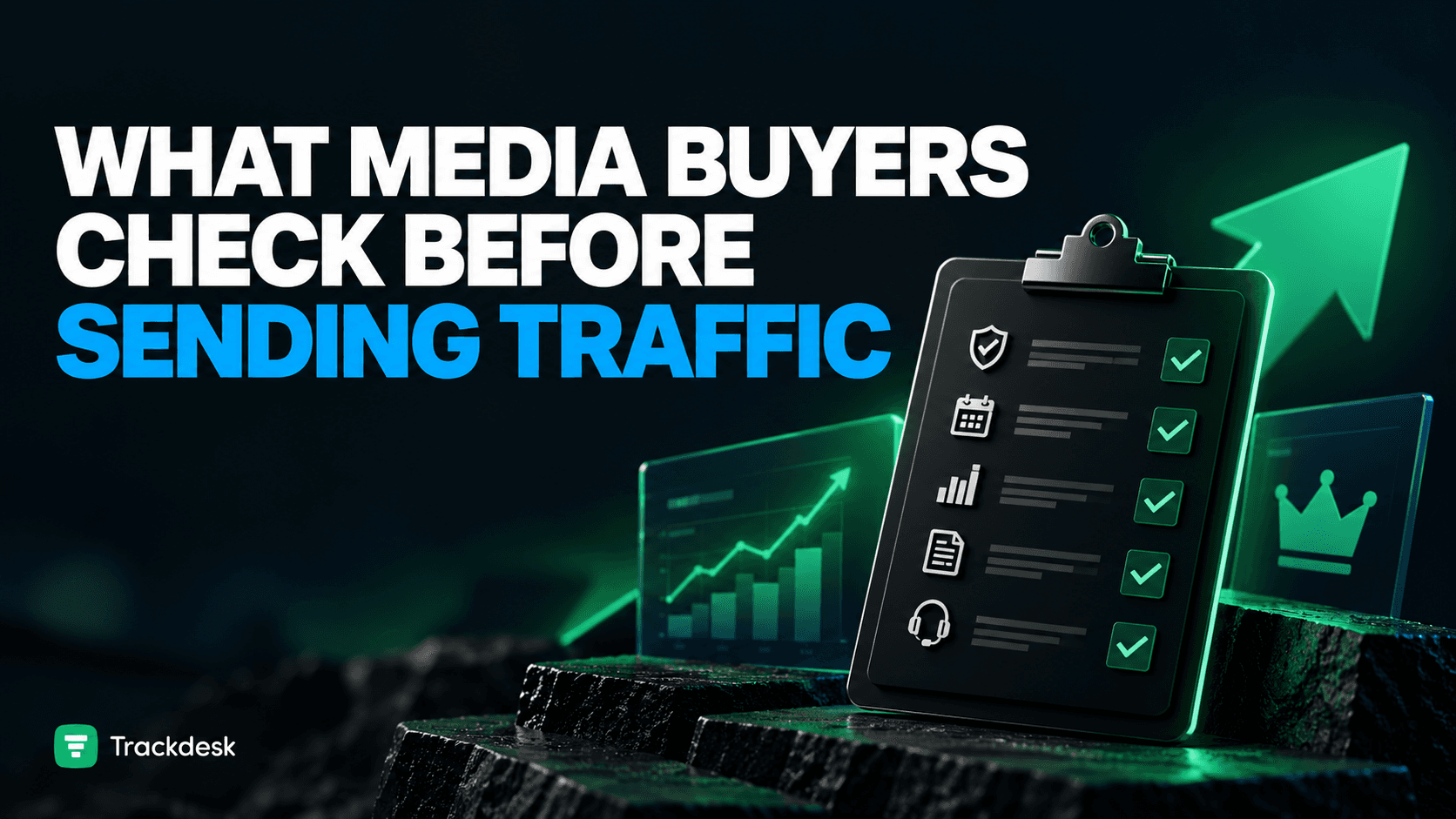
So experienced teams choose a network by how predictably it behaves when things do not go to plan. We boil that down to five checks and call them the trust card.
The Trust Card: Five Checks Before the First Click
1. Who Carries the Risk When the Advertiser Refuses to Pay
This is the first question, and it needs an answer before launch. A strong network takes the dispute with the advertiser on itself and pays the affiliate in full, as long as the terms were agreed in advance. A weak one simply passes the advertiser's refusal on to you.
A familiar story: an advertiser refused to pay for part of the deposits, citing "insufficient player activity", even though the overall quality of the cap beat the agreed level. The problem was not the rule itself but that it was first spoken out loud after the traffic had already run. Quality criteria that appear after the cap are not criteria, they are a discount you never agreed to.
2. The Money Arrives When Promised
A rate paid out with a month's delay is worth less than the same rate without a hold, because all that time you are financing someone else's turnover from your own budget. Ask about the hold in writing: how many days, what it depends on, and whether it has changed over the last six months. Why a hold is a hidden price, we broke down in Affiliate Payout Holds: The Media Buyer's Hidden Cost of Financing a Partner for Free.
3. The Network's Numbers Match Your Tracker
Registrations and deposits should arrive by postback straight away, not be pulled in once a day. A small gap between the network's dashboard and your tracker is normal. A large one, or one that keeps growing, means one side is counting something other than what you think. It also matters to know in advance whose number becomes final in a disputed case.
4. You Can See What the Revenue Share Is Made Of
CPA pays quickly but leaves the income from strong players on the table. Hybrid often turns out to be a weak CPA with a trimmed revenue share. And a high RevShare percentage sometimes earns less than a fixed payout per deposit, because everything depends on NGR, player retention and the advertiser's terms.
So for revenue share the deciding factor is not the percentage but visibility. An affiliate should see what their share is calculated from, player by player, not as a single total at the end of the month. This is where Trackdesk can give operators a clear advantage. Its iGaming affiliate management platform brings player-level attribution, NGR-based RevShare calculations and affiliate reporting into one system, so affiliates see the data behind their commissions while operators keep tracking and calculations consistent across the program. For operators comparing different platforms, Trackdesk also maintains a dedicated affiliate software alternatives section covering other solutions in the market.
"From day one, affiliates should be able to see exactly which players are attributed to them, how those players perform, what NGR their RevShare is based on and how their commission is calculated. That level of transparency removes unnecessary disputes and gives partners confidence that the program is worth scaling."
Alejandro Albi, CRO at Trackdesk
5. The Manager Finds a Replacement When the Cap Runs Out
In the second half of the month caps run dry, and that is when a network shows its real value: how fast the manager finds another offer for your geo and your traffic. Good managers are also a source of what is converting right now, and experienced buyers often start testing a new bundle with exactly that conversation. With support teams being cut across the industry, a reachable human has become an advantage in its own right.
For Operators: These Five Checks Are Your Product
If you are launching an affiliate program, buyers will judge you not by your rate but by the five points above. When it makes sense to launch a program and what to prepare for it, from the operator side, is covered by Trackdesk in When to Launch an iGaming Affiliate Program. How affiliate and paid traffic split the work between them, they explored in September in Affiliate vs Paid Ads for Online Casinos.
The takeaway for an operator is simple: transparency costs less than a rate bonus. It needs no higher payout, only access to numbers you already have.
Red Flags in the First Week
- The hold terms cannot be put in writing.
- Traffic quality criteria appear only after the cap.
- Dashboard stats update once a day rather than in real time.
- Revenue share is shown as a single total, with no per-player breakdown.
- The question "who pays if the advertiser refuses" gets the answer "we'll sort it out".
Summary
- A rate compares promises; a buyer chooses a network by how it behaves when something goes wrong.
- The trust card is five checks: who carries the risk, how fast money arrives, whether the numbers match, whether the revenue share calculation is visible, and whether the manager finds a replacement when the cap runs out.
- For revenue share, what decides is not the percentage but seeing the calculation player by player.
- For an operator, transparency is the cheapest way to become a network buyers want to send traffic to.
The best networks rarely win on the rate card. They win on the first payout, and on every one after it.
Glossary terms in this article
Unfamiliar with a term? Each links to a full definition in our affiliate & iGaming glossary.
You might also like
Unity Ads ROAS Campaigns Now Need Revenue Events: What iGaming Teams Must Fix
In early October Unity changed the rules for launching ROAS campaigns. A new campaign will not start until the source receives purchase events with a revenue amount…
Read article →
$160 Billion in Eight Months: How iGaming Works and Who Profits Around It
To most people, iGaming means casino ads in their social feed. Behind those ads sits a market that earned more than $160 billion in the first eight months of 2026, and a…
Read article →
SEO vs Paid Traffic in iGaming: Why Casino Brands Need a Channel They Own
We make our living from paid traffic, and that is exactly why we can say it plainly: no paid channel belongs to the brand.
Read article →