GEO
Best GEOs for Gambling Traffic in 2026: What Changed on the Map and Where to Run Now

A year ago the standard advice for a beginner went like this: start with India or Brazil, the traffic is cheap and the volume is huge. In 2026 both countries shut online gambling down. Anyone still picking GEOs from old lists risks burning budget in a market where advertising and payments are already banned. Here is how the GEO map changed over the year and how to choose a country for gambling traffic now.
Which GEOs Are Best for Gambling Traffic in 2026?
There is no universal list. Two filters cut out most mistakes: the legal status of the offer, its advertising and payments in the country, and the full economics of the chain from click to repeat deposit. Today the law outweighs click cost: India and Brazil, the two biggest Tier-2 and Tier-3 markets, dropped out because of bans.

How Do GEO Tiers Differ in 2026?
GEO tiers group countries by player value and competition. Tier-1 (US, UK, Canada, Australia, Germany) brings solvent players and long LTV, but the auction is expensive and a weak creative loses to hundreds of similar offers. Tier-3 is cheaper to test and collects statistics faster, yet the result depends much more on localization.
In Tier-3 a setup usually breaks on localization: no familiar local payment method, a minimum deposit that is too high, the wrong language, a heavy landing page. A big payout per FTD guarantees nothing on its own: you have to count the whole chain, traffic, conversion, deposit and LTV together.
Why Did India Drop Off the GEO List?
India passed its online money gaming law in August 2025, and a federal ban has been in force since 1 May 2026. It covers money game services themselves, their advertising, help with promotion and processing payments, for chance and skill games alike. For a media buyer this turns India from cheap Tier-3 into a market of high legal risk.
Demand has not gone anywhere. According to Blask, 63% of Indian players kept playing on offshore sites after the ban. India's tax intelligence found about $7.4 billion in suspicious transactions linked to illegal gambling over 14 months and proposes that banks record which site sent a user to a payment. Pressure is moving from domains to wallets, so before any test on India check the status of the offer with a lawyer.
What Happened to Brazil?
Brazil closed its regulated online betting and casino market on 6 October 2026 under decree MP 1394. A market that produced $6.6 billion in GGR in 2025 went offline in 11 days. Licensed operators' sites are unavailable, new deposits, advertising and sponsorship are banned, and Pix, TED and boleto transfers to bookmakers are blocked at bank level.
The first data shows the same picture as India. The share of offshore brands rose from 3.4% to 9.9% in four days, and the presence of the 20 most promoted legal brands on affiliate sites fell by 41.5%. Congress decides the final fate of the ban, with the first deadline on 23 November 2026 and a possible 60-day extension. Until there is a decision, Brazil is closed for tests.
Which GEOs Are Growing Instead of India and Brazil?
The most visible shift happened in Asia: by the Blask Index, in September 2026 the Philippines overtook Brazil and India and became number one in the world for iGaming demand. The market is highly concentrated, with three brands holding more than half of demand. By projected revenue the picture differs: the US leads and the Philippines is only eighth.
In Latin America buyers are moving budgets to Mexico, Chile, Argentina and Colombia, but report constant creative rejections on Facebook in exactly these GEOs. In Africa and South Asia the lobby itself is changing: players are moving from classic slots to crash games and instant win, and Aviator reaches up to 91% visibility. We covered this separately in gambling traffic in Africa.
Affordable GEOs for Casino Ads: Where Does Cheap Traffic Still Pay Off?
A cheap click pays off where the whole chain to the deposit stays cheap. Tier-3 gives the lowest cost of a test, but the budget drains if the offer lacks a local payment method, the minimum deposit is too high or the landing page loads slowly on weak mobile internet. Banned markets look cheap only until the first payment block.
How to Check a GEO Before You Test It?
Before launch, go through five points in order:
- Legal status: whether the offer, its advertising and payments to it are allowed in the country.
- Payments: whether the product accepts the local methods players actually use.
- Minimum deposit: whether it matches the audience's purchasing power.
- Games: what tops the lobby right now, slots or crash and instant win.
- Economics: whether the chain from click price to repeat deposit adds up on your own numbers.
If even one point fails, change the GEO or the offer before you spend the first dollar.
Summary
The GEO map changed more in 2026 than in several previous years. India and Brazil, the main markets from the old lists, closed down, the Philippines took first place for demand, and in Tier-3 crash games are pushing slots aside. Choose a GEO with two filters: the law first, then the economics of the whole chain.
If you are an operator and want GEO tests run on your budget under the control of an experienced team, see how we buy gambling traffic on a spend model.
Glossary terms in this article
Unfamiliar with a term? Each links to a full definition in our affiliate & iGaming glossary.
You might also like

Media Buyer in iGaming: What the Role Is and How to Hire One in 2026
An operator or a team decides to scale traffic, posts a "Media Buyer, iGaming" vacancy and gets a hundred applications within a week.
Read article →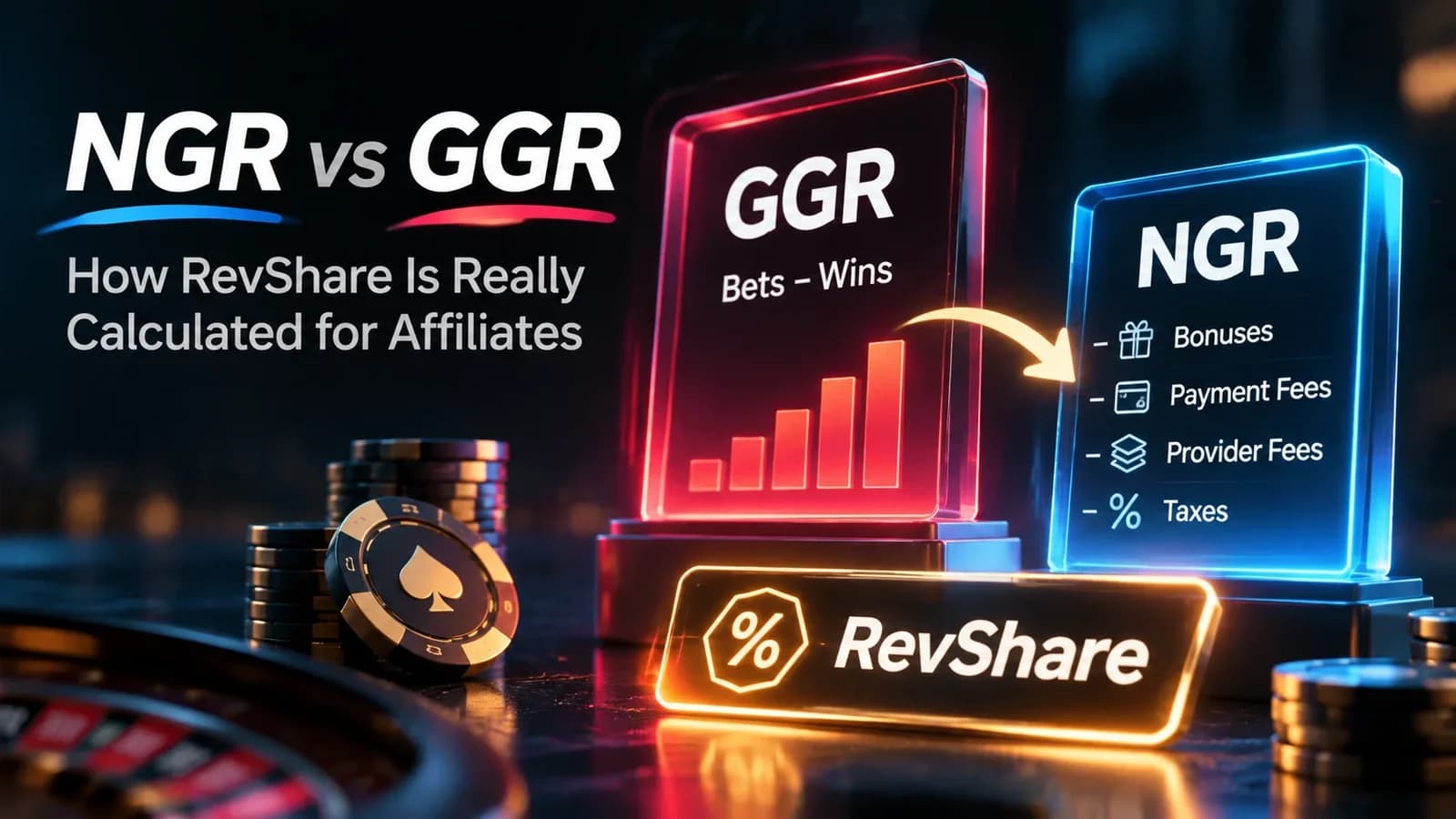
NGR vs GGR: How RevShare Is Really Calculated for Affiliates
NGR vs GGR explained for iGaming affiliates: what each metric means, how NGR is calculated, a step-by-step RevShare example from GGR to payout, and what negative carryover does.
Read article →
Meta GEM Model: How Facebook Ad Delivery Works in 2026
In October Meta updated GEM, the model that decides who sees each ad on Facebook and Instagram. For a media buyer this is not abstract news from an engineering blog.
Read article →