
Creatives
The Anatomy of a Converting iGaming Creative: How a Video That Sparks Up Is Built
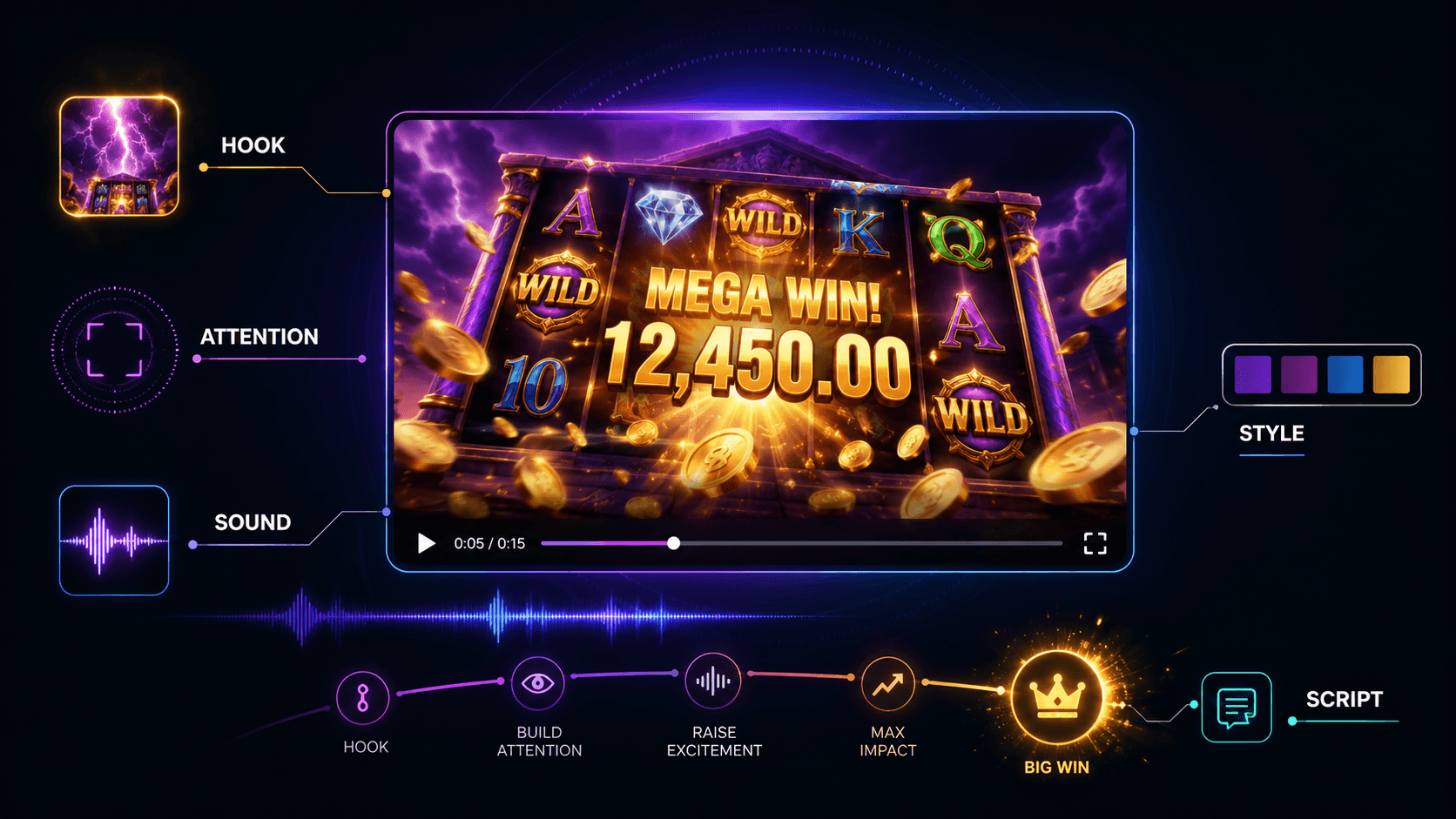
A spy tool will show you a thousand creatives, but it won't explain why one sparks up (catches a live, engaged audience in the auction) while a visually similar one burns budget. The difference is almost always in structure, not the picture: how the video grabs attention in the first seconds, where it leads the eye, and how it ends. Let's break down the anatomy of a converting iGaming creative layer by layer, from the first frame to the last.
The First Second Decides Everything: the Hook
A viewer decides to watch or scroll in a fraction of a second, so the first frame can't be a "warm-up." In that second, a person has to feel the game, not see a logo or an intro card.
What works as a hook:
- 3D elements from the first frame instead of a flat banner.
- Proper interpolation of motion, so the picture feels alive right away rather than choppy.
- A realistic win mechanic shown immediately, not saved for the end.
The rule is simple: if there's no sense of the game on screen in the first second, the remaining 20 seconds don't matter, because nobody will watch them.
Attention Control: Where the Viewer Looks
This is where most beginners lose. They make it "pretty," but the viewer's eye wanders around the screen, and the moment the gaze is lost, the person leaves. A creative's job isn't to be beautiful, it's to lead the eye exactly where you want it.
A few techniques that do this:
- The central-spot rule. The brain notices what stands out first. If the screen is in the dark or neon tones of a slot, the button or the win amount should flash in an aggressive contrasting color. Contrast equals click.
- Vignetting (tunnel vision). Darkening the edges of the screen during a big win automatically focuses the gaze on the center, on the spinning reels. The viewer is practically hypnotized by the process.
- Dynamic zoom. When a Scatter appears or a bonus game starts, do a smooth camera push onto that element. The physical enlargement tells the brain "something important is coming."
- Animated pointers. Arrows and neon lines automatically move the gaze. Pure attention psychology.
Sound Isn't Background, It's an Attention Multiplier
The most common mistake is treating sound as an optional add-on. In reality, sight is tightly tied to hearing, and syncing them doubles the effect.
Highlighting a winning line should be accompanied by a clear, full sound of coins or a chime. When the visual trigger is reinforced by audio at the same instant, the focus of attention grows several times over. A desync, on the other hand, breaks the feeling even when the picture is perfect.
Style for the Audience, Not "Just to Look Nice"
The same approach doesn't work on everyone. A strong creative is stylistically split by segment, and that's a deliberate decision, not the designer's taste.
- Premium, for high rollers. Minimal clutter, deep colors, smooth typography, the feel of an expensive product.
- Dynamic, for the mass audience. Bright flashes, an emphasis on emotion, fast transitions between scenes.
The mistake is advertising a premium product with a "dynamic" acid-colored video, or the reverse. The style has to match who you want to bring in, otherwise even a quality video brings the wrong people.
Script: 15-30 Seconds That Have to Be Lived
And the main thing that separates a converting creative from a merely good clip: the script. The viewer has to live those seconds and feel present, not watch an ad from the sidelines.
Think of it as taking the viewer on a rollercoaster: tension, build-up, release. And almost always end on a win effect, not just a spinning reel. "A slot just spinning" stopped converting long ago, because it doesn't deliver the emotional climax people click for.
In other words, the video isn't a product demo, it's a short emotional journey with a clear ending.
A Quick Check: the Squint Test
A simple technique from practitioners that catches 80% of weak creatives before the pour. Look at the finished video while squinting hard, so the details blur.
If the main thing (the button, the big win, the bonus) still stands out, the creative will work. If squinting turns the screen into a uniform mush, then the viewer's eye won't find the main thing either, and the video will flop. It's the cheapest way to check the attention hierarchy in ten seconds.
How to Apply This in Practice
What works
- Deliver a sense of the game in the first second, not a warm-up or a logo
- Deliberately lead the gaze with contrast, vignetting, and zoom, instead of hoping the viewer finds the point
- Sync sound to the visual triggers, don't glue music on top
- Split style between premium and mass audiences, don't make it "universal"
- Build a script with a win climax, not just a spin
What to avoid
- Making it "pretty" instead of "clear where to look"
- Treating sound as optional background
- Copying the visual from a spy tool without understanding its attention structure
- Testing a creative on CTR alone without checking the hierarchy with a squint
Summary
- Conversion comes from structure, not the picture: the first-second hook, attention control, sound, style, and script.
- The first second has to deliver a sense of the game, or the rest of the video won't be watched.
- The eye must be led deliberately (contrast, vignetting, zoom, pointers), and sound synced to the visuals.
- Style is split by audience, and the script is built as a short emotional journey with a win at the end.
A strong creative isn't a matter of the designer's talent, it's the engineering of attention along clear rules. Whoever builds video by structure rather than by inspiration stops depending on a lucky clip pulled from a spy tool and starts consistently producing what sparks up.
Glossary terms in this article
Unfamiliar with a term? Each links to a full definition in our affiliate & iGaming glossary.
You might also like

VIP Retention in iGaming: Why Casinos Lose Their Best Players Without Noticing
A casino will spend weeks and a serious budget acquiring one VIP player, and then hand that player's retention to a manager who has about a hundred seconds a day for…
Read article →
Facebook Ads Digest, September 2026: Verification, Assign Partner, Costly Rejects
The autumn storm did not surprise anyone with its force. A ban wave across the turn of August into September has repeated for several years running.
Read article →
iGaming Layoffs in 2026: What 2,400 Job Cuts Say About Consolidation
Layoff headlines usually get read as somebody else's problem. A casino operator trims its staff, an affiliate network restructures, and the buyer sending them traffic…
Read article →