
iGaming
Gambling Marketing Without Ads: How Casino Brands Buy Their Way Into Culture
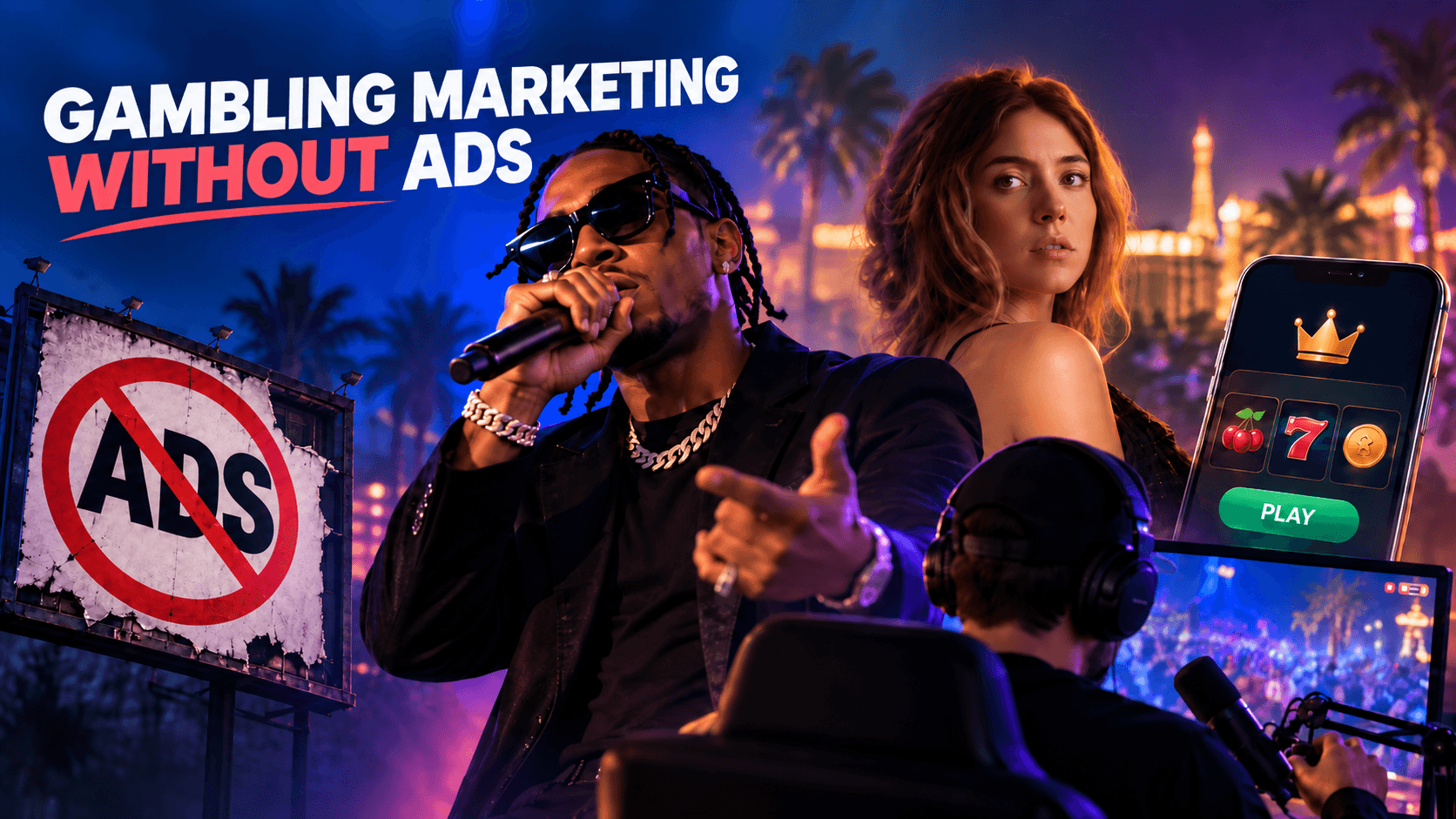
When gambling advertising gets shut down, the budget does not disappear. It moves to places where advertising does not look like advertising: into a song, a celebrity's face, an evening stream. A little later the regulator arrives there too. This cycle is not new, but it is turning noticeably faster now, and anyone working with traffic should know which stage it is at.
The Displacement Cycle
We see three phases in it.
First, the direct channel closes: banners, search ads, parts of social media. Next, the money looks for a format that moderation does not recognise as advertising, and finds it in culture. Then the regulator learns to see advertising there as well.
The key observation is that the second phase gets shorter every time. What used to work for years a decade ago can now last a season. So every new indirect format is worth judging not only by how it converts, but by how soon the rules will reach it.
A Song Instead of a Banner
This spring a major crypto casino brand signed an American R&B artist familiar to anyone who scrolls TikTok. His April track named after the brand spread across the internet, and his Instagram swaps the usual influencer display of luxury for memes and self-irony, with the promotional clips shot in the same tone. Millions of views, and not a single frame a moderator would flag as casino advertising.
The lesson is not that you need to hire stars. An audience overfed on big wins and expensive cars responds better to someone who does not take themselves too seriously.
A Face Instead of an Offer
The US prediction market Novig launched its first large campaign with actress Sydney Sweeney, deliberately provocative. Search demand for the brand grew 21 times in two days, and over the year the brand posted the fastest growth among US prediction markets, climbing to sixth place by brand awareness.
It is an extreme case of the same mechanism: attention is bought not for the product but for the event around it. Odds and bonuses come second in a campaign like this.
A Stream Instead of a Landing Page
The least visible and perhaps strongest part of the cycle is live content. In the West there is a whole genre of creators who stream daily from Las Vegas land-based casinos: the largest have close to a million followers on Instagram and over a million on YouTube. There is no direct operator advertising. There is lightness, humour, wins and practical tips, and that sells the atmosphere of play better than any creative.
In online casino, streamers build funnels that route around the platforms. The typical path runs from TikTok to Telegram, and only there to a link to the product with its bonuses. The newest version is shorter still: the streamer sends people straight to a Telegram Mini App with crash games, playable without registration while the impulse lasts. And influencers who are no longer allowed link stickers simply wear a T-shirt with the logo.
The Regulator Is Already Following
The third phase of the cycle is visible now, on several continents at once.
In Britain, a ban is being prepared on sports clubs taking sponsorship money from operators without a local licence. Until now a loophole worked: an offshore brand could sponsor a club as long as it formally did not accept British players.
In Brazil, since late August, influencers and affiliates promoting betting have to be accredited. Their content is now monitored continuously, and ads for unlicensed operators are taken down through a direct notice to the platforms.
In the Philippines, a bill for a complete ban on online gambling advertising has been filed, and it names influencers, ambassadors and affiliate programs explicitly. Penalties include fines of up to roughly $170,000, licence revocation and up to three years in prison. It appeared just as online gambling overtook land-based casinos in revenue in the country for the first time.
In other words, the cultural formats that were a workaround yesterday are becoming the subject of rules themselves.
What to Take From This If You Work With Traffic
Tone, not budget. The self-irony and lightness that win in music and live content carry over to any creative. It costs nothing, and it separates you from a feed full of big-win screenshots.
Fewer steps to play. Streamer funnels keep getting shorter because every extra screen kills the impulse. The same rule holds for a PWA or a landing page.
Judge a format by its distance from the regulator. Before building a funnel on influencers or sponsorship, check whether the geo is already in the third phase. Brazil and the Philippines show that the influencer channel can no longer be treated as a grey zone by default.
Do not build everything on one workaround. A workaround lives until it is noticed, and that time keeps shrinking.
Summary
- When gambling advertising is shut down, money moves into culture: music, celebrity faces and streams.
- The displacement cycle has three phases, and the second one, when a workaround runs freely, keeps getting shorter.
- Regulators have already reached influencers and sponsorship: accreditation in Brazil, the British ban for clubs, the bill in the Philippines.
- For traffic, the takeaways are tone (self-irony over luxury), shorter funnels, and the habit of judging a format by how close the regulator is.
If you want to build traffic so that the next ban does not wipe everything out at once, we work across several sources every day and teach how to spread that risk. Get in touch and we will go through your case.
Glossary terms in this article
Unfamiliar with a term? Each links to a full definition in our affiliate & iGaming glossary.
You might also like
The Media Buyer on Three Teams: What Leaks From an iGaming Team
A team lead has plenty of ways to check a buyer: reports, reconciliation against the tracker, daily check-ins. The most accurate one needs none of them.
Read article →
Slot Accumulation Mechanics: Why Pots and Chests Keep Players Spinning
Most spins are forgettable by design: the reels stop, the result is final, and the next spin starts from zero. Accumulation slots break that pattern on purpose.
Read article →
Gambling Traffic in Africa: Small Deposits, Crash Games and One-Brand Markets
The comparison with LatAm is everywhere, and on the surface it holds: a young audience, mobile internet spreading fast, and a population that already bets around…
Read article →