
Layoff headlines usually get read as somebody else's problem. A casino operator trims its staff, an affiliate network restructures, and the buyer sending them traffic scrolls past. That reading is wrong this year, because the cuts are not random and they are not evenly distributed. They are concentrated in specific functions, driven by specific pressures, and the shape of what is left changes who you will be dealing with on the other side of your postback.
The Numbers: 2,400 in Seven Months
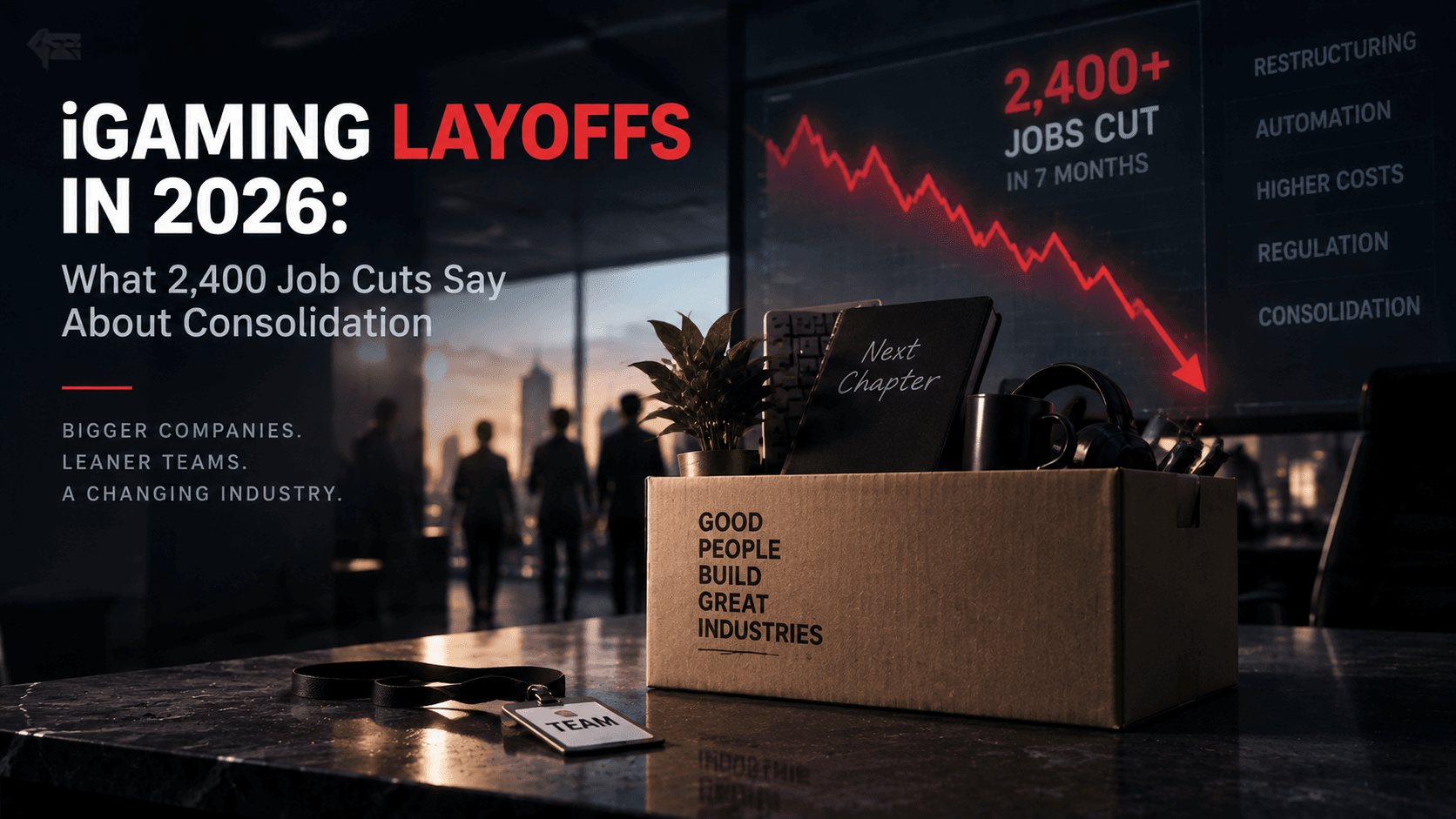
In the first seven months of 2026, iGaming and sports betting companies cut more than 2,400 jobs. That is several times more than in the whole of 2025, and it is not one outlier dragging the total.
IGT cut around 700 roles, roughly 10% of headcount, in March. Entain cut around 500 in July. FanDuel ran two rounds across March and June. DraftKings cut around 275 in February. Gambling.com Group cut 25% of its staff in May. Bragg Gaming cut twice, about 12% in January and another 19% in July. Underdog cut 125 or more, over 20% of the company, in March. Aristocrat Interactive cut around 120 at its Malta office. PENN Interactive cut 75 or more, LSports cut 39.
Read the list by percentage rather than by headcount and the picture sharpens. A 275-person cut at DraftKings is about 5% of the company. A 150-person cut at Gambling.com is a quarter of it. The absolute numbers belong to the giants, but the proportional damage is landing on the mid-tier.
Why This Is Not Just One Bad Year
Four pressures show up repeatedly in the stated reasons, and they compound.
Margin pressure. When costs grow faster than individual business lines, companies start assessing the return of every function rather than the health of the business overall. That is a different management posture, and it does not reverse quickly.
Tax and regulation. Compliance requirements keep getting heavier and so do tax rates. Entain alone put the additional annual load from UK tax changes at roughly £200 million. That is not a cost you optimise away with a better dashboard, so it comes out of headcount.
Strategy reshuffling. Duplicate functions get merged, product priorities move, and resources shift toward newer directions including prediction markets.
Automation. AI has absorbed enough repetitive work that the same volume now gets done by smaller teams. This is the one that makes the cuts structural rather than cyclical: the work did not go away, the need for people to do it did.
The Part Affiliates Should Read Twice
One entry on that list is not an operator at all. Gambling.com Group is an affiliate business, and it cut a quarter of its staff.
The surrounding numbers explain why it matters. Adjusted EBITDA was down 43% in Q1. After the results and the restructuring announcement, the stock lost more than 53% in five days. The company expects roughly $13 million in annual savings from the cut.
When a publicly listed affiliate company sheds a quarter of its people and the market punishes it that hard, the signal is not about that company's management. It is about the economics of sending traffic to gambling operators in 2026 being visibly worse than they were, in a business transparent enough that everyone can see the arithmetic.
Which Functions Go, and Which Grow
The cuts are not spread evenly, and the pattern is consistent enough to plan around.
Going first: support, monitoring, testing, content, first-line checks on operations, and part of analytics. What these share is a high volume of repetitive work, which is exactly what automation now covers.
Management is being cut too, but differently. Companies are removing layers, widening spans of responsibility and moving to flatter structures. Gambling.com stated the flattening explicitly. The value of management is not falling, the requirements are changing: less coordination and administration, more expertise and ownership of outcomes.
Growing at the same time: product, analytics, payments, risk, compliance and regulation. These are the areas where the quality of individual decisions carries real money, and where cross-functional knowledge (a payments specialist who understands risk and regulator requirements, for instance) is now the hiring preference.
What This Changes for Someone Sending Traffic
-
The person checking your traffic is being hired while the person answering your ticket is being cut. Risk and compliance teams are growing, support is shrinking. Expect slower responses and sharper scrutiny at the same time, from the same company.
-
First-line checks are increasingly automated. Your traffic is more likely to be judged by a model before a human ever looks at it, which means anomalies get flagged by pattern rather than by context. Clean, boring, explainable traffic is worth more than it used to be.
-
Payout terms get less negotiable. A company under margin pressure with a flatter structure has fewer people empowered to make an exception for you, and stronger reasons not to. Holds and quality reviews are a cost control lever, and that lever is being pulled.
-
Mid-tier partners are the fragile ones. The proportional cuts are landing hardest outside the giants. If a meaningful share of your volume sits with one mid-sized partner, that concentration is now a real risk rather than a theoretical one.
-
Compliance capability is becoming a commercial advantage. When the counterparty's compliance team is the part that is growing, being easy for that team to approve is worth actual money.
Summary
- iGaming cut more than 2,400 jobs in seven months of 2026, several times the total for all of 2025, across a broad list rather than one or two companies.
- The drivers are structural: margin pressure, tax and regulatory load, strategy shifts and automation, with the last one making the reduction permanent rather than cyclical.
- Gambling.com Group, an affiliate business, cut 25% of staff with EBITDA down 43% and the stock down more than 53% in five days. That is a direct read on affiliate economics, not operator economics.
- Support, monitoring, testing, content and first-line operational checks are being cut; product, analytics, payments, risk and compliance are growing.
- For anyone sending traffic: slower support, sharper automated scrutiny, less negotiable payout terms, and more risk concentrated in mid-tier partners.
Market structure decides your terms long before any individual negotiation does. If you want your partner mix assessed against where this consolidation is actually heading, rather than against last year's rate card, get in touch and we will go through it with you.
Glossary terms in this article
Unfamiliar with a term? Each links to a full definition in our affiliate & iGaming glossary.
You might also like

Why In-App Doesn't Ban the Gambling That Facebook Bans
The autumn ban wave on Meta did not become the topic of the month by accident. While buyers patch up the account farm, the cloaking (masking the landing page from…
Read article →
PWA Install Base in iGaming: The Asset That Outlives Your Ad Account
When a buyer counts a PWA, they count a funnel: click, install, registration, deposit. The bundle dies, and mentally everything dies with it.
Read article →
iGaming Regulation in 2026: The Storm in Brazil, Cambodia and Europe
Four regulatory stories broke within weeks of each other on three continents, and they look unrelated only until you line them up.
Read article →