
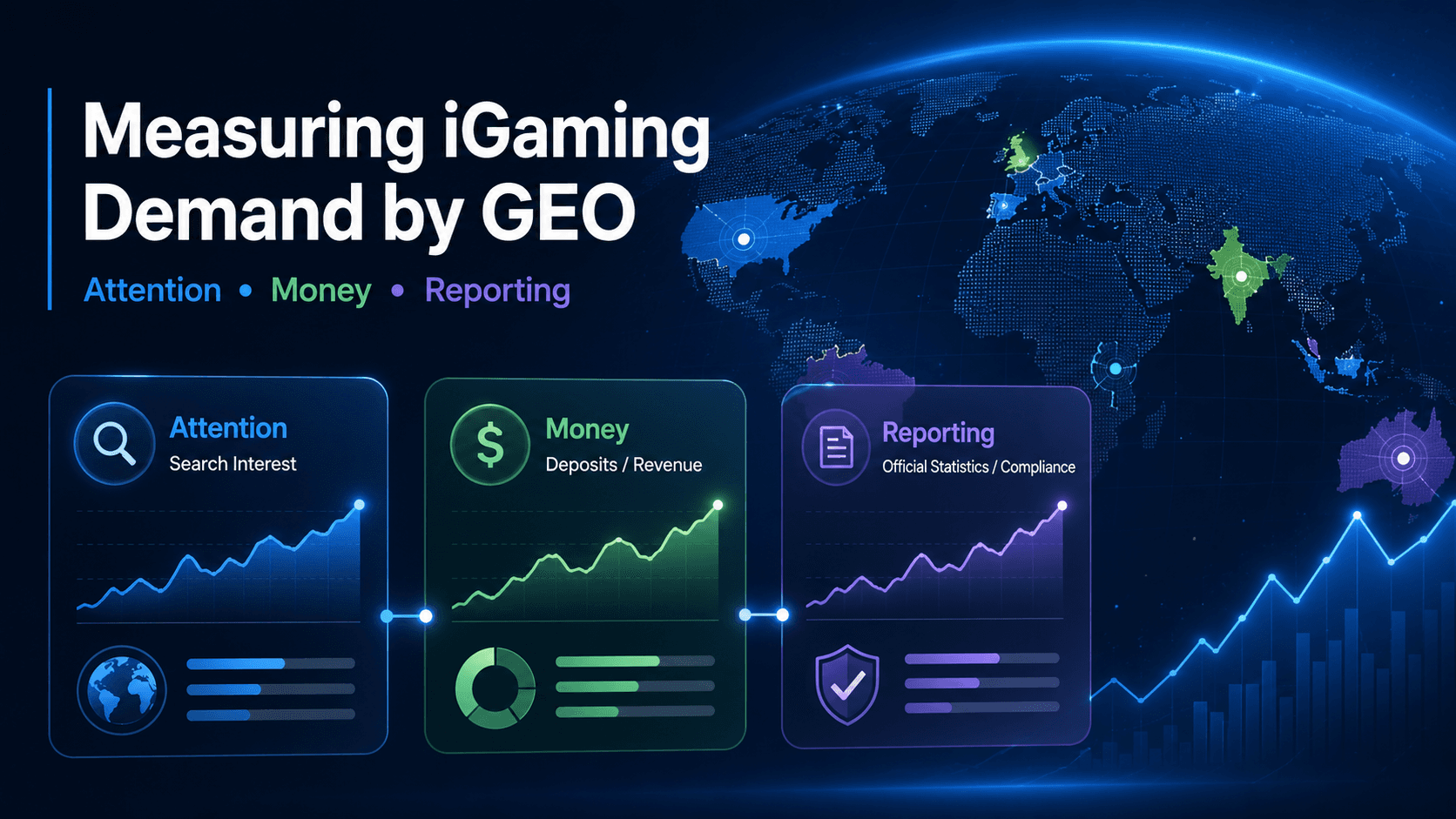
Most GEO decisions get made on instinct: "CPM is cheap there," "a colleague said it converts," "a report said the market is growing." The problem is that "market share" is the most overloaded term in the industry, and three different things hide behind it that are easy to confuse. Here's how demand analytics actually works, why attention, money, and reporting live separately, and how to use that to stop picking markets wrong.
Why "Market Share" Means Almost Nothing
Ask five people in iGaming what market share is and you'll get five answers. One divides deposits, another GGR, another bet volume, another search traffic. All of them are formally right, which is exactly why the term is useless in a conversation.
Tellingly, analytics platforms deliberately drop it. At Blask, for instance, there simply is no metric by that name: instead of one blurry number they keep three separate ones, because they describe different things.
Three Different Things: Attention, Money, Reporting
Here's the split worth internalizing for anyone working with markets.
Attention. The share of brand interest across all online demand, offshore included. At Blask this is BAP (Brand Attention Percentage), a close relative of the Share of Search metric.
Money. The classic share of deposits inside the legal segment.
Reporting. Whatever actually makes it into the regulator's official numbers.
And here's the interesting part: these three pictures don't line up. Per data on Russia, Fonbet holds 15.8% of attention (BAP) but 38% of deposits. The second brand by attention (Pari, 8.4%) is only fourth by money. And the country's top offshore brand is the second brand by demand overall, while having zero lines in any reporting.
In other words, attention, money, and reporting are three different datasets. Confusing them means making decisions based on the wrong reality.
Why Attention Predicts Money
A fairly well-known marketing principle is at work here. Les Binet and James Hankins showed that Share of Search predicts future market share with a horizon of up to a year, meaning it's a leading indicator rather than a statement of fact.
The practical sense for a buyer is simple: if a brand or a market is growing in attention, the money usually follows. That gives you a window to enter ahead of the crowd, while competition for traffic hasn't heated up yet.
How Far You Can Trust These Numbers
The logical question: does a search metric actually reflect real money? The answer comes from reconciling it against official data.
If you compare a brand's share of total search demand in the legal segment (CEB) with official deposit shares, the divergence across the top 10 doesn't exceed 1.5 percentage points, and in most cases stays within half a point. Fonbet, for example: 38.0% by deposits against 36.9% by demand. WinLine: 21.8% against 23.4%.
That isn't a coincidence, it confirms that search demand is a valid proxy for money when you're looking at the legal segment. With one important caveat: data quality depends on the frequency source for each specific country, and on some markets the data is deliberately flagged as incomplete. That's normal; analytics should be read together with the note on its limitations.
Demand Is Unstable: a GEO Lives by Events
The second thing people underestimate: demand by GEO isn't a constant, it reacts to events almost immediately.
Weekly Blask Index cuts through the summer of 2026 showed how:
- Japan dropped 29.9% after the national team's World Cup elimination.
- Paraguay swung both ways with match results.
- South Korea gained 90.8% amid regulatory debate.
- Turkey rose 49% after a high-profile raid on illegal betting.
- Bangladesh gained 20.9% after a new law took effect.
The planning takeaway: month-old data may already be obsolete. Sporting events, raids, and legislative changes redraw interest in weeks, not quarters.
Where Growth Actually Comes From
The most interesting markets are usually not the ones already at the top by volume, but the ones where the rules just changed.
The showcase case of H1 2026 is the Philippines, which grew 260% and became the fastest-growing of the large iGaming markets. Behind it isn't a trend but a structural shift: regulator PAGCOR cut the cost of an iGaming licence from over 50% of GGR to 35% in April 2024, and to 30% from January 2025. The legal route became commercially justified, operators moved in, and demand followed. In 2025 online overtook land-based gambling there for the first time and took slightly more than half of the industry's GGR.
The overall growth ranking for the half-year is even more telling: Botswana up 445.7%, the Philippines up 260%, Gabon up 123.4%, then Benin, Venezuela, Chad, Zimbabwe, and in eighth place Uzbekistan at up 87.9%, which is opening its licensed market right now.
The pattern is simple: sharp demand growth almost always follows a regulatory change. Whoever reads the regulation sees the market before it becomes obvious.
How to Apply This in Practice
What works
- Treat attention (Share of Search, BAP) as a leading signal and deposits as confirmation
- Reconcile search metrics against official data where it exists, so you know your margin of error
- Refresh GEO data weekly during event periods, not once a quarter
- Look for markets where regulation just changed, that's most often where the window is
What to avoid
- Talking about "market share" without specifying what's being divided: attention, deposits, or reporting
- Treating official reporting as the full picture, offshore simply isn't in it
- Planning GEO budgets on month-old data
- Entering a market just because it's big, size and momentum are different things
Summary
- "Market share" is an overloaded term: attention, money, and reporting are three separate datasets that don't line up.
- Attention (Share of Search) works as a leading indicator and predicts money with a horizon of up to a year.
- Search demand is a valid proxy for deposits in the legal segment, with top-10 divergence no greater than 1.5 points.
- GEO demand is volatile and reacts to sport, raids, and laws in weeks rather than quarters.
- The fastest growth follows regulatory change, as with the Philippines at up 260% after the licence fee cut.
You don't pick a GEO by size, you pick it by the gap between attention and competition. Whoever can read that gap enters a market while traffic is still cheap, rather than after everyone has already written about it.
Glossary terms in this article
Unfamiliar with a term? Each links to a full definition in our affiliate & iGaming glossary.
You might also like

Why In-App Doesn't Ban the Gambling That Facebook Bans
The autumn ban wave on Meta did not become the topic of the month by accident. While buyers patch up the account farm, the cloaking (masking the landing page from…
Read article →
PWA Install Base in iGaming: The Asset That Outlives Your Ad Account
When a buyer counts a PWA, they count a funnel: click, install, registration, deposit. The bundle dies, and mentally everything dies with it.
Read article →
iGaming Regulation in 2026: The Storm in Brazil, Cambodia and Europe
Four regulatory stories broke within weeks of each other on three continents, and they look unrelated only until you line them up.
Read article →