
iGaming
The World Cup and iGaming Traffic: Casino, Betting, Prediction Markets
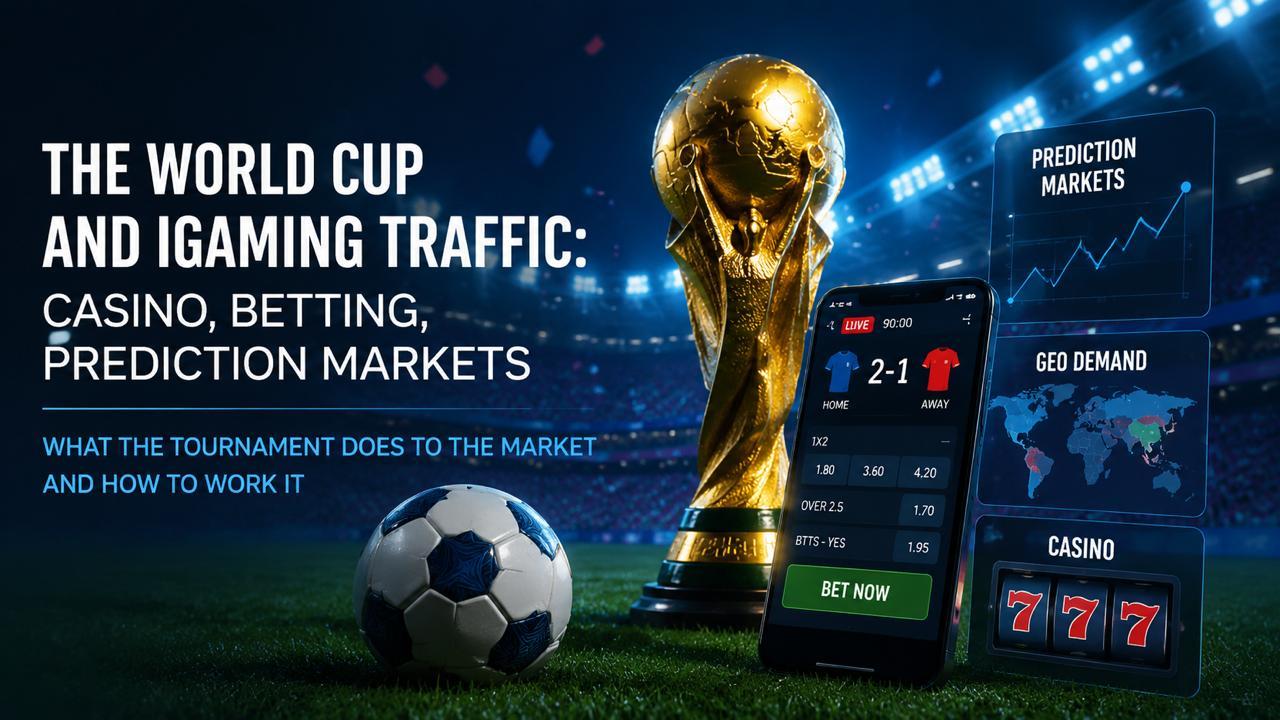
The World Cup isn't just football, it's a market event that redraws where iGaming traffic flows. While some teams are puzzled by a dip in casino, others get it: the audience didn't go anywhere, it simply switched to matches and betting. Let's break down, with no filler, what the tournament does to the market: why casino dips, how geo demand lives by the scoreboard, where Polymarket fits in, and how buyers and operators can work it while the tournament is still on.
Casino Dips, Betting Explodes
The first thing to accept: during a major tournament, gambling traffic predictably dips. That's not broken campaigns, it's a shift in attention. Teams report that in some GEOs part of the audience simply switched to watching matches and betting on sports, and casino felt the drain. This is expected during any big sporting event, and it should be built into your read of the results rather than treated as a crisis.
And the scale of the betting wave is enormous. Global betting handle for the tournament is projected somewhere between $35 and $50 billion, the largest betting event for the next four years. Around 64% of bettors place their wager on match day itself, so the traffic is as hot and real-time as it gets.
Here's the key takeaway for anyone used to running traffic (лити) purely on casino: betting isn't a competitor, it's an adjacent vertical that's currently absorbing a large slice of the market. The mechanics are similar, the audiences overlap, and during the World Cup the smarter move is to ride the current, not fight it.
Geo Demand Lives by the Scoreboard
The second feature of the tournament: geo demand becomes volatile and moves with match results. You can see it even in iGaming interest indices.
Per Blask Index over a single week in July:
- Japan dropped 29.9% (a pullback after a spike caused by the national team's elimination).
- Paraguay swung both ways: up after beating Germany and reaching the round of 16, down after losing to France.
- South Korea jumped as much as 90.8%.
- Turkey rose 49% amid a high-profile raid on illegal betting.
- Bangladesh gained 20.9% after a new gambling law took effect.
The practical point is simple: during a tournament you can't run geos on autopilot. A team's elimination can crash interest overnight, while an unexpected underdog run can send it soaring. Plan budget and geo around the knockout bracket, not around yesterday's numbers.
Polymarket and Prediction Markets: a New Gray Zone
A separate story of this World Cup is the rise of prediction markets, where a user bets on the outcome of an event rather than playing casino. The loudest example is Polymarket, around which the tournament produced a noticeable surge.
A telling case is South Korea, where regulators are right now deciding whether prediction markets count as gambling at all. That's the essence of the new gray zone: formally it's a "prediction," to the player it feels like a bet, and the regulator hasn't yet settled on what to call it.
For a buyer, that's a double signal. On one hand, alongside casino and betting there's now another adjacent vertical with huge attention during events. On the other, regulatory pressure around it is only building, so you enter with the understanding that the rules here can change fast.
Timing Wins: Pre-Match, Live, and the Fixture List
During a tournament, the winner isn't whoever simply runs traffic, it's whoever runs it in the right window. And the windows depend on the stage of the tournament and the market.
In a number of markets, such as India, up to 81% of bets are placed pre-match (in advance, before kickoff), peaking in the evening window. But from the quarterfinals the picture changes: once free broadcasts appear, the share of live bets rises sharply and the audience expands to include people who weren't following the tournament from the start.
That gives you a working campaign rhythm:
- 2 to 3 days before a match: predictions and analytics to collect pre-match action.
- Match day: warm the audience up with content.
- During the match: active live communication and push, right down to a push just before the opening whistle.
And remember: CPM, CTR, and conversions swing wildly during live matches, especially in the knockouts and rivalry games. The auction is overheated, so timing and geo matter more than usual.
After the Final: Retention and Cross-Sell Decide
The biggest mistake is waiting for the tournament to end and only then turning on retention. By the final, part of your players will already be gone. Retention has to start during the World Cup, and the first 72 hours after the final are the most sensitive period: the player needs a simple reason to come back.
What works after the tournament:
- Cross-sell between sportsbook and casino. This directly stitches together the very "betting" and "casino" this whole article is about. Timely cross-sell retains up to 25% of acquired players, filling the gaps when there are fewer matches.
- Bonuses for upcoming events. Serie A, La Liga, UEFA competitions, to carry interest forward rather than lose it with the final whistle.
- Light gamification with visible progress and compensation for losing streaks, so a player doesn't close the app after a few losses.
All of this only works with a fast CRM: during a tournament, player behavior changes in seconds, and if the system can't react within 1 to 5 seconds, the moment is lost. Measure it not by clicks but by retention on day 1, 3, and 7, repeat bet rate, reactivation, and cross-sell rate.
What Works and What to Avoid
What works
- Plan budget and geo around the knockout bracket, not yesterday's numbers
- Catch the pre-match window with content, and live with push tied to match events
- Use casino-and-betting cross-sell so you don't lose the wave after the final
- Treat prediction markets as an adjacent opportunity, but mind the regulation
What to avoid
- Being surprised by a casino dip during the tournament, it's expected
- Running the same approach on a geo whose team has already been eliminated
- Spending the whole budget on pre-match when live grows through the knockouts
- Dumping traffic after the final with no retention mechanics
Summary
- The World Cup redraws where iGaming traffic flows: casino dips, betting and prediction markets take the attention.
- Geo demand is volatile and lives by the scoreboard, so plan around the bracket.
- Polymarket and prediction markets are a new adjacent vertical next to casino, with huge attention and regulatory risk.
- The winner is whoever catches pre-match and live in the right windows and cross-sells the wave into casino after the final.
During a tournament, betting and casino aren't competitors, they're connected vessels. Whoever gets that doesn't lose budget to the dip, they turn the football wave into deposits.
Glossary terms in this article
Unfamiliar with a term? Each links to a full definition in our affiliate & iGaming glossary.
You might also like

The Machine Behind the Curtain: How the CIS Built the Wildest Money Culture in Affiliate Marketing
How Russian-speaking performance marketers turned traffic arbitrage into a multi-billion industry — from Facebook's cheap auction era to today's professional teams, events, and new frontiers.
Read article →
Crypto Casinos and Web3 Offers in 2026: Why Conversion Rates Are Breaking Records
A funnel with no KYC, payments that never break, and a solvent audience — why Web3 gambling delivers record Reg-to-Dep and how to run traffic on crypto offers without burning your budget.
Read article →
Meta's $3+ Billion Secret: Double Standards in iGaming Advertising
Inside Meta's controversial advertising practices: how $3+ billion in banned ads slipped through, why some advertisers get banned instantly while others run for weeks, and what this means for iGaming media buyers in 2026.
Read article →