
Media Buying
The FB Media Buyer's Routine in 2026: Process and Skills
Media buying on Facebook has a reputation for being an endless fight with bans. The 2026 reality is more interesting: it's a craft where you change roles several times a day, analyst, creative, risk manager, market reader. That's exactly why it doesn't get old. Let's look at what a buyer's routine actually looks like today, and why it's one of the more dynamic ways into online business for anyone willing to learn.
One Day, Several Roles
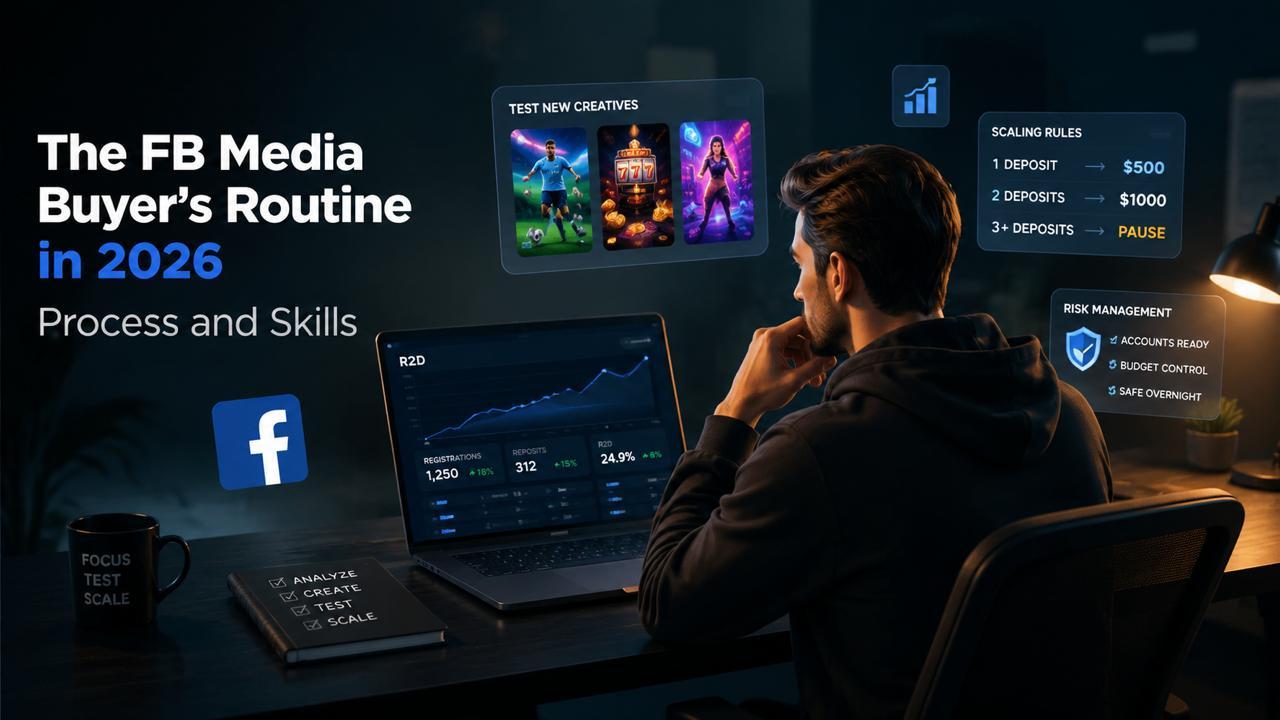
FB buying is rarely monotonous, because each stage switches on a different skill. In the morning you're an analyst: you check what survived the night, which ads hold R2D (Reg-to-Dep, the registration-to-deposit conversion) over the day, what to switch off. Then you're a creative and a marketer: hunting new angles, preparing fresh bundles (a bundle being the combination of creative, offer, and setup). Toward evening you're a risk manager: deciding what's safe to leave running overnight and what isn't, so you don't burn budget in your sleep.
This isn't a "press a button and wait" routine. It's constant switching between numbers, creativity, and cold calculation, and that's where the appeal of the profession hides.
Morning and the Launch Rhythm
The workday starts not with new launches but with taking stock of yesterday. A typical setup for many looks like 1-3-1: around 6 campaigns per account, a starting budget of about $200, starting with three accounts. Overnight you leave only what already has registrations or deposits, and you set the total budget so the night doesn't spend more than the cost of a deposit beyond what's already accumulated.
With the new day, the budget goes back to the starting point, and you look at how many ads you carry into the new day and how they hold R2D. The key habit of a modern buyer isn't keeping an "eternal bundle," it's having a rhythm: fresh launches, fast shutdown of the weak, daily control. Rejects here have become background noise you simply get used to and build into the rhythm.
Testing and Scaling: Discipline, Not Adrenaline
The most valuable skill in buying is patience. Scaling is built on rules, not emotion. A working scale-up logic might look like this: one deposit, you raise to $500; a second deposit, to $1000; above that you don't push. Then you don't rush: you take one more account, pour campaigns, turn them on in the evening, and again watch R2D over the day.
The reason for the caution is simple: in scaling it's easy to hit a wall. Strong early metrics over the first two days don't guarantee a bundle will survive scale, so the decision is made on how the traffic holds over distance, not on the first good day. That's the risk manager's skill: not breaking what works by rushing it.
The Main Skill of 2026: Less Fiddling With FB, More Thinking About Creatives and Product
Now the most important thing that separates a strong buyer from a beginner. The best thing a media buyer can do in 2026 is spend less time on media buying itself. Less on campaign structure, the CBO-vs-ABO choice, bids, dupes, the endless fiddling with the account. More on creatives, offers, landings, and product.
The logic is harsh but liberating: if a bundle flies, it flies on ABO and on CBO, on $20 and on $200. And if a bundle is weak, no amount of FB fiddling will save it. In other words, your results come from your creatives, offer, and landing, not from the next checkbox in the account. Whoever realizes this earlier stops chasing the "magic button" and invests time where profit is actually born.
Bans and Rejects: Part of the Game, Not a Verdict
Yes, accounts fly and rejects come in waves. But that's not a reason for gloom, it's a parameter of the task. An experienced buyer doesn't take a ban as a personal tragedy, they build it into the system: a fresh structure, the right rhythm of actions, a reserve of accounts. Risk becomes manageable the moment you stop fighting it and start planning for it.
This is exactly where beginners and pros diverge. A beginner hunts for the "eternal account" and gets upset when it flies. A pro builds a process that survives bans and treats them like weather, not the end of the world.
Why It's an Interesting Field to Enter
If you're looking at FB buying as a future field, here's the honest picture. It's a demanding craft, but that's exactly why it's interesting: it rewards skill almost linearly, and the barrier to entry here is knowledge, not a diploma or a network you were born into.
In a single shift you get to be an analyst, a creative, and a strategist, and that variety keeps you sharp. The market is fast, platforms keep rebuilding themselves, new sources appear, so it never gets boring. The winners aren't those who "guessed the button," but those who can learn fast and switch skills to fit the task.
What Works and What to Avoid
What works
- Keep a rhythm: fresh launches daily, fast shutdown of the weak, control by R2D
- Scale by rules, not emotion, and don't be afraid to pause the scaling
- Put your main time into creatives, offers, and landings, not into fiddling with the account
- Treat a ban as a parameter of the task and build a process that survives it
What to avoid
- Hunting for an "eternal bundle" or a "magic button" in FB settings
- Sharply raising budget after the first good day
- Confusing activity in the account with real work on the result
- Reacting emotionally to rejects and bans instead of planning for them
Summary
- The FB buyer's routine isn't monotony, it's constant role-switching: analyst, creative, risk manager.
- Rhythm beats the "eternal bundle": fresh launches, control by R2D, disciplined scaling.
- The main skill of 2026 is less time on FB itself and more on creatives, offers, and product.
- Bans and rejects are a manageable parameter, not a verdict, and it's systematic work that separates a pro from a beginner.
FB buying in 2026 isn't roulette with an ad account, it's a craft where different skills switch on every day. It's demanding, but that's exactly why it's interesting, and learning it now means entering a dynamic field while it still rewards those who grow fast.
Glossary terms in this article
Unfamiliar with a term? Each links to a full definition in our affiliate & iGaming glossary.
You might also like

Creative as a Consumable in iGaming: New Facebook Rules in 2026
Learn why old creative strategies no longer work in iGaming. How to combat audience fatigue, use spy tools, and build effective funnels in Facebook Ads.
Read article →
Top 5 Mistakes Media Buyers Make When Running Casino Campaigns: How to Avoid Losses in 2026
Learn the 5 most common mistakes that kill ROI in casino campaigns. Discover practical solutions for creative-landing-offer fit, metrics analysis, account diversification, GEO selection, and scaling strategies from the ADvantage team.
Read article →
Facebook Ads Digest, July 2026: BM Ban Waves, New Controls, Ad Taxes
July's Facebook platform changes for media buyers: a business manager ban wave, zombie-account crackdowns, new in-account controls, DST ad taxes, and a CTR drop. What changed and what it means.
Read article →
Facebook Media Buying for iGaming: The Decision Chain from Ad Account to Scale
Most material on Facebook media buying in gambling is either a case study or a digest of platform news. Neither explains the thing that actually decides the outcome: in…
Read article →