
Facebook Ads
Meta Quietly Changed Three Things in Your Ad Account
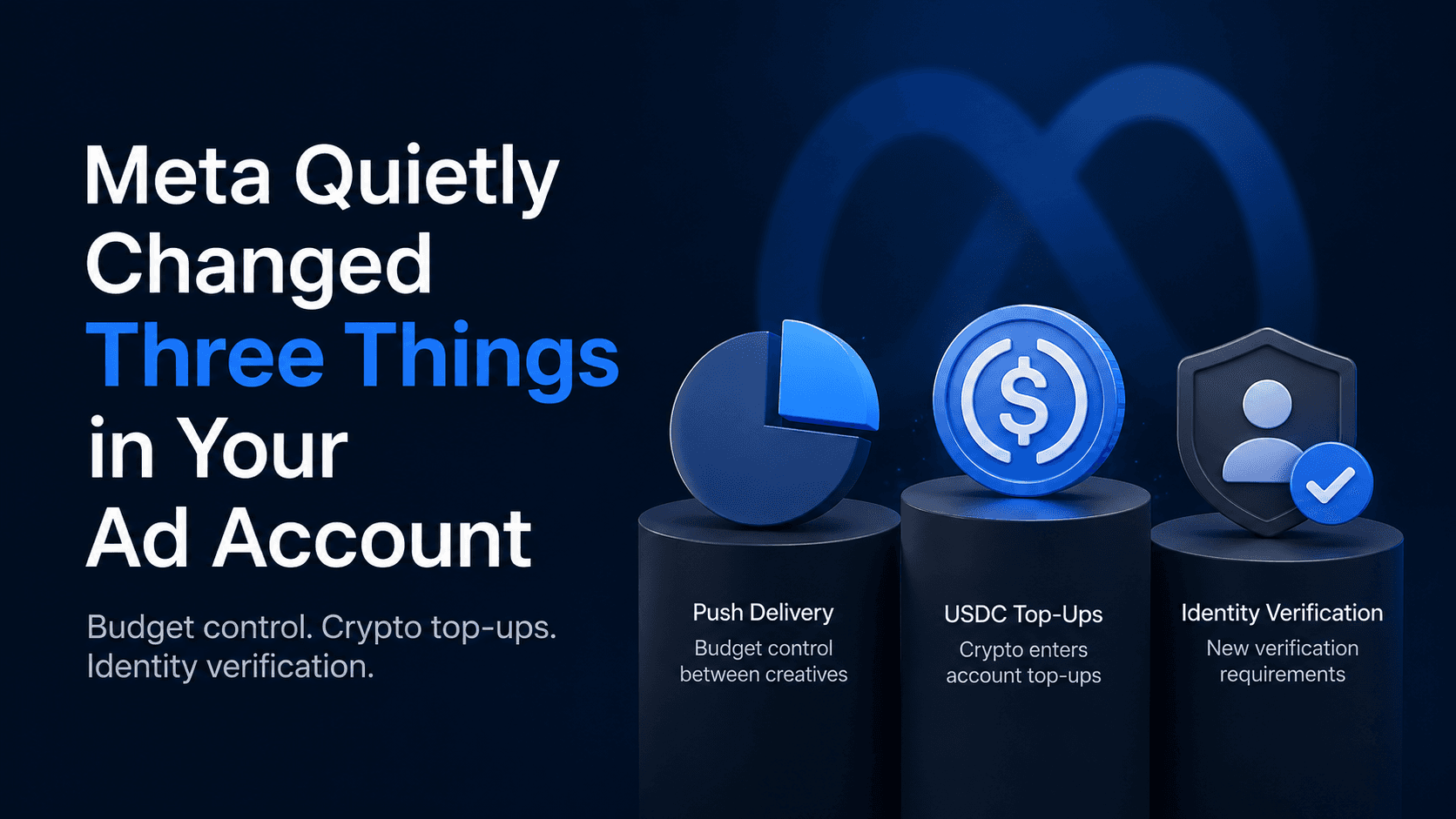
While everyone talks about ban waves, Meta rolled out three changes without a loud announcement that hit a buyer's daily work directly: a new budget-distribution toggle, top-ups in a crypto stablecoin, and mandatory identity verification. Each one either hands you a new lever or adds new friction. Let's break down what they are, who benefits, and who gets a fresh headache.
Push Delivery: Finally, Budget Control Between Creatives
A familiar pain: an ad set has several creatives, but Meta pours the whole budget into one ad and gives the others no impressions. Now there's an official lever for it.
Push Delivery to This Ad is a toggle at the ad level that lets you direct a set percentage of the budget to a specific creative. It appears once an ad set is running at least two creatives.
Here's how it looks in practice: you pick a share of the daily budget (say 20% on a $19 daily budget, so a target of around $3.80 a day) for up to 7 days or until the ad set ends. After that the ad reverts to normal logic.
Why it matters to a buyer. The real value isn't "force-feeding your favorite creative," it's giving a new test creative a chance that the algorithm would otherwise choke at the start. It's effectively a built-in tool for fair A/B without juggling separate ad sets. Caveat: Meta doesn't guarantee exact distribution, so treat it as a guideline, not a hard splitter.
USDC: Crypto Enters Account Top-Ups
The second change is quiet but potentially the loudest in its consequences. Meta is adding USDC (a dollar stablecoin) to the ways you can top up ad accounts.
The mechanic: USDC is converted by a third-party payment partner into dollars or local currency, and then credited to your balance. For now the feature works only for accounts with a prepaid balance and only in some countries.
Why this matters for our vertical specifically. Payments were always the bottleneck: cards decline, gateways block, refunds are a pain. Crypto as a top-up method means potentially less dependence on traditional banking and simpler money movement across GEOs. It's too early to call it a finished solution (limited countries, prepaid only), but the direction is very interesting for a gambling buyer, and expanding access is worth watching.
Identity Verification: New Friction to Prepare For
The third change works the other way, it doesn't hand you a lever, it adds a check. Meta is rolling out identity or organization verification for advertisers, and it can pop up mid-routine, right when you're simply raising the budget on an ad set.
Two paths to pass it:
- Verify an organization via a corporate email or direct contact, with a list of the organization's people.
- Verify your identity via a government ID, sometimes plus a selfie.
And here's the key nuance: the information provided for verification may appear in the ad access report and in Meta's Ad Library during the run, and sometimes beyond it. For media buying that's significant: verification ties an ad to a real person or structure, and does it publicly. This change needs to be understood in advance and built into how you work, rather than run into unexpectedly mid-pour.
What It Adds Up To
The three changes line up into one clear vector: Meta is simultaneously giving more control over budget (Push Delivery), simplifying money movement (USDC), and tightening the link between an ad and a real identity (verification). The platform is getting more flexible in tools but stricter on identity.
The takeaway for a buyer is simple: master the new levers first, while competitors don't know about them yet, and build the new friction into your processes ahead of time so it doesn't become a surprise.
What Works and What to Avoid
What works
- Use Push Delivery to give new creatives a chance on test, not just to scale existing ones
- Watch USDC expand to new GEOs, it's potentially simpler payments for the vertical
- Prepare your structure for verification in advance, not mid-pour
- Read these changes as a vector: more budget control, stricter identity
What to avoid
- Treating Push Delivery as an exact splitter, Meta doesn't guarantee distribution to the percent
- Counting on USDC as a finished solution right now, access is still narrow
- Ignoring that verification data can be public in the Ad Library
- Learning about the new check at the moment it's already blocking an action
Summary
- Push Delivery to This Ad gives controlled budget distribution between creatives at the ad level (from two creatives up), useful for a fair test.
- USDC enters account top-ups via a third-party partner, prepaid-only and in select countries for now, but a strong direction for payments.
- Identity or organization verification adds friction and can publicly link an ad to a real identity via the Ad Library.
- The overall vector: more control over budget and money, stricter identity.
Meta rarely announces things like this loudly, so they slip past anyone not watching. And the difference between the buyer who masters a lever first and the one who hits a new check by surprise is exactly that attention to quiet changes.
Glossary terms in this article
Unfamiliar with a term? Each links to a full definition in our affiliate & iGaming glossary.
You might also like

VIP Retention in iGaming: Why Casinos Lose Their Best Players Without Noticing
A casino will spend weeks and a serious budget acquiring one VIP player, and then hand that player's retention to a manager who has about a hundred seconds a day for…
Read article →
Facebook Ads Digest, September 2026: Verification, Assign Partner, Costly Rejects
The autumn storm did not surprise anyone with its force. A ban wave across the turn of August into September has repeated for several years running.
Read article →
iGaming Layoffs in 2026: What 2,400 Job Cuts Say About Consolidation
Layoff headlines usually get read as somebody else's problem. A casino operator trims its staff, an affiliate network restructures, and the buyer sending them traffic…
Read article →