

Facebook Ads
Meta Is Turning Ads Manager Into a CRM: What It Means for iGaming Buyers
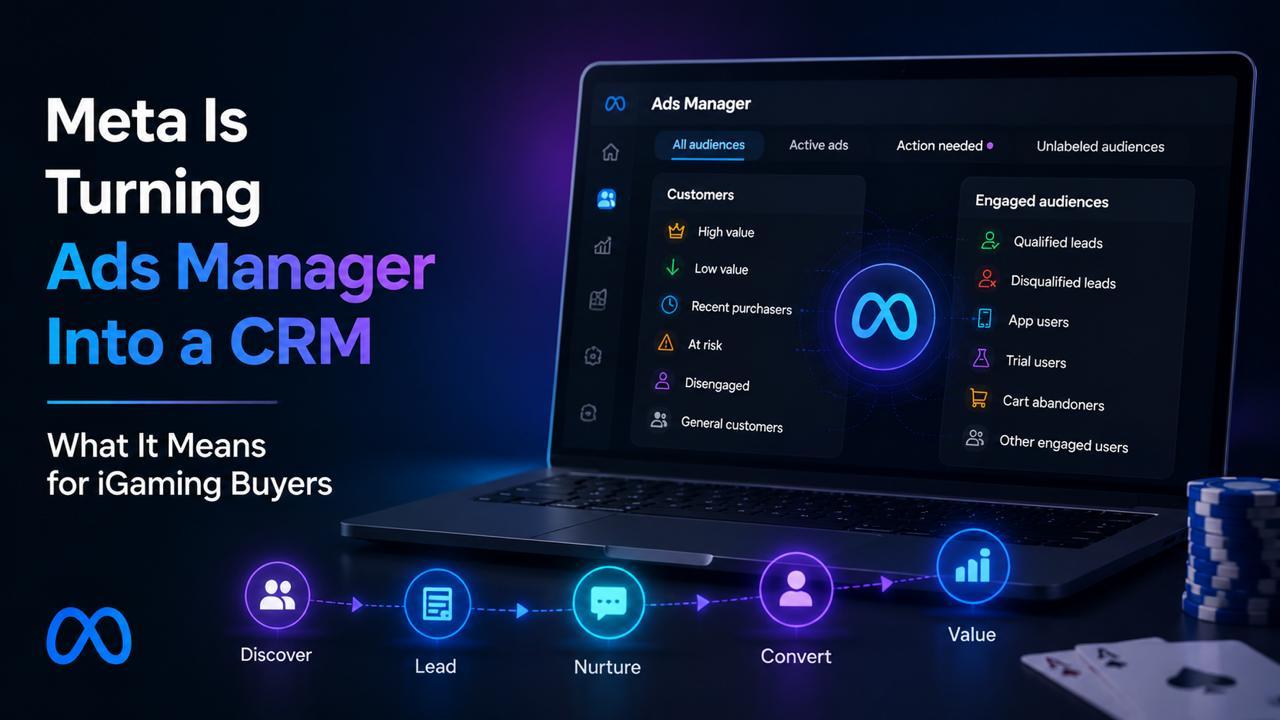
Meta quietly did something big: it moved CRM logic, customer value and lifecycle stage, straight into Ads Manager. What used to live in separate CDP systems now sits inside the ad account. This isn't cosmetic. It's the groundwork for the algorithm to optimize delivery by customer value and stage, not just behavior. Here's what changed, where it's heading, and what it means for anyone running gambling traffic.
What Actually Changed
Audiences in Ads Manager are now grouped automatically by labels into two big categories:
- Customers: High value, Low value, Recent purchasers, At risk, Disengaged, General customers.
- Engaged audiences: Qualified leads, Disqualified leads, App users, Trial users, Cart abandoners, Other engaged users.
Unlabeled audiences, Lookalikes, and Saved audiences are broken out separately. Up top there are new quick tabs: All audiences, Active ads, Action needed, Unlabeled audiences. The old view is still available via "Switch to standard audience view," but the direction is set.
Why This Is a Shift, Not a New Filter
This is the first time value-tier and engagement-stage logic sits inside Ads Manager instead of living separately in a CRM or CDP. In effect, Meta is laying the groundwork for targeting by customer lifecycle stage, not just by behavior.
The practical takeaway is simple: whoever labels their audiences correctly now gets an edge when Meta starts using those labels in delivery optimization. The Action needed tab already works as a ready checklist of audiences that require attention, and separating out Unlabeled audiences rescues accounts with dozens of retargeting and lookalike segments, where junk audiences have piled up unnoticed for years.
Where It's Heading: Value Rules and Customer Lifecycle
This is part of a wider 2026 shift by Meta toward value rather than raw conversions:
- Value Rules for Audiences: you can adjust the bid for specific segments (qualified lead, high value, disqualified) by up to +1000% or down to -90%. You're literally telling the algorithm who is worth more to you.
- Customer Lifecycle Strategy: at the ad set level there's now an "Acquire new customers only" setting that tells Meta to spend budget only on people who haven't purchased before. Early reports from DTC buyers put CPA roughly 40% below classic prospecting.
Both tools currently work best on white and lead-gen setups with clean first-party audiences, but the vector is clear: the algorithm increasingly optimizes for value and stage, not for a raw click.
Native Lead Nurturing Inside the Account
Another brick in the same shift. Meta added a Lead Nurturing section: after a form is submitted, a lead can be routed straight into Messenger, Instagram, or WhatsApp natively, with no Zapier or Make in between. Meta is testing an AI agent for instant engagement (booking a call, for example), there's integration with Manychat and Botcake, and dynamic routing between a site and an instant form delivers, per Meta, a 14-24% lower lead cost. In other words, Meta is taking the funnel warm-up for itself, not just the buying.
What This Means for a Gambling Buyer
Honestly: for pure cloaked gambling, these labels aren't directly usable, because the funnel doesn't feed Meta clean first-party signals. But the direction is critical for us, and here's why:
- The algorithm is moving from "raw behavior" to judging player value and stage. That's the same logic an operator uses when it looks at a deposit and LTV rather than a click. Meta is baking it into the buying layer.
- White and hybrid setups (registration, lead form, legal products) can already extract value from value rules and lifecycle settings.
- It's another signal that quality traffic wins over cheap volume: the algorithm keeps getting better at telling who "delivers" from who merely clicked.
What Works and What to Avoid
What works
- Label your audiences now on white/hybrid accounts, so you have an edge when Meta switches these into optimization
- Use Value Rules to bid up on quality segments instead of treating everyone equally
- Test native Lead Nurturing instead of external glue for lead-gen funnels
- Think about traffic in terms of value and lifecycle stage, not just CPL
What to avoid
- Dismissing the shift as a "white-hat feature" — it changes how the algorithm will judge your traffic
- Leaving dozens of junk Unlabeled audiences that pollute the signal
- Judging a campaign on the click alone when Meta already measures value
- Waiting while competitors label their audiences first
Summary
- Meta moved CRM logic (value, lifecycle stage) straight into Ads Manager, the groundwork for lifecycle optimization.
- Value Rules (up to +1000%/-90%) and "Acquire new customers only" (CPA down ~40%) show the vector: the algorithm optimizes for value, not the click.
- Native Lead Nurturing hands Meta the funnel warm-up too.
- For gambling, it's mainly a signal: quality traffic wins, and whoever understands the value logic sooner adapts first.
Meta is less and less about "buy a click" and more and more about "buy the right customer." The buyer who reads this shift as a change of rules, not as a white-hat feature, wins tempo over those who wait.
Glossary terms in this article
Unfamiliar with a term? Each links to a full definition in our affiliate & iGaming glossary.
You might also like

Meta's $3+ Billion Secret: Double Standards in iGaming Advertising
Inside Meta's controversial advertising practices: how $3+ billion in banned ads slipped through, why some advertisers get banned instantly while others run for weeks, and what this means for iGaming media buyers in 2026.
Read article →
Facebook Ads Digest, June 2026: Ban Storms, the Death of Copy-Paste Creatives, and Why Tier-3 Saves ROI
An insider digest from the Advantage team for June 2026: a wave of ad-account and profile bans, why copy-pasting creatives no longer works, the Tier-1/Tier-3 numbers, and a cheap fresh-pixel trick for expensive CPM.
Read article →
Creative as a Consumable in iGaming: New Facebook Rules in 2026
Learn why old creative strategies no longer work in iGaming. How to combat audience fatigue, use spy tools, and build effective funnels in Facebook Ads.
Read article →