

Affiliate Marketing
Anti-Fraud and Shave: Protecting Your Traffic When Partners Won't Pay
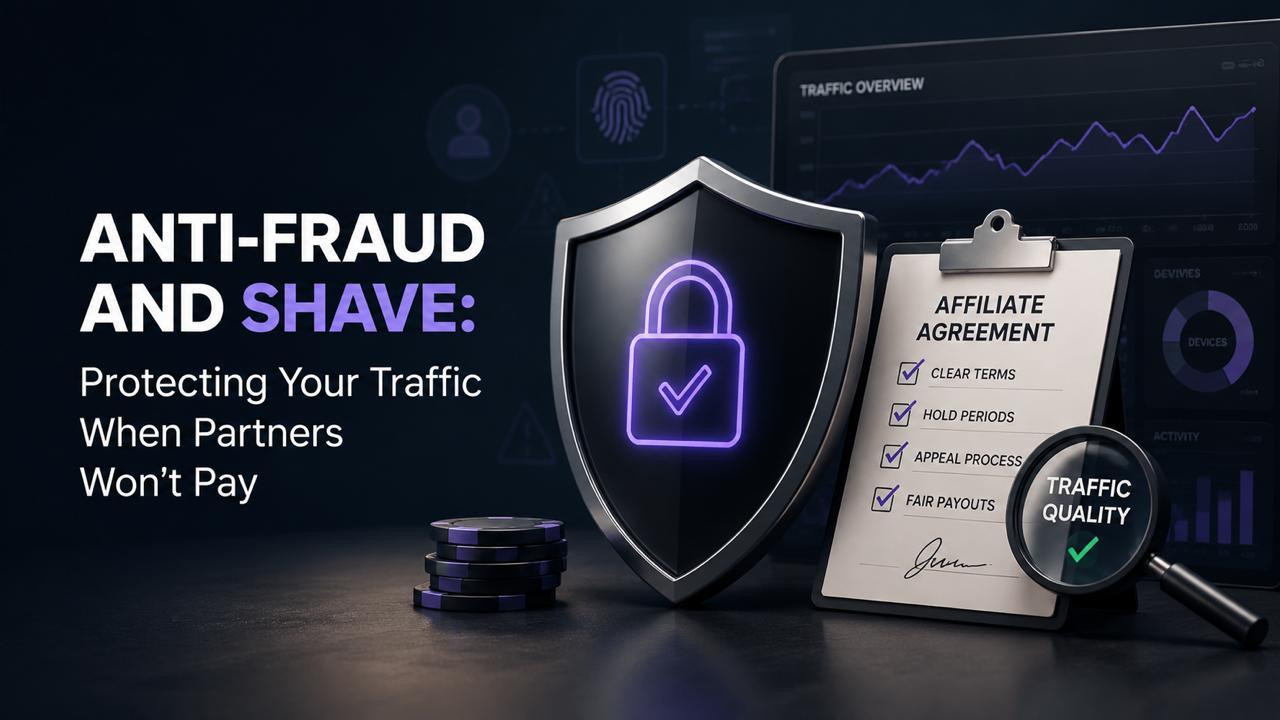
Here's a scene every buyer knows: you pour a cap, you beat the KPI on average check, and the advertiser refuses to pay for half the deposits because the players are supposedly "not active enough." Not every rejected lead is a shave (a cut to your payout), but the line between honest anti-fraud and outright shaving is thin. Below is how anti-fraud actually reads your traffic, how to prove its quality with data, and how to protect yourself on paper so you don't run traffic for free.
Shave vs Honest Anti-Fraud: Where the Line Is
Let's be fair first: not every hold (a freeze on your payout) is an attempt to cheat you. Advertisers have learned to filter suspicious traffic hard through anti-fraud systems, and some rejections are genuinely justified. The problem is that the same machinery easily turns into a shaving tool when a product wants to protect its margin at your expense. So a buyer has to understand both sides: the signals you're judged on, and where judging ends and cutting begins.
What Anti-Fraud Actually Analyzes
Today this is full traffic scoring across many characteristics. Technical signals:
- Many leads from a single device fingerprint.
- Sharp traffic spikes with no history behind them.
- Unusually fast registrations right after the click.
- A high fraud-score by source.
- Mismatch between GEO, browser language, and time zone.
- Repeat leads with similar data.
Plus behavioral signals, how the user acts on the page:
- Scroll depth and time on site.
- Chaotic mouse movement.
- Clicks on interactive elements.
- Activity right before the form submit.
The system compares the lead's behavior against normal patterns (FBT, behavior pattern analysis). Understanding this matters for two reasons: so you don't hand anti-fraud a reason, and so you know exactly what can be pinned on you.
A Real Case: KPI Beaten, Money Withheld
A typical case from the market. A buyer poured a cap on Tier-1 under a new advertiser with a KPI of an 88€ average check per FTD. In reality the average check came in at 130€, so the KPI was beaten. Yet the advertiser refuses to pay for half the deposits, because those players "show insufficient activity."
The buyer's argument, that you should look at the stats across the whole cap rather than player by player, gets ignored. For the ones who dropped 500-1000€ in the first week, they pay happily. But for the player who deposited 100€ and was active only the first couple of days, they cut or hold the payout "for insufficient activity," even though the whole flow had just one small withdrawal.
That's the core of the problem: many operators still live by 2020 logic, where all the traffic risk is dumped on the affiliate. Instead of improving the product, every year they invent new ways to protect margin at the partner's expense. A telltale marker of the same shift: you get pushed to work on RevShare only instead of CPA or Hybrid, which moves the entire traffic risk onto you.
How to Check Your Own Traffic Quality
If mass holds start, don't argue on emotion, show up with data. Check the traffic yourself:
- Turn on session recording and heatmaps (Hotjar, Microsoft Clarity).
- Analyze time-to-form-submit through your tracker (Keitaro, Binom).
- Check the distribution of devices, browsers, and IPs.
- Use device fingerprint verification services.
When you have session recordings and clean flow stats in hand, the conversation with the advertiser moves from "take our word for it" to facts, and that sharply narrows the room for an unjustified shave.
Legal and Documentary Protection
Half the problems are solved before the pour, at the terms stage. Fix in writing:
- Reasons for rejecting leads and hold periods.
- Restrictions on traffic sources.
- The procedure for appealing a lead cut.
- And separately: keep tracker exports, postbacks, and chat history.
It's tedious, but this "paperwork" part decides whether you can prove your case when it comes to a dispute.
How to Pick an Honest Network
The best defense against shave isn't fighting after the fact, it's not walking into a place where it's systemic. Look at how they cooperate right from the start:
- Whether there's feedback on rejections.
- Transparency of hold reasons.
- Speed of reaction to disputes.
- Openness of statistics.
Honest networks talk openly about rejection reasons and help you control your bundles without the risk of an unjustified cut. If, from the start, you hear vague answers about holds and see no statistics, that's already a signal.
What Works and What to Avoid
What works
- Come to a dispute with data: session recordings, time-to-form, IP and device distribution
- Fix hold and appeal terms in writing before the pour
- Keep postbacks, exports, and correspondence as an evidence base
- Judge a network by the transparency of its stats, not just its rate
What to avoid
- Handing anti-fraud obvious reasons: sharp spikes with no history, repeat leads, GEO mismatch
- Accepting vague "insufficient activity" wording with no concrete criteria
- Treating a switch to RevShare as "normal" by default, it often just shifts risk to you
- Arguing on emotion without tracker exports
Pre-Pour Checklist
- Are the hold terms, periods, and appeal procedure fixed in writing?
- Are the criteria for a "quality" lead spelled out concretely, not as "activity"?
- Is the tracker set up to give time-to-form and IP/device distribution?
- Are session recording and heatmaps connected?
- Do you understand the signals the advertiser's anti-fraud scores traffic on?
- Is there an agreement to look at stats across the flow, not player by player?
Summary
- Not every hold is a shave, but anti-fraud machinery easily becomes a tool for cutting margin at your expense.
- Anti-fraud scores traffic on technical and behavioral signals, so don't hand it obvious reasons.
- A beaten KPI doesn't guarantee payment: many operators still dump all the risk on the affiliate.
- Protection is data plus documents: session recordings, clean stats, terms fixed in writing, and choosing a transparent network.
Shave isn't beaten by shouting, it's beaten by an evidence base. Whoever enters a partnership with data in hand and terms locked down leaves operators far less room to not pay for real traffic.
Glossary terms in this article
Unfamiliar with a term? Each links to a full definition in our affiliate & iGaming glossary.
You might also like

CPA vs Spend Model in iGaming: How to Pay for Casino Traffic in 2026
CPA or a percentage of spend? How each model works for casino traffic, where CPA is stronger, and why Spend often brings operators more stable traffic.
Read article →
Why Tracker Data Doesn't Match Facebook: Solving Registration Discrepancies for Gambling PWA Campaigns
How to fix big gaps between Facebook Ads Manager and your tracker for gambling PWAs by repairing the attribution chain, postbacks, and network integrations.
Read article →
Top 5 Mistakes Media Buyers Make When Running Casino Campaigns: How to Avoid Losses in 2026
Learn the 5 most common mistakes that kill ROI in casino campaigns. Discover practical solutions for creative-landing-offer fit, metrics analysis, account diversification, GEO selection, and scaling strategies from the ADvantage team.
Read article →