
Facebook Ads
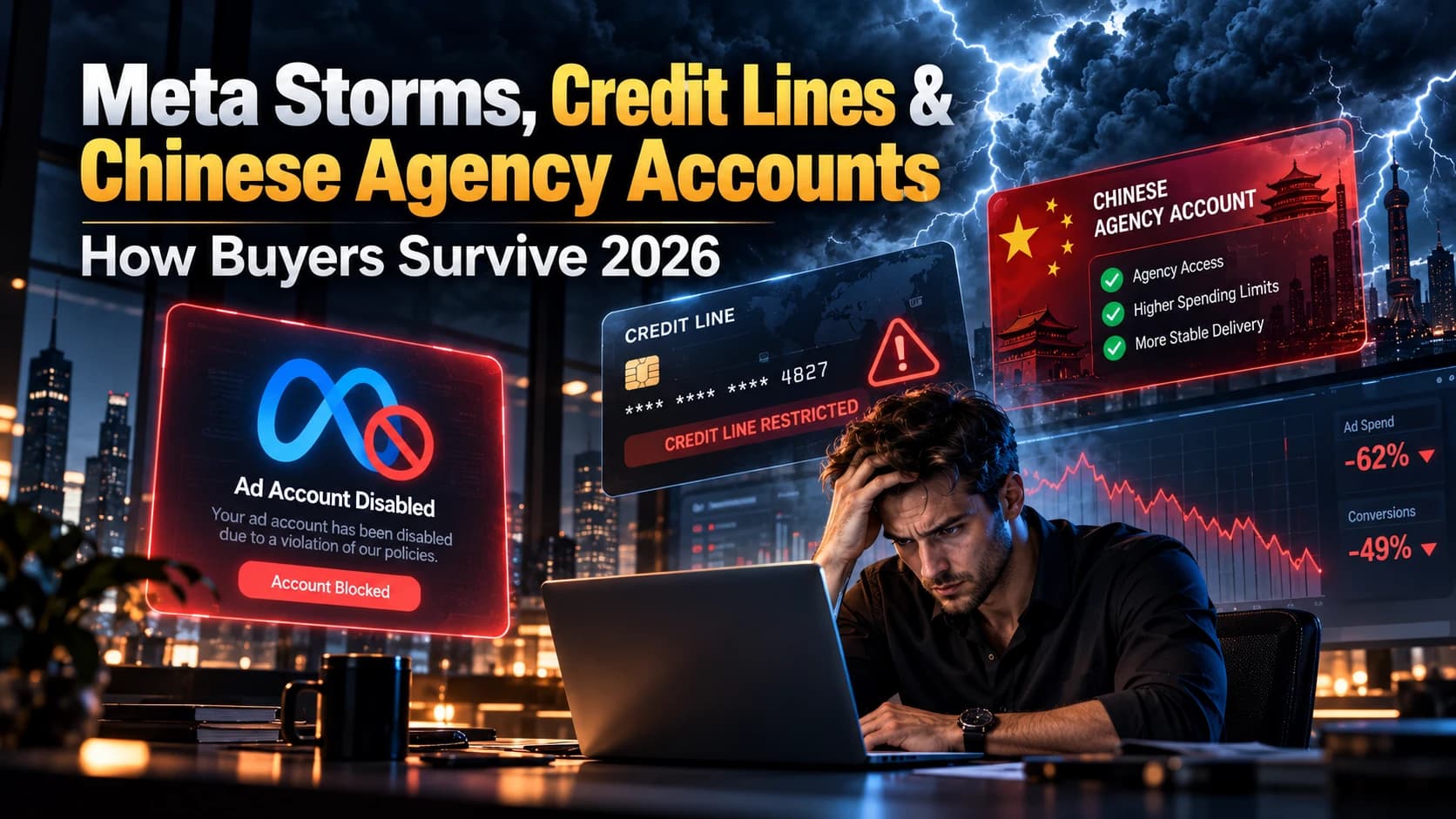
Meta Storms, Credit Lines, and Chinese Agency Accounts: How Buyers Can Survive 2026 Without a Heart Attack
1. The logic of Meta storms and the approximate yearly rhythm
Meta does not live by chaos, but by cycles: strong ban waves are most often tied to quarterly checks and political/media pressure.
Large partners and official Chinese agents have direct contact with people who are responsible for credit lines and information security, so they receive signals in advance: "in two weeks, get ready for checks, clean your client pool."
A conditional yearly pattern (a reference point, not a strict calendar):
- January-February
- Chinese New Year: sharp traffic distortions from China, part of teams is offline, Meta redistributes risks.
- There is often a wave of internal scam reviews for Q4 (Christmas, Black Friday, massive spends).
- March-late April
- A typical period of "putting things in order" after public investigations, scandals, and regulatory reports.
- Possible waves against financial schemes, crypto scam, and gambling.
- Late June
- End of Q2: global review of violations, large ban waves across verticals with high fraud rates.
- August-September
- Historically one of the hardest storm periods, when Meta compares real traffic quality against revenue and runs cleanup in gray/black niches.
- November-December
- On one hand, maximum monetization (Black Friday, Xmas); on the other, targeted strikes on toxic links to reduce public risks and legal claims.
Important: this is not a "ban calendar." It is a rhythm where the probability of global storms is higher, and big agents already know and begin tightening clients several weeks before the peak.
2. Why direct suppliers see the storm earlier and how that hits you
Chinese agents and official partners have a direct connection with Meta through:
- credit line contracts,
- dedicated account managers,
- internal fraud reports from China, where 19% or more of revenue is linked specifically to scam, casino, and pornography.
When Meta gets a political/media hit (investigations, complaints, regulators), it launches reinforced anti-fraud checks, and these partners are the first to hear:
- "we sharply reduce the scam share from China from 19% to 9% of revenue,"
- "get ready, enforcement tools will be strengthened, we are cutting off the most toxic clients."
What this means for you as a buyer:
- An agency that sits directly on a Chinese credit line starts looking not only at who pays, but at your violation footprint.
- If you systematically run at the edge or beyond policy boundaries, during check periods you fall into a "black list," and they can simply cut you off from the fattest accounts.
- After that, you "no longer fit their risk strategy," even if you pay well.
Consequences:
- Loss of access to the most stable agency accounts and credit lines.
- Migration to second-tier services without direct provider access, where storms hit harder and more suddenly.
- Growth of buying cost and decline of ROI stability.
3. Backup plan: how to prepare white traffic to clean your reputation
Meta evaluates you not only by the creatives you made, but by the whole ecosystem: payments, links, behavior, GEO, and environment.
To avoid being perceived only as a scam team during storm moments, you need a pre-built "white profile."
In practice:
- Build separate "white infrastructure"
- A white BM with a clean history: legal products, adequate creatives, transparent payments (real cards, aligned merchant countries).
- Separated pixels, domains, pages, so that black and white traffic are not mixed in one ecosystem.
- Maintain regular turnover there, even if small, but stable
- Regular white spend so the system sees you as a business, not only as an "anomaly with a high fraud rate."
- Keep a low violation rate: maximum policy compliance, no serious reports.
- During a storm period
- Reduce load on gray/black links on credit lines.
- Switch part of traffic to white traffic (especially on the same agency accounts where possible, or on separate infrastructure).
- If an agency works with you, show them: "look, we have a clean white-traffic block," this reduces the desire to simply cut you off.
In essence, white traffic is an insurance policy for your reputation in front of Meta and in front of your account suppliers.
4. Standard agency accounts vs credit lines: what changes for the buyer
Standard agency account (without a credit line):
- In essence, this is an agency/partner account with higher trust, but you pay for actual spend like standard billing, with limited caps.
- Advantages: better reputation, higher tolerance for experiments, fewer bans at launch.
- Minus: limits and dependence on how the agency itself manages its client pool.
Credit line:
- This is when a provider (bank/Meta partner) gives an agency a conditional "open credit" for ad spend with deferred payments.
- As an end buyer, you effectively rotate the provider's money: you can run large volume until something breaks (ban/overlimit/check).
- From Meta's perspective, there is a separate risk profile for that line: if there is a lot of scam, violation rate by money (not by number of accounts) grows, and the provider itself becomes a storm target.
What this changes for you:
- On a credit line, Meta tolerates "hard" creatives longer, so ROI is often better there, because you can play closer to the boundary.
- But if you overdo it, you hit not only yourself, but the whole line, becoming a toxic client for agency accounts.
- On regular agency accounts, you have less leverage, but also fewer chances that your activity will put problems on the whole provider.
In short:
- A credit line gives more freedom and volume, but makes you dependent on the provider's risk policy and its relationship with Meta.
- Standard agency accounts are less "rocket fuel," but a more controlled, predictable mode.
5. "You have to go hard" in advertising: how to live with this within risk limits
There are offers and niches where, without aggressive creatives, promises, and semi-gray wording, ROI does not work.
This is objective reality: if you go too far into a "white" presentation, CPA goes to the sky and the model dies.
How to combine this with life on agency accounts and credit lines:
- Do not run all gray traffic in one place.
- Darker links should run on tools where you are ready to lose access.
- More "civil" versions of offers should run on lines where you build a long history.
- Test the boundary clearly.
- Run A/B by degree of creative "hardness" and analyze where ROI is still normal but violation rate does not fly into space.
- Do not bring outright trash into agency accounts.
- The agency looks not at your specific profit, but at the overall risk for the line. Schemes like "squeeze another $400 on billing" on agency cabinets do not work the way they work on self-reg accounts.
In practice, the strategy is this: "go hard" where you have mentally already said goodbye to the account, and on key credit lines play at the boundary, not far beyond it.
6. Chinese vs Vietnamese: what this means specifically for you
From Meta's point of view:
- China is the main source of fraud, but also one of the biggest revenue sources: between 2022 and 2024, ad revenue from China grew from $7.4B to $18.4B.
- Because of this, Meta simultaneously fights Chinese scam and tolerates it, because it is billions in profit; internal documents show that holidays like "Golden Week" directly change global fraud levels.
Chinese agency accounts for you:
-
Pros
-
Direct contracts with Meta or official providers.
-
Better sense of upcoming storms.
-
Usually more structured service and technical base.
-
Cons
-
You are one of many global clients, and if your violation profile is toxic, you are cut quickly to preserve the line.
Vietnamese service providers:
-
Pros
-
Often a lower entry threshold, willingness to work with more "black" links, and more flexible arrangements.
-
Cons
-
High level of greed and scam: cases where, when approaching 600-900 on billing, "Meta blocked the payment," but in fact money is simply not withdrawn, are very common.
-
Weaker/chaotic support and no real accountability to you as a client.
What is more beneficial for you as an end buyer:
- If your strategy is "long game + scale," where stability and predictability matter, it is more beneficial to keep your core stack on Chinese/official agencies with a clear risk policy.
- It makes sense to treat Vietnamese providers as a "gray zone" for specific tasks, but not as a foundation: there is a higher probability of scam, payout failures, and a complete lack of help during storms.
Glossary terms in this article
Unfamiliar with a term? Each links to a full definition in our affiliate & iGaming glossary.
You might also like

The Ban Moved to the Wallet: Gambling Regulators Now Block Payments, Not Domains
In September we wrote that the enforcement point in gambling was shifting from the operator's licence to the payment rail (iGaming Regulation in 2026).
Read article →
What Media Buyers Check Before Sending Traffic to a Casino Affiliate Network
Affiliate networks compete on rates because a rate is easy to compare: it sits right on the offer card. A buyer looks at something else.
Read article →
Unity Ads ROAS Campaigns Now Need Revenue Events: What iGaming Teams Must Fix
In early October Unity changed the rules for launching ROAS campaigns. A new campaign will not start until the source receives purchase events with a revenue amount…
Read article →