
iGaming
PWA as a Funnel for BlackHat iGaming in 2026: Cloaking, Tracking, FTD & Critical Mistakes
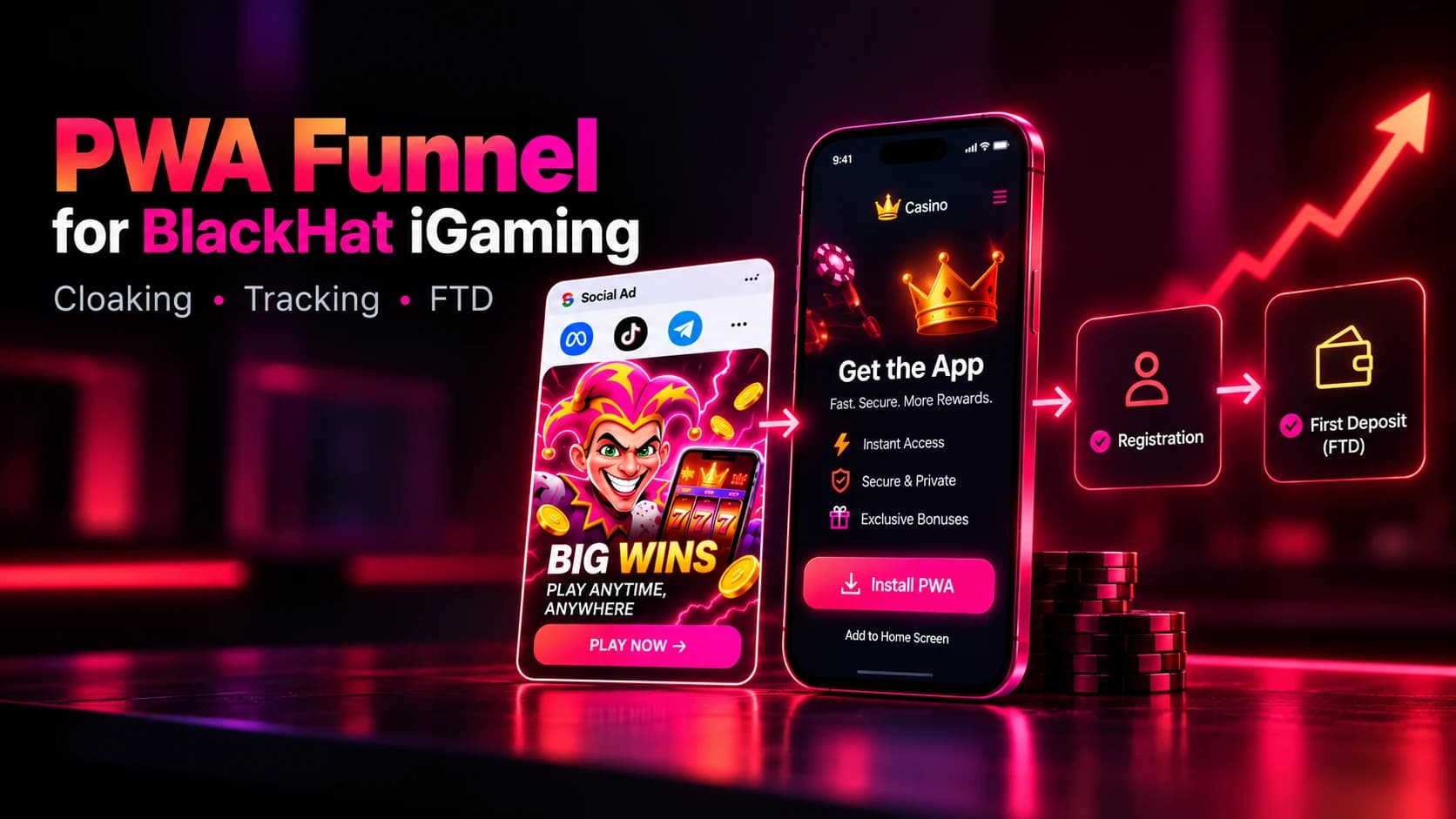
If you're still running traffic "straight to a link," you're fighting against the user's smartphone and Facebook's mechanics. In 2026, PWA isn't just an "arbitrage trick"—it's an infrastructural answer to mobile reality: short attention spans, quick drop-offs, aggressive moderation, and the need to guide players to FTD through a clear path without unnecessary friction.
This article covers how to build a PWA funnel for Facebook ads, what actually impacts FTD, how to set up tracking, and where budgets most often burn.
What is PWA in iGaming and Why It Works
PWA stands for Progressive Web App—a web product that installs on a phone like an app but remains web-based, installed through a browser and launched in an "almost like an app" format.
In arbitrage context, PWA is often presented through a page that mimics Play Market to increase trust and install conversion. After installation, PWA opens the mobile version of the site in a convenient format, and most importantly, remains on the user's screen as a permanent contact point, not a one-time click.
The core business idea is simple: You're not just buying a click in Facebook ads—you're buying an installed re-entry point that helps push the user toward registration and FTD.
Why "Just to a Link" Loses to PWA
Landing pages in mobile iGaming often lose due to friction. Extra transitions, registration forms, weak trust, short session life—all this cuts click-to-reg and reg-to-dep rates.
PWA solves the behavioral problem: installation creates a habit and repeat opens, while full-screen presentation feels closer to an app than a website.
Another reason PWA has lasted for years: You have customization freedom that classic store apps don't offer—design, structure, screen logic, microcopy, "social proof"—everything edits quickly.
PWA in 2026: What You Really Need to Customize for Install & FTD Growth
What's worth split-testing systematically:
- Name, icon, screenshots, description, category, rating, reviews—any elements of the page that mimics Play Market
- Play Market design color scheme
- Localization: language, currency, cultural symbols, names and tone of voice, because PWA sells as "your own product"
The professional approach in media buying is to create not 1 PWA, but a lineup of variants. You test different templates, different "proofs," different first-launch scenarios, and keep only those that give better install rates.
PWA and iOS: What You Need to Know Without Myths
PWA can work on iOS, but behavior differs from Android. For web push on iOS, you need iOS 16.4+ and the app must be added to Home Screen, otherwise push notifications won't work.
This is important for the funnel: if you're counting on push as "warm-up," on iOS you need to account for a lower opt-in rate.
Cloaking in PWA Funnel: How to Think Systematically
In a PWA funnel, cloaking isn't one filter—it's traffic routing architecture. Part of the traffic should see the "white" scenario, part should go to the "working" scenario, and this must be stable for tracking, analytics, and scaling.
Some PWA services directly declare built-in cloaking tools, white pages, pre-landers, and push notifications as integrated modules, which simplifies the start for beginners but doesn't eliminate the need to properly connect everything.
PWA Tracking in 2026: What to Measure to Avoid Burning Budget
The diagnostic logic is simple:
- Many clicks, few installs → problem is in the PWA page and trust in installation
- Installs exist, few registrations → problem is in first launch and UX, or mismatch between creative and product
- Registrations exist, weak FTD → look at payment methods, deposit flow, and traffic quality
Push Notifications in PWA: How They Actually Drive Additional FTD
Push in PWA is a "pressure" tool. It's especially useful when a user installed but postponed registration or deposit.
On Android, push works more stably; on iOS there are requirements, so in 2026 push is a strong lever, but not the only one.
The professional approach is to write pushes as part of a scenario, not "deal of the day": triggers, timing, frequency, and clear CTA to the next step in the funnel.
Biggest Mistakes That Kill PWA Campaigns
-
One PWA for everything. Without splits, you won't find the converting design, and budget burns on the "average" variant.
-
No match between creative and funnel. When the ad shows one slot or style, but after installation the mood is different, the user loses trust.
-
Poor first open. Even a strong creative won't save you if the first screen after installation looks cheap or breaks.
-
Tracking only by FTD. Without intermediate metrics, you don't understand where exactly the "crack" is and start making unnecessary moves.
Building the PWA: Our Platform
The PWA itself is only half of the funnel, the other half is knowing what happened after the install. That is why we build PWA funnels on our own platform, where both halves live in one place. Traffstore is the PWA builder, with event-based push notifications to bring users back after the install. Trafftrack follows the click all the way to the deposit, so install, registration and FTD sit in one attribution chain instead of three separate dashboards.
The rest of a launch lives in the same account: ad spy, antidetect browser, creative library, playables and pre-landers, and a calculator for the funnel maths. You can see how it fits together on the ADvantage platform page.
Disclaimer
This article is for informational purposes only. It describes how PWA funnels and the tools around them work in the iGaming market and does not encourage anyone to break advertising platform rules, local laws or regulations. Online gambling is restricted or prohibited in many jurisdictions, so check the requirements that apply to you before running any campaign.
Glossary terms in this article
Unfamiliar with a term? Each links to a full definition in our affiliate & iGaming glossary.
You might also like

The Media Buyer on Three Teams: What Leaks From an iGaming Team
A team lead has plenty of ways to check a buyer: reports, reconciliation against the tracker, daily check-ins. The most accurate one needs none of them.
Read article →
Slot Accumulation Mechanics: Why Pots and Chests Keep Players Spinning
Most spins are forgettable by design: the reels stop, the result is final, and the next spin starts from zero. Accumulation slots break that pattern on purpose.
Read article →
Gambling Traffic in Africa: Small Deposits, Crash Games and One-Brand Markets
The comparison with LatAm is everywhere, and on the surface it holds: a young audience, mobile internet spreading fast, and a population that already bets around…
Read article →