


Playable Ads: Why Interactive Creatives Win - and Belong in InApp
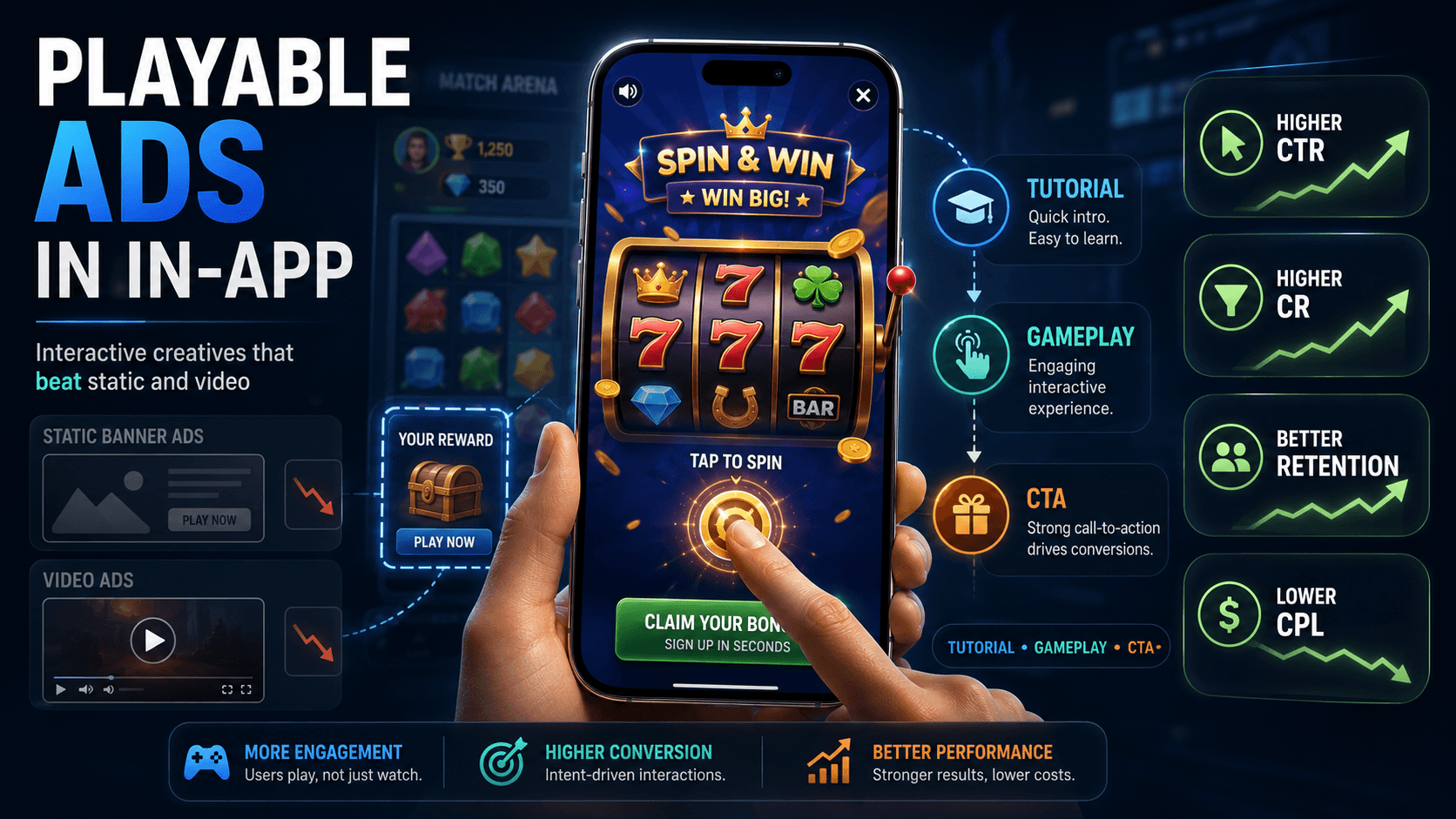
Playable ads let users try the offer before they install, breaking banner blindness, lifting CTR, CR and retention, and often cutting CPL by 25-30%. Here's how they work and why InApp is their home.
Playable ads let a person "poke" the product before they ever install it - and that's exactly why they punch through banner blindness, lift CTR, CR and retention, and often cut cost per lead by 25-30%. No filler: let's break down how an interactive creative is built, why its natural habitat is InApp sources, and where it's easiest to burn your budget.
Users have learned to not see static and video: the "skip the ad" reflex fires in a fraction of a second. Playable breaks that reflex with a simple trick. It doesn't tell you about the product - it lets you play it. Instead of "look at our slot," it offers "spin the reel right here." And that changes the entire economics of the creative. Here's why it works, and how to squeeze the most out of the format.
What a Playable Ad Is and What It's Made Of
A playable ad is an interactive ad in which the user tries the product's mechanic before installing the app or visiting the site. It's essentially a mini HTML5 game that lives right inside the ad slot.
A classic playable has three stages, each with its own job:
- Tutorial (2-3 seconds): a quick animation showing the mechanic. A finger taps the screen, the reel spins, the scratch card is scratched. No instruction text - just the gesture.
- Gameplay (10-30 seconds): the interaction itself. The user performs 2-3 actions with their hands and gets the dopamine loop of "action → result → I want more."
- CTA (about 5 seconds): the final screen with a guaranteed win and a target-action button, while the emotion is still at its peak.
The key rule we build into every playable: a minimum of 2-3 interactions before the CTA. One tap isn't enough to hook; five already tire the user. Two or three is the sweet spot of engagement.
Why Interactive Beats a Regular Creative
Breaking through banner blindness. The brain ignores anything that looks like an ad. But the moment the screen responds to a touch, a different mode of attention kicks in. The user is no longer "watching an ad" - they're playing. It's the cheapest way to buy a few seconds of genuine attention.
The "test drive" effect. Someone who has already spun the reel and seen a win arrives in the app not blind, but with a ready-made expectation. That's why they convert better and stay longer: the playable effectively warms the user up before the install.
Audience self-filtering. This is an underrated advantage. Non-target users are screened out right inside the creative: whoever isn't interested in the mechanic simply doesn't finish playing. A warmer segment reaches you - and that's exactly where the 25-30% drop in lead cost comes from.
Together this shifts all the key metrics in the same direction:
- CTR goes up - interactive is more appealing than a static banner.
- CR goes up - the user arrives warmed, not cold.
- Retention goes up - the "test drive" filters out those who'd have dropped on the first screen anyway.
Why InApp Is the Home of Playable Ads
Here's the key thesis people often skip: a playable comes alive not where the traffic is, but where the context is right.
Picture a user scrolling their social feed. They're in content-consumption mode: reading, liking, scrolling. A "play now" prompt here feels like an obstacle. Now picture that same user inside another game: they just lost a level and are waiting to continue. Their brain is already in game mode, their hands are already reaching to tap. At that moment a playable isn't an ad - it's a natural extension of the experience.
That's exactly why InApp sources (Unity Ads, AppLovin, Moloco, ironSource, Mintegral) are the format's native habitat:
- The audience is already in a gaming context and ready to interact.
- The format is natively supported under MRAID: the playable loads as a fullscreen interactive, not off to the side.
- These sources deliver huge volumes of mobile game traffic that classic media buying struggles to reach.
That's why the "Playable + InApp" combo works better than "Playable + social": in the first case, you catch the person at the exact moment they want to play.
Facts Worth Knowing About the Format
- Playable isn't only for casino. The format was born in mobile gaming, but mechanics like "wheel of fortune," "scratch card," "chests" and "mini-slot" map perfectly onto iGaming - because they're literally a simplified version of the product itself.
- Size matters. A playable is a single inline HTML file with a hard weight limit (up to 5 MB on Unity). The whole game, graphics and logic must fit that budget, or the creative simply won't pass moderation.
- A playable can't see the outside internet. It runs in a sandbox with no external requests: any analytics inside are blocked. That's why A/B tests are done with separate builds, not with a tracker inside the creative.
- One template, hundreds of variations. A well-built playable decouples logic from content: offer, GEO, language and store link can be swapped without rewriting code. That's what turns a playable from a "$100 expensive creative" into a production line.
The Downsides, Honestly
The format isn't a guaranteed win. It has three real weak spots:
- Production costs money. On freelance marketplaces a single playable starts at $100, and a good one costs more. Without your own infrastructure or a template base, the cost per creative bites.
- It takes skill. A playable is design plus code plus an understanding of mechanics, all at once. AI raised the floor, but without fundamentals the creative comes out crooked - and it shows.
- One slip breaks the campaign. This is a trust format: a typo in the CTA, clumsy localization, or an overloaded mechanic, and the campaign won't move even if everything else is done well.
In plain terms: playable ads are the choice for those who have either the budget or the infrastructure for streamlined production.
How Not to Burn Your Budget
✅ Spend 20-30 minutes on research. Running a playable on a mechanic this GEO doesn't like is a loss booked in advance. Half an hour of analysis saves dozens of hours and thousands of dollars later.
✅ Enter through InApp. This is the source where the format shines fully: the audience is already in game mode.
✅ Don't skimp on translators. A button like "Fabulos Bonus" will get a laugh sooner than a conversion. Localization is done by a native speaker, not machine translation.
✅ Focus on one mechanic. The user has 1-2 seconds to decide. An overloaded playable, they'll simply scroll past.
❌ Don't run on social the same way as InApp - the context is different
❌ Don't stuff several mechanics into one creative
❌ Don't launch without a test in Unity Ad Testing (iOS + Android)
❌ Don't judge the creative by CTR alone - look at CR and in-app retention
Pre-Launch Checklist for a Playable Ad
- Does the mechanic match the GEO's taste (research done)?
- Does the creative have 2-3 interactions before the CTA - no more, no less?
- Are the store link and the network bridge (MRAID/Unity) set and valid?
- Is the weight within the source's limit (≤5 MB for Unity, less for the rest)?
- Is localization done by a native speaker?
- Is the playable tested on iOS and Android in a real environment?
- Are separate builds set up for A/B, rather than analytics inside the creative?
Summary
- Playable ads work because they don't tell you about the product - they let you play it, and that's how they break banner blindness.
- The format lifts CTR, CR and retention, and cuts lead cost by 25-30% through audience self-filtering.
- Its native home is InApp sources, where the user is already in a gaming context and ready to interact.
- It's a trust tool for teams with budget or infrastructure: one slip in mechanic, localization or weight breaks the whole campaign.
Interactive creative isn't magic - it's the engineering of attention. The winner is whoever builds one clear mechanic, tests it for a specific GEO, and launches it where the person already wants to play.
Want to launch an iGaming offer through playable ads in InApp and find out whether the format pays off for your GEO? Reach out - we'll advise on mechanics, sources and production.
You might also like

Meta vs Moloco for iGaming: What Scales Better?
Meta vs Moloco for iGaming: which source fits PWA better, which one is stronger for apps, and how to choose the right setup for scaling.
Creative as a Consumable in iGaming: New Facebook Rules in 2026
Learn why old creative strategies no longer work in iGaming. How to combat audience fatigue, use spy tools, and build effective funnels in Facebook Ads.
Crypto Casinos and Web3 Offers in 2026: Why Conversion Rates Are Breaking Records
A funnel with no KYC, payments that never break, and a solvent audience — why Web3 gambling delivers record Reg-to-Dep and how to run traffic on crypto offers without burning your budget.