
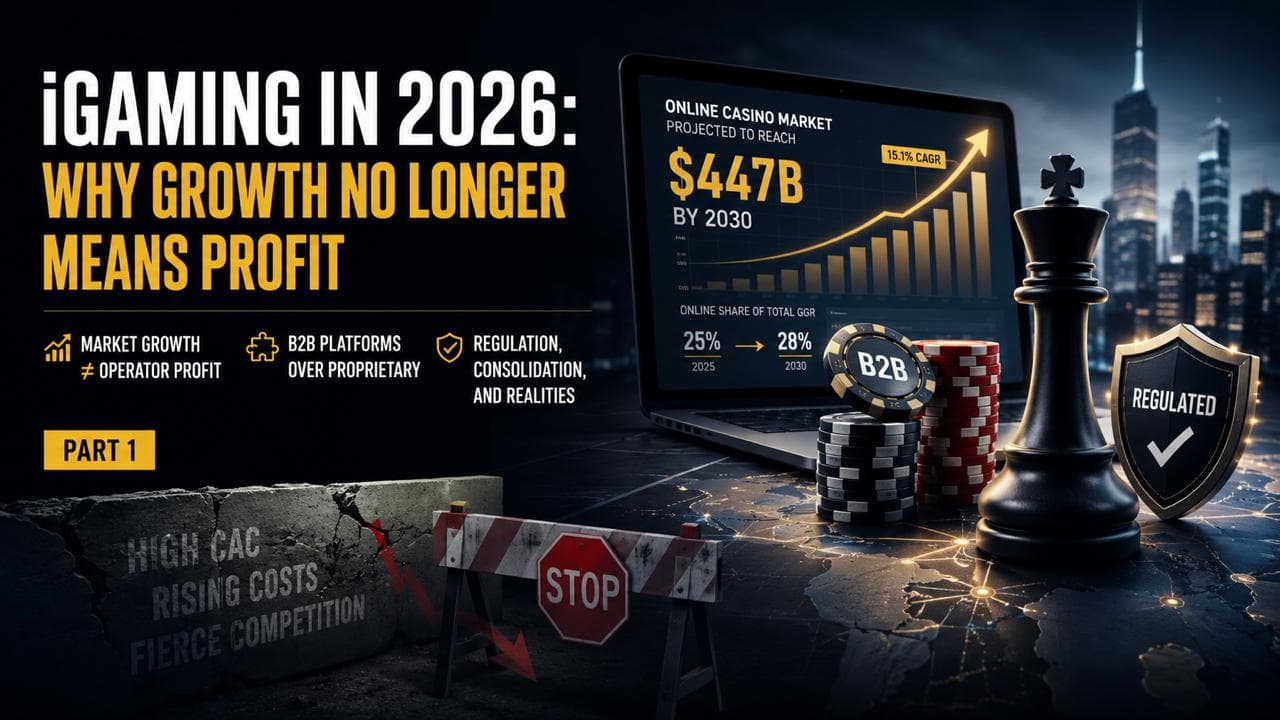
The online casino market could grow to $447B by 2030. It sounds like a gold rush, but operators are finding it harder to profit, not easier. The market is growing, while an individual brand's profit no longer is, because the battle has shifted from acquiring new players to keeping existing ones. This is part one of a two-part breakdown of iGaming's current reality. Here we cover the structural shifts: why market growth stopped equaling profit, why the barrier to entry rose, and what regulation is breaking.
The Market Is Growing, but Operator Profit Isn't
The numbers look optimistic: the total online casino market is projected to reach $447B by 2030 at a 15.1% CAGR. But there's a catch that breaks the picture. The online segment's share of total casino GGR is growing slowly, from 25% in 2025 to 28% by 2030. In other words, the inflow of new players is limited, and competition is intensifying around redistributing demand that already exists.
The consequence is simple and painful: CAC is rising, and so is the cost of a mistake in marketing, product, or compliance. Market growth no longer guarantees growth in any single operator's profit. The winner isn't whoever simply brought in more traffic, it's whoever works more precisely with the traffic they already have.
The Barrier to Entry Rose: Proprietary Platforms Are Dying, B2B Is Consolidating
A few years ago, launching your own proprietary (in-house built) casino platform was standard for an ambitious brand. Today it's nearly extinct. In 99% of cases, the operator's iGaming business now comes down to ready-made B2B platforms:
- Building a proprietary platform got expensive, and making it competitive costs several times more.
- The B2B platform market is overheated: there's a top 15 used by the Russian-speaking community, separate rankings within Asian and Western tiers, and standalone projects for local licenses. New platforms have almost no real differentiation left.
- The number of operators isn't multiplying, most use roughly the same set of solutions, and newcomers often burn out fast.
Today, proprietary platforms are mostly the domain of top players with large budgets, projects built for local licenses, and part of the crypto casino segment, and even those increasingly run on ready-made B2B stacks. The market is consolidating, and building from scratch gets more expensive every year.
Regulatory Pressure: the Market Is Maturing
An external force accelerating the industry's maturity is regulation. The market is moving toward local licensing, with a local online casino license reportedly on the way in several jurisdictions, and the market is gradually cleaning up around it.
For operators, this changes the geography of the business itself. Keeping a legal entity, let alone C-level staff, in gray-market regions has become an openly risky move. Jurisdictional risk stopped being theoretical: line staff can still work remotely from almost anywhere, but keeping leadership in unstable regions is an invitation for trouble. The market is absorbing that lesson and gradually restructuring around the coming wave of local licenses.
The Labor Market Shifted Too
The industry isn't only changing at the top, it's changing inside teams as well. The hiring market has noticeably tilted:
- There are now far more candidates than open roles. Some companies are closing or downsizing, pushing more people onto the market.
- The bar is higher: employers want more expert, more competent, more multi-skilled people, for less money than in 2024 and 2025.
- Companies are building teams more deliberately, rethinking processes and the purpose of certain roles, which naturally shrinks headcount.
- AI is also quietly eliminating junior roles by simplifying routine work and reducing the need for extra headcount.
This isn't a crisis, it's optimization: the industry is shifting from "hire a lot" to "hire precisely."
Do / Don't for Operators in a Mature Market
✅ Plan your business for a mature market where value comes from precision, not for a gold rush
✅ Choose a ready-made B2B platform unless you're a top player with a serious budget
✅ Keep your legal entity and C-level staff in safe jurisdictions
✅ Build lean teams deliberately instead of inflating headcount
❌ Don't assume market growth will automatically bring you profit
❌ Don't launch a proprietary platform from scratch without a top-tier budget
❌ Don't ignore regulatory and jurisdictional risk
❌ Don't overestimate how easily you can hire strong people cheaply
Summary
- The iGaming market is growing, but market growth no longer equals operator profit growth: the fight is over existing players.
- The barrier to entry rose: proprietary platforms are dying out, and the market is consolidating around B2B stacks.
- Regulatory pressure and the move toward local licenses are forcing operators to rethink their jurisdictional footprint.
- The labor market is shifting from mass hiring to precision hiring, and AI is accelerating that shift.
iGaming is no longer a gold rush, it's becoming a mature market where precision beats scale for its own sake. Part two covers exactly how to win the player back: retention, personalization, and predictive scoring.
Glossary terms in this article
Unfamiliar with a term? Each links to a full definition in our affiliate & iGaming glossary.
You might also like

Crypto Casinos and Web3 Offers in 2026: Why Conversion Rates Are Breaking Records
A funnel with no KYC, payments that never break, and a solvent audience — why Web3 gambling delivers record Reg-to-Dep and how to run traffic on crypto offers without burning your budget.
Read article →
CPA vs Spend Model in iGaming: How to Pay for Casino Traffic in 2026
CPA or a percentage of spend? How each model works for casino traffic, where CPA is stronger, and why Spend often brings operators more stable traffic.
Read article →
Why Every Media Buyer Burns Budget on Gates of Olympus (And How to Avoid It)
Why Gates of Olympus became a cult slot and how media buyers use it for FTD. Insights on RTP, creatives, and Facebook ads strategies for iGaming.
Read article →